




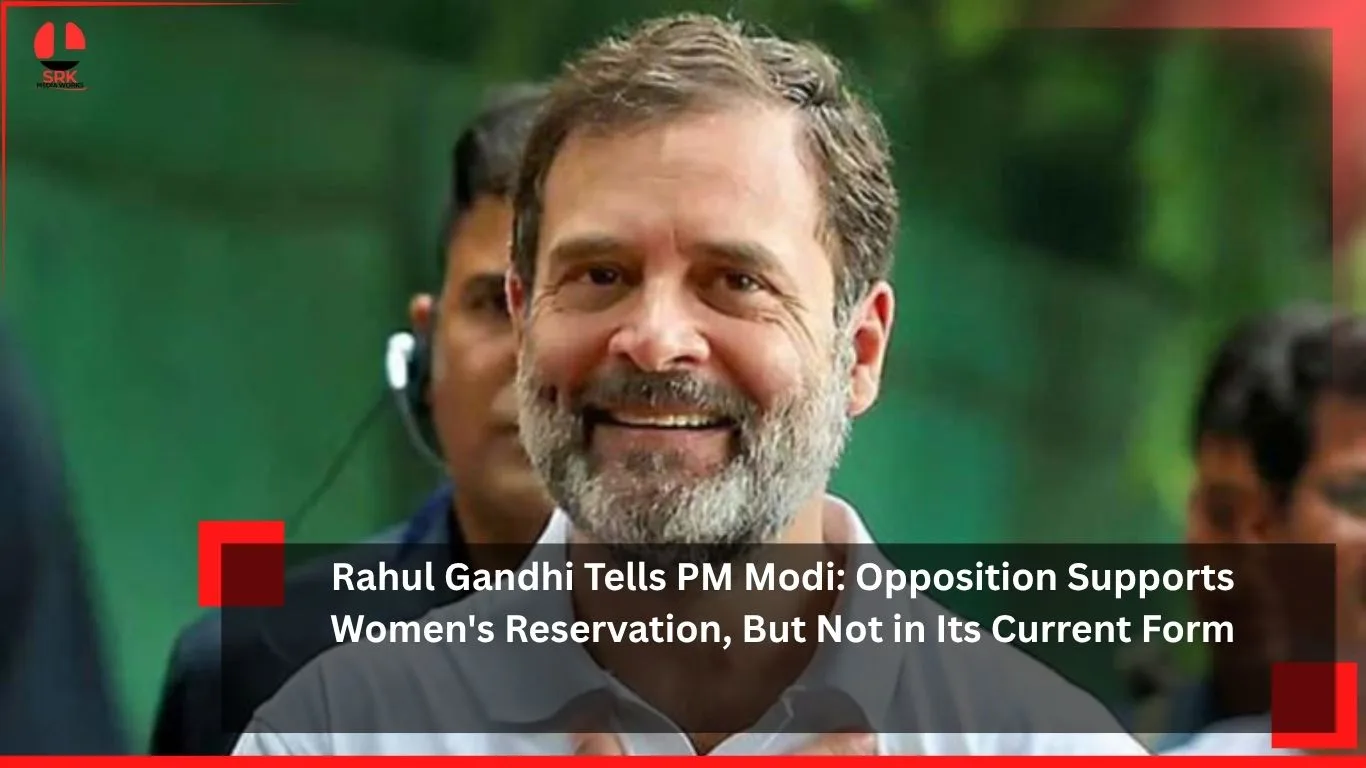
Congress leader Rahul Gandhi has reiterated the Opposition’s support for women’s reservation in Parliament and state assemblies but clarified that they do not back the bill in its current form. Addressing Prime Minister Narendra Modi, Gandhi emphasized that while the principle of women’s representation is widely accepted, the structure and implementation of the proposed legislation require significant changes to ensure fairness and inclusivity.
Rahul Gandhi’s Position
Rahul Gandhi stated that the Opposition is committed to empowering women through political representation but criticized the current draft of the bill for lacking clarity and inclusivity. He argued that the bill must address representation for marginalized communities and ensure immediate implementation rather than being delayed.
- Support for Reservation: Gandhi confirmed that the Opposition supports the idea of women’s reservation.
- Criticism of Current Bill: He highlighted flaws in the draft, including delayed implementation.
- Call for Inclusivity: Emphasized the need to include women from backward classes and marginalized groups.
Key Highlights of Gandhi’s Remarks
| Issue | Gandhi’s Position | Implication |
|---|---|---|
| Women’s Reservation | Supports principle | Opposition backs reform |
| Current Bill | Criticized | Needs changes before approval |
| Inclusivity | Must include marginalized women | Ensures fairness |
| Implementation | Should be immediate | Avoids delays in representation |
Government’s Position
Prime Minister Narendra Modi and the ruling Bharatiya Janata Party (BJP) have championed the women’s reservation bill as a landmark reform. The government argues that the legislation will transform Indian politics by ensuring greater participation of women in decision-making.
- BJP’s Stand: Strongly supports the bill in its current form.
- Implementation Timeline: Government insists the bill will be implemented after delimitation.
- Political Messaging: Presented as a historic step toward gender equality.
Opposition’s Concerns
The Opposition has raised several concerns about the bill, particularly regarding its timeline and inclusivity. Rahul Gandhi’s remarks reflect broader apprehensions among Opposition parties.
Opposition’s Key Concerns
| Concern | Explanation |
|---|---|
| Delayed Implementation | Bill linked to delimitation, delaying benefits |
| Lack of Inclusivity | No specific provisions for marginalized women |
| Political Strategy | Seen as a tool for electoral messaging |
| Structural Weakness | Ambiguity in execution mechanisms |
Historical Context
The debate over women’s reservation has spanned decades in Indian politics. Multiple attempts have been made to pass the bill, but disagreements over its structure and inclusivity have stalled progress.
Timeline of Women’s Reservation Debate
| Year | Event |
|---|---|
| 1996 | First introduction of bill |
| 1998–2008 | Multiple attempts, stalled by disagreements |
| 2010 | Bill passed in Rajya Sabha, stalled in Lok Sabha |
| 2026 | Renewed debate under Modi government |
Public Sentiment
Public opinion on women’s reservation remains largely supportive. Citizens across India view the bill as a necessary step toward gender equality, though many echo the Opposition’s concerns about inclusivity and delayed implementation.
- Supporters: Applaud the principle of reservation.
- Critics: Demand immediate and inclusive implementation.
- Neutral Observers: Call for consensus between government and Opposition.
Comparative Analysis of Global Practices
Women’s reservation is not unique to India. Several countries have implemented quotas to ensure female representation in legislatures.
| Country | Quota System | Impact |
|---|---|---|
| Rwanda | 30% reserved seats | Women hold majority in Parliament |
| Nepal | 33% reservation | Increased female participation |
| France | Gender parity laws | Balanced representation |
| India (Proposed) | 33% reservation | Pending implementation |
Strategic Implications
The debate over women’s reservation has significant political implications. For the government, passing the bill strengthens its image as a reformist force. For the Opposition, demanding changes ensures it remains aligned with marginalized communities.
- Government Strategy: Showcase bill as historic reform.
- Opposition Strategy: Highlight flaws to demand inclusivity.
- Electoral Impact: Women voters may be influenced by the debate.
Future Outlook
The fate of the women’s reservation bill will depend on negotiations between the government and the Opposition. If consensus is reached, the bill could mark a turning point in Indian politics. However, disagreements over inclusivity and implementation may prolong the debate.
Key Factors to Watch
| Factor | Potential Outcome |
|---|---|
| Government Flexibility | Could lead to consensus |
| Opposition Pressure | May force changes in bill |
| Public Opinion | Likely to influence political strategy |
| Electoral Impact | Could shape upcoming elections |
Conclusion
Rahul Gandhi’s statement to Prime Minister Modi underscores the Opposition’s nuanced position on women’s reservation. While supporting the principle, Gandhi made it clear that the bill in its current form is unacceptable due to concerns about inclusivity and delayed implementation. The debate reflects the complexities of Indian politics, where consensus on principle often clashes with disagreements over execution. The coming months will determine whether India finally achieves a breakthrough on women’s reservation or whether the issue continues to remain unresolved.
Disclaimer
This article is a comprehensive analytical report based on publicly available information and political developments. It is intended for informational purposes only and does not constitute political endorsement or advice. Readers are encouraged to verify facts independently and consider multiple perspectives before forming conclusions.