





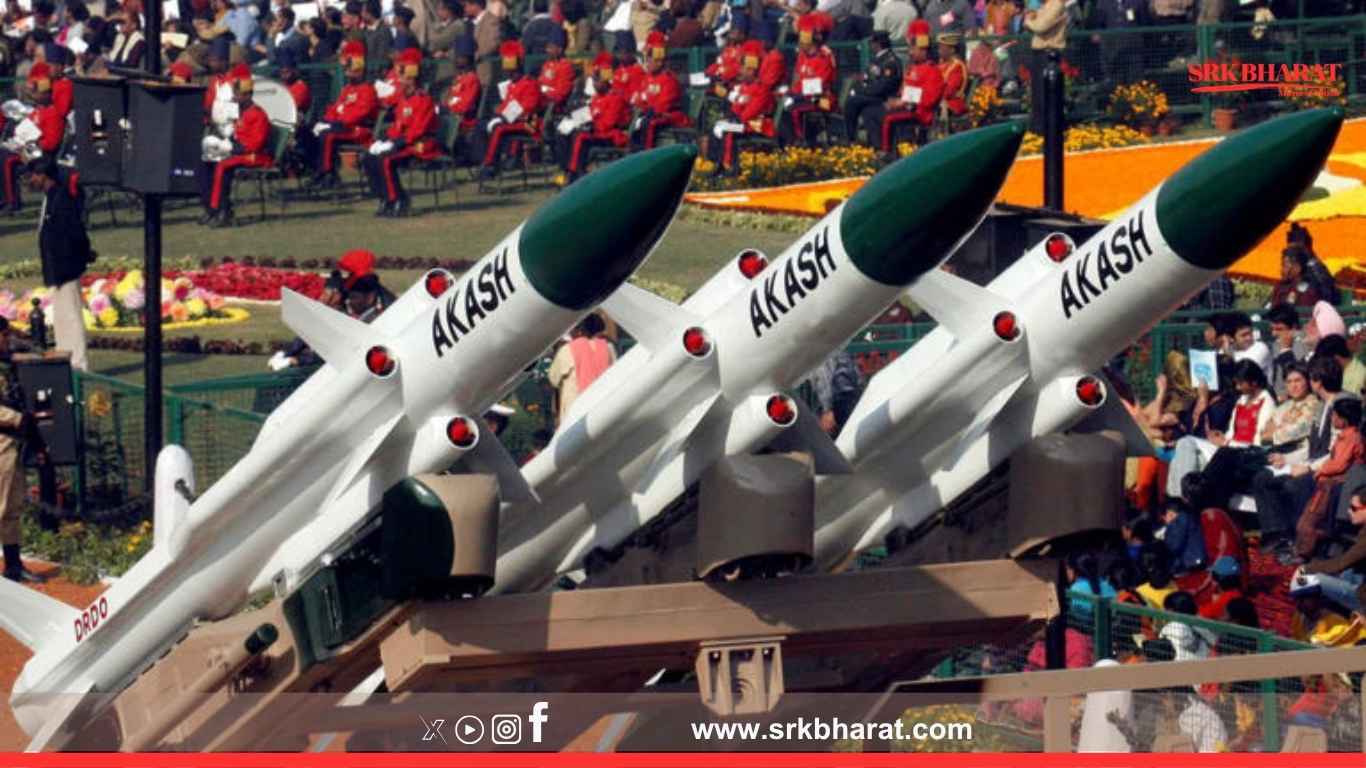
Brazil is reportedly in advanced exploratory talks to procure India’s indigenous Akash missile defence systems after closely studying their operational performance in recent South Asian military engagements, particularly Operation Sindoor, which showcased their reliability and effectiveness.
Why Is Brazil Interested In Akash Missiles?
Brazilian defence officials have highlighted several drivers behind the procurement interest:
- Operational success of Akash missiles during Operation Sindoor, where India demonstrated layered air defence against enemy UAVs, cruise missiles, and tactical aircraft.
- Rising regional security threats in Latin America, including narco-terror drones, transnational insurgency aerial intrusions, and cyber-kinetic hybrid warfare.
- Desire to diversify military imports beyond traditional US, Israeli, and European suppliers.
- India’s willingness to offer technology transfer and local assembly provisions, strengthening Brazil’s domestic defence manufacturing under its Strategic Defence Industrial Base (BID).
What Is The Akash Missile System?
Developed by India’s Defence Research and Development Organisation (DRDO), the Akash is a medium-range surface-to-air missile (SAM) system, inducted in 2008 and progressively upgraded.
| Feature | Specification |
|---|---|
| Type | Medium-range surface-to-air missile |
| Range | Up to 25 km (Akash-1), up to 40 km (Akash NG) |
| Speed | Mach 2.5 |
| Warhead | 60 kg pre-fragmented explosive |
| Guidance | Command guidance with phased array radar tracking |
| Targets | Fighter jets, cruise missiles, UAVs, helicopters |
| Radar | Rajendra multi-function radar system |
| Mobility | Highly mobile; mounted on trucks or tracked vehicles |
| Production | DRDO, Bharat Electronics Ltd, Bharat Dynamics Ltd |
Operational Performance In Operation Sindoor
During Operation Sindoor, India’s multi-domain demonstration aimed at deterring regional adversaries, the Akash system:
- Successfully engaged enemy tactical drones and decoy aerial targets with high accuracy.
- Integrated with Indian Air Force’s Integrated Air Command and Control System (IACCS) for real-time data fusion.
- Showcased rapid mobility, quick deployment, and network-centric capability against saturating aerial threats.
Brazilian military attaches stationed in South Asia during the operation filed positive assessments on:
- Ease of integration with legacy radar networks.
- Lower operational and maintenance costs compared to US Patriot systems.
- Potential adaptation for Brazilian Amazon-based mobile air defence requirements.
Why Does Brazil Need Akash Missiles?
Brazil faces unique air defence challenges:
- Vast territorial expanse with dense rainforest canopies, limiting radar coverage.
- Increasing illegal aerial incursions by narco-traffickers using drones and light aircraft for smuggling.
- Strategic requirement to protect energy infrastructure, hydroelectric dams, and military bases in remote areas.
- Ongoing defence modernisation under Brazil’s National Defence Strategy (END), which prioritises self-reliance and multi-layered air defence.
Comparative Assessment: Akash vs Other SAM Systems
| Parameter | Akash (India) | Spyder (Israel) | NASAMS (US/Norway) |
|---|---|---|---|
| Range | 25-40 km | 15-35 km | 25-30 km |
| Speed | Mach 2.5 | Mach 2.2 | Mach 2.5 |
| Radar | Indigenous Rajendra radar | EL/M-2106 ATAR | Sentinel radar |
| Guidance | Command guidance | Electro-optical & radar | Active radar homing |
| Cost | $25-30 million per battery | $50 million per battery | $65 million per battery |
| Technology Transfer | Yes | Limited | No |
Defence experts note that while the Akash lacks active seeker technology present in systems like NASAMS, its cost efficiency, indigenous radar integration, and Indian readiness for local manufacturing make it attractive for Brazilian strategic planners.
India-Brazil Defence Relations: Recent Trends
| Year | Development | Impact |
|---|---|---|
| 2020 | India and Brazil sign defence cooperation MoU. | Framework for defence research and joint production. |
| 2023 | HAL offers Tejas fighter jets to Brazil. | No procurement finalised; dialogues continue. |
| 2025 | Brazil explores Akash missile procurement post Operation Sindoor. | Potential first Indian missile system export to Latin America. |
Strategic Implications Of Brazil’s Akash Purchase
- Strengthens India’s defence export portfolio, supporting PM Modi’s ‘Atmanirbhar Bharat’ and ‘Make in India’ initiatives.
- Expands Indian strategic footprint in Latin America, historically dominated by Western and Israeli defence suppliers.
- Opens avenues for joint radar and missile R&D projects, leveraging Brazil’s advanced aerospace sector.
- Enhances Brazil’s air defence capabilities at a fraction of Western procurement costs, allowing redeployment of budgetary savings for other modernisation programs.
Expert Views
- Dr. Rajeswari Pillai Rajagopalan, ORF Defence Analyst:
“The Akash deal, if concluded, will be a landmark for India’s defence diplomacy, signalling its rise as a reliable missile supplier outside Asia and Africa.” - Brig. Gen. Ricardo Machado (Retd), Brazil Strategic Studies Institute:
“Brazil seeks affordable yet effective solutions for our vast territory. The Akash system’s successful operational deployment in India makes it worthy of evaluation.” - Prof. Paulo Velasco, International Relations Scholar, Rio de Janeiro:
“Strategically, this deal may indicate Brazil’s foreign policy diversification, balancing traditional Western ties with emerging Asian powers.”
Challenges To The Deal
- Brazil’s internal procurement processes involve lengthy evaluation, operational testing, and congressional approvals.
- Possible US pressure to avoid purchases from non-NATO suppliers due to interoperability concerns.
- Need for adaptation to Brazilian Amazon and Cerrado environmental conditions.
Next Steps
Indian defence ministry sources confirm that:
- A technical evaluation team from Brazil is expected to visit India in August 2025 to inspect Akash production units in Hyderabad and conduct live-fire demonstrations.
- Discussions are underway for possible licensed assembly by Brazil’s Avibras or Embraer Defence divisions.
Broader Defence Cooperation Outlook
If the Akash deal progresses smoothly, it may pave the way for:
- Future sales of Akash-NG (Next Generation) missiles, extending range to 50 km with active seeker capability.
- Co-development of short-range cruise missiles under Brazil’s National Missile Development Plan.
- Joint satellite launch programs, as both countries share space research collaboration histories.
Conclusion
Brazil’s consideration of India’s Akash missile system reflects New Delhi’s growing reputation as a credible defence exporter offering cost-effective and battle-tested solutions. For Brazil, integrating Akash could fill critical air defence gaps while strengthening ties with an emerging Asian strategic partner. As procurement evaluations progress, this potential deal could reshape South-South defence trade dynamics in the coming years.
Disclaimer: This report is based on official statements, defence analyst inputs, and open-source intelligence for public informational purposes only.