


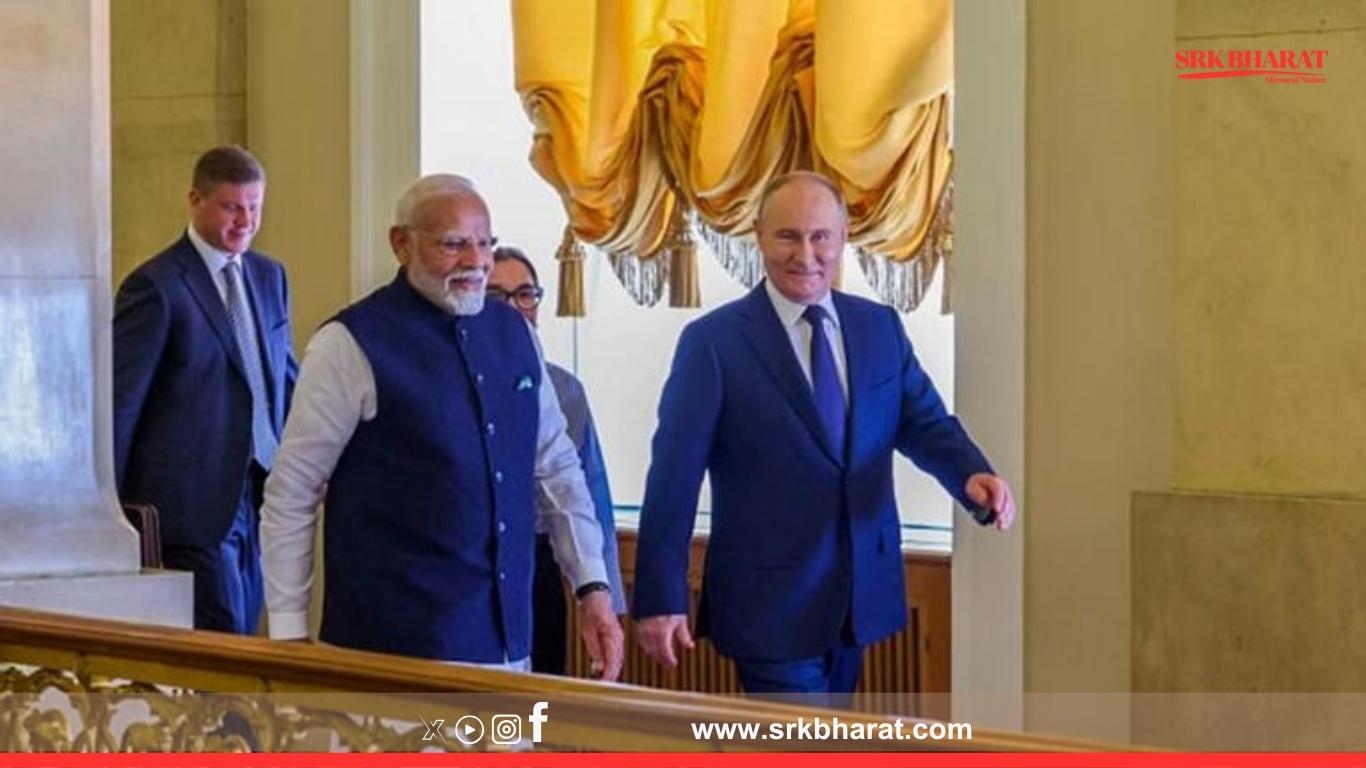
India is actively evaluating a fresh Russian proposal to supply and manufacture Sukhoi Su-57 fifth-generation fighter jets under a joint production framework ahead of Russian President Vladimir Putin’s scheduled visit to New Delhi later this month. The development signals a possible revival of advanced Indo-Russian defence collaboration amid changing regional security dynamics and emerging gaps in India’s fighter jet fleet modernisation plans.
Background: From FGFA Exit to Re-entry Talks
The Sukhoi Su-57, known internally as the PAK FA or T-50, is Russia’s flagship fifth-generation stealth fighter aircraft programme. India was initially a co-development partner under the Fifth Generation Fighter Aircraft (FGFA) project launched in 2007, which aimed to customise the Su-57 for Indian Air Force (IAF) requirements. However, New Delhi formally withdrew from FGFA in 2018 over concerns regarding:
- Inadequate stealth characteristics
- Underdeveloped engines (Saturn AL-41F1)
- Lack of complete technology transfer assurance
- Cost escalation exceeding initial estimates
Why is India Reconsidering Now?
Defence and strategic affairs officials underline multiple reasons behind New Delhi’s renewed interest:
- Fleet Capability Gaps: With IAF’s fighter squadron strength dwindling to around 31-32 squadrons against an authorised 42, fifth-generation fighters are seen as crucial for deterrence and air dominance.
- Delays in AMCA Timeline: India’s indigenous Advanced Medium Combat Aircraft (AMCA) is unlikely to enter squadron service before 2032-33, leaving a capability void over the next decade.
- Regional Security Environment: China’s J-20 fifth-generation fighter fleet is expanding rapidly, with newer WS-10C engine variants operationalising from 2022. Pakistan is also exploring the Chinese J-31/35 stealth platform in the coming decade.
- Russian Offer of Local Production: The current proposal reportedly includes local manufacturing, partial assembly, and maintenance, repair, overhaul (MRO) capabilities under Make in India, with deeper technology transfer assurances compared to the earlier FGFA structure.
Key Features of Sukhoi Su-57
| Parameter | Specifications |
|---|---|
| Type | Fifth-generation multirole stealth fighter |
| Length | 20.1 m |
| Wingspan | 14.1 m |
| Engine | Saturn AL-41F1 (current); Izdelie 30 under development |
| Maximum Speed | Mach 2.0 |
| Supercruise | Mach 1.6 |
| Combat Radius | ~1500 km |
| Stealth Features | Internal weapons bays, radar-absorbing materials, reduced RCS design |
| Avionics | AESA radar, advanced EW suite, sensor fusion |
| Weapons Load | Up to 10 missiles/bombs internally + external pylons if needed |
Russia’s Proposal: What Has Changed?
According to defence ministry officials, Russia’s current proposal offers:
- Supply of fully built Su-57 aircraft with immediate induction timelines for 2 squadrons.
- Joint production of Su-57 airframes with HAL and select Tier-1 suppliers.
- Technology transfer for maintenance and upgrades to ensure lifecycle independence.
- Option to integrate Indian-origin avionics, weapons, and electronic warfare systems for customised IAF configurations.
- Future engine upgrade pathways with potential collaboration on Izdelie 30, the next-generation Su-57 engine.
Challenges and Concerns
Despite strategic interest, India remains cautious due to:
- Past Experience with FGFA: Project execution delays and dissatisfaction over co-development clauses remain fresh in decision-makers’ minds.
- Engine Maturity: The Su-57’s current engine, AL-41F1, is an upgraded derivative of Su-35 engines, while the fully indigenous fifth-generation engine (Izdelie 30) is still under trials, raising questions on thrust-to-weight ratios and stealth performance.
- Stealth Performance Doubts: Western and Indian assessments suggest Su-57 radar cross-section (RCS) reduction is significant but not comparable to American F-22 Raptor levels.
- Cost Considerations: The Su-57’s unit cost, currently above $45-50 million without full ToT, would necessitate substantial budgetary allocations amidst other priority acquisitions.
Strategic Imperatives Driving Interest
| Factor | Impact |
|---|---|
| China’s J-20 Deployment | Growing stealth imbalance along LAC; J-20 reportedly operating from Hotan and Kashgar airbases. |
| IAF’s Fighter Gaps | Projected fall below 30 squadrons by 2030 without major inductions. |
| AMCA Delay | Indigenous fifth-gen platform earliest from 2032-33; delays likely extend to mid-2030s for full operational clearance. |
| Geopolitical Hedging | Diversification to balance US (F-414, MQ-9B) and European (Rafale) defence ties with Russian capabilities. |
Possible Procurement Models Under Discussion
| Model | Description | Advantages | Disadvantages |
|---|---|---|---|
| Direct Import | Buy 36-48 Su-57s fully built from Russia | Fastest induction; strategic messaging | High forex outgo; limited industrial gains |
| Buy and Make | Import initial units, assemble remainder in India | Build local MRO base; phased capability build-up | Requires strong ToT clauses |
| Joint Production with ToT | Co-produce with HAL under Make in India | Industrial ecosystem growth; future upgrades possible | Long gestation; higher initial investments |
Possible Impact on India-Russia Defence Ties
If finalised, the Su-57 deal will:
- Reinforce Russia’s position as India’s largest strategic arms supplier, amidst concerns over declining Indian orders in favour of US and European OEMs.
- Revitalise joint aerospace production ecosystems, with spin-offs for future unmanned combat aerial vehicles (UCAVs) and next-gen transport aircraft collaborations.
- Strengthen political trust amidst Western sanctions, with rupee-rouble settlement options under discussion to bypass SWIFT disruptions.
Comparison with Other Fifth-Gen Programmes
| Aircraft | Developer | Status | India-Relevance |
|---|---|---|---|
| Su-57 | Russia | Limited production started | Direct import and Make in India possibilities |
| AMCA | India | Under development; first flight by 2028-30 | Indigenous, but delayed |
| F-35 | USA | Operational | No current offer to India due to export policy and S-400 sanctions risks |
| J-20 | China | Operational | Strategic threat along LAC |
The Road Ahead
Defence ministry sources caution that final decision-making will depend on multiple inter-ministerial evaluations, including:
- Cost-benefit analysis versus AMCA development acceleration
- Engine performance validation trials in high-altitude Indian conditions
- Technology transfer and intellectual property sharing guarantees
- Strategic fit within IAF’s doctrine and operational environment
Conclusion
President Putin’s upcoming visit is expected to see detailed negotiations on the Su-57 proposal alongside discussions on S-400 follow-on orders, nuclear cooperation, and energy deals. Whether India greenlights the Su-57 acquisition will signal its defence procurement philosophy for the next decade – balancing immediate operational readiness with long-term self-reliance and indigenous development goals.
Disclaimer: This content is for informational purposes only. It does not constitute defence policy advice or an official government position.