

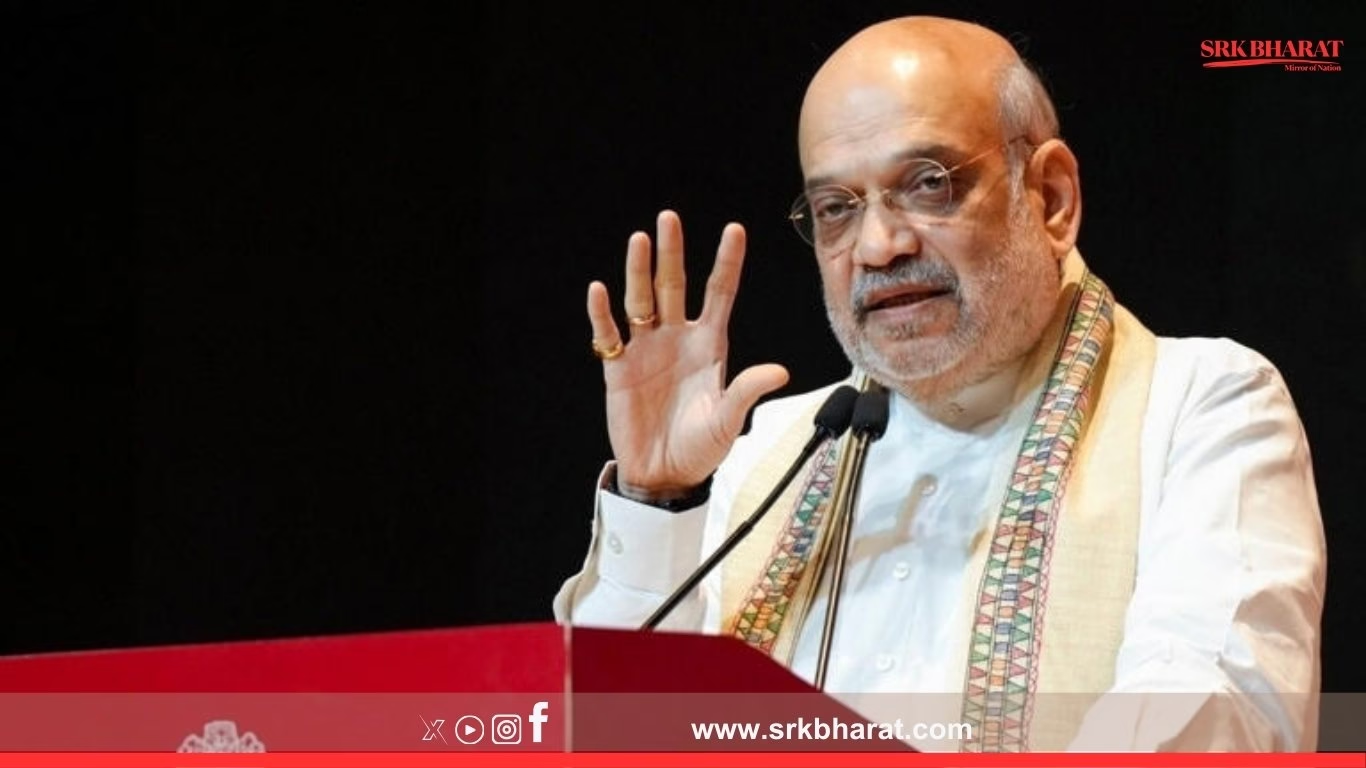
Union Home Minister Amit Shah has reignited a fierce national debate by asking whether a Prime Minister or Chief Minister can legitimately run a government from jail. His remarks came during a high-profile interview defending the Constitution (130th Amendment) Bill, 2025, which mandates the removal of any Prime Minister, Chief Minister, or Minister who remains in custody for more than 30 days on charges carrying a sentence of five years or more.
The bill, introduced during the monsoon session of Parliament, has been met with intense resistance from Opposition parties, who have labeled it a “Black Bill” and accused the BJP-led government of attempting to weaponize legal provisions to destabilize non-BJP state governments. Shah, however, insisted that the legislation is rooted in constitutional morality and applies equally to all leaders—including the Prime Minister himself.
🧭 Timeline of the Criminal Netas Bill and Political Reactions
| Date | Event Description | Political Impact |
|---|---|---|
| August 2025 | Constitution (130th Amendment) Bill introduced | Sparks protests in Parliament |
| August 25, 2025 | Amit Shah defends bill in ANI interview | BJP doubles down on legal rationale |
| August 26, 2025 | Joint Parliamentary Committee begins review | All-party inputs invited |
The bill has now been referred to a Joint Parliamentary Committee (JPC), where members from both Houses will examine its provisions and suggest amendments.
📊 Key Provisions of the Constitution (130th Amendment) Bill
| Clause | Description | Implication for Elected Officials |
|---|---|---|
| Automatic Removal | Ministers to be removed if jailed for 30+ days | Applies before conviction |
| Applicable Charges | Offenses punishable by 5+ years | Includes corruption, money laundering |
| Scope | PM, CM, Ministers at Centre and State | Uniform application across parties |
| Safeguards | Judicial oversight, JPC review | Prevents arbitrary enforcement |
Shah clarified that the bill does not affect the majority status of any party in Parliament or Assembly. “One member will go, other members of the party will run the government, and when they get bail, they can come and take the oath again,” he said.
🔍 Amit Shah’s Argument: “Jail Cannot Be Turned Into CM House or PM House”
In his interview, Shah asked:
“Can a Chief Minister, Prime Minister, or any leader run the country from jail? Does that suit the dignity of our democracy?”
He criticized attempts by jailed leaders to continue issuing orders from prison, stating that such practices undermine democratic norms. “Even today, they are trying that if they ever have to go to jail, they will easily form the government from jail. The jail will be made CM House, PM House and the DGP, Chief Secretary, Cabinet Secretary or Home Secretary will take orders from the jail,” Shah said.
| Shah’s Statement | Implication for Governance |
|---|---|
| “Jail cannot be CM House” | Rejects remote governance from prison |
| “Democracy demands dignity” | Upholds constitutional morality |
| “PM post included in bill” | Applies to all leaders, including Modi |
| “No one is indispensable” | Party can continue governance without jailed leader |
Shah also pointed out that Prime Minister Narendra Modi personally insisted on including the PM’s office under the bill’s purview, contrasting it with the 39th Amendment brought by Indira Gandhi, which shielded top officials from judicial scrutiny.
🧠 Opposition’s Counter: “Bill Is a Political Weapon”
Opposition parties have slammed the bill as a tool to target non-BJP Chief Ministers and ministers. They argue that the provision could be misused to frame political rivals, jail them under serious charges, and remove them from office without conviction.
| Opposition Concern | Alleged Motive |
|---|---|
| False cases against rivals | Political vendetta |
| Arrests used to topple governments | Undermines federalism |
| Bill lacks safeguards | Risk of misuse by ruling party |
| Targeted enforcement | Selective application of law |
During the bill’s introduction, Opposition MPs tore copies of the legislation and hurled paper balls at Shah, prompting adjournments and chaos in Parliament.
📉 Historical Context: Legal Precedents and Political Fallout
The bill marks a significant shift from past legal frameworks. While convicted leaders are already barred from holding office, the 130th Amendment introduces a pre-conviction clause based on prolonged custody.
| Legal Framework | Status Before Bill | Status After Bill |
|---|---|---|
| Conviction-based removal | Required final court judgment | Removal after 30 days in jail |
| Scope of application | Limited to MPs and MLAs | Expanded to PM, CM, and Ministers |
| Judicial review | Post-facto challenge | Pre-emptive safeguard via JPC |
Shah emphasized that the bill will not affect the functioning of elected governments and that parties can appoint alternate leaders until the jailed member returns.
📌 Conclusion
Amit Shah’s defense of the Criminal Netas Bill has reignited debate over the balance between democratic accountability and political autonomy. By asking whether a Prime Minister can run office from jail, Shah has framed the legislation as a moral and constitutional imperative, not a partisan maneuver.
As the Joint Parliamentary Committee begins its review, the bill’s fate will depend on whether it can address concerns of misuse while upholding the principle that governance must be free from criminal entanglements.
—
Disclaimer: This article is based on publicly available news reports and official statements as of August 26, 2025. It is intended for informational purposes only and does not constitute legal, political, or constitutional advice.