




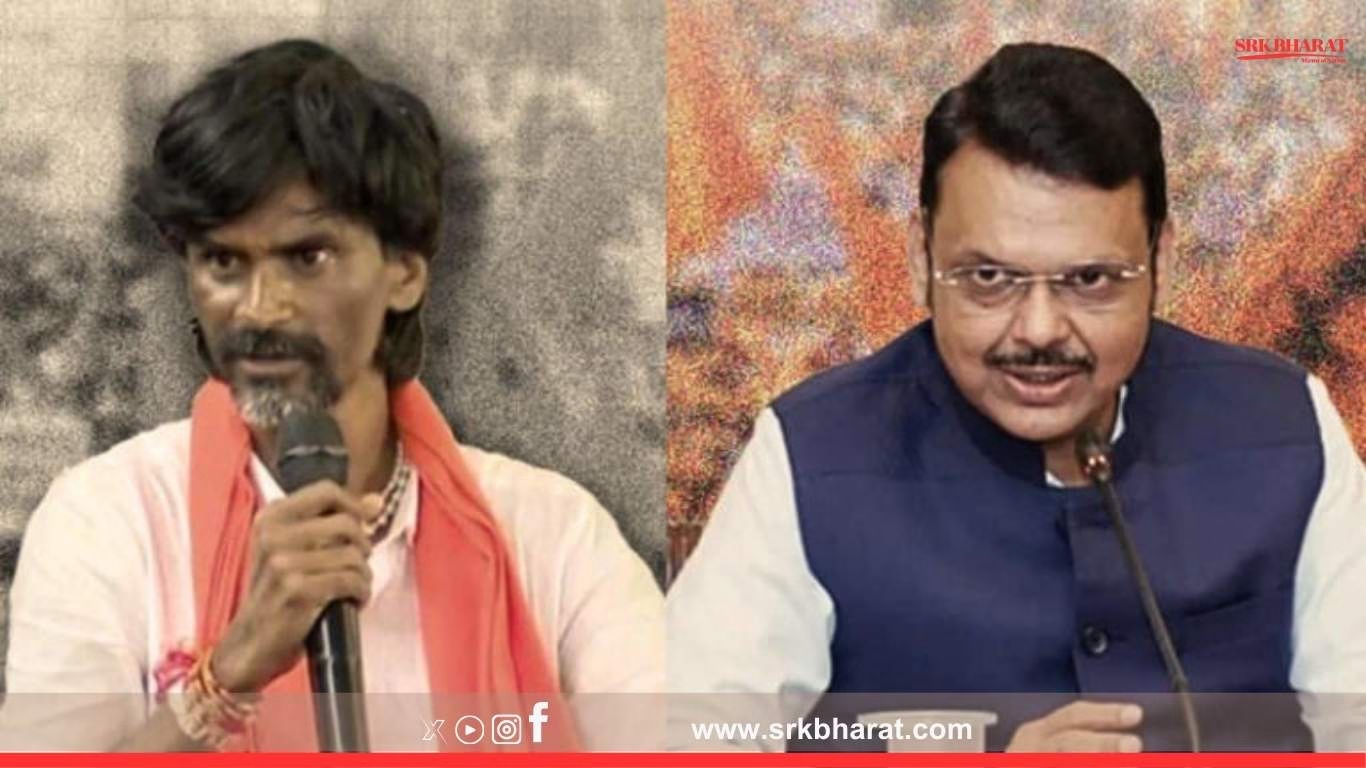
The weeks-long Maratha quota agitation in Maharashtra has entered a phase of de-escalation following a breakthrough between the state government and activist Manoj Jarange Patil. Jarange, who had been on a hunger strike at Mumbai’s Azad Maidan, formally called off his protest after receiving a written proposal from the government that promises a pathway for Maratha individuals to access reservation benefits under the Other Backward Classes (OBC) category.
However, Chief Minister Devendra Fadnavis tempered the optimism with a cautionary note, stating that while individual-based solutions are being implemented, a blanket reservation for the entire Maratha community remains “legally untenable.” His remarks underscore the complex legal and constitutional challenges surrounding caste-based quotas in India, especially in light of Supreme Court judgments that cap reservations at 50%.
🧭 Timeline of Key Developments in the Maratha Quota Agitation
| Date | Event / Development | Outcome / Impact |
|---|---|---|
| August 2025 | Jarange begins hunger strike at Azad Maidan | Gains widespread support across Maharashtra |
| September 2 | Government delivers written proposal | Jarange ends fast, calls for calm |
| September 3 | CM Fadnavis addresses media | Warns against blanket reservation |
| September 30 | Deadline to withdraw protest-related cases | Government promises legal relief |
The resolution was handed over by Revenue Minister Radhakrishna Vikhe Patil, who heads the cabinet sub-committee on the Maratha quota. It includes immediate implementation of the Hyderabad gazette, which lists Marathas as Kunbis—a sub-caste already classified under the OBC bracket.
🔍 What the Government Has Offered: Individual-Based Certification
The government’s proposal focuses on enabling Maratha individuals to obtain OBC certification through historical documentation. The Hyderabad gazette, which covers the Marathwada region, will be used to identify Marathas listed as Kunbis.
| Region Covered | Document Source | Certification Type |
|---|---|---|
| Marathwada | Hyderabad gazette (pre-1948) | Kunbi / Maratha Kunbi |
| Satara, Pune, Aundh | Regional gazetteers | Pending legal examination |
| Village-Level Committees | Gram Panchayat offices | Verification and issuance |
The state has committed to pasting 58 lakh historical records outside gram panchayat offices to expedite the process and ensure transparency.
📉 Legal and Constitutional Constraints on Blanket Reservation
While the government has taken steps to address individual claims, CM Fadnavis reiterated that a community-wide reservation for all Marathas would violate constitutional limits.
| Legal Principle | Source / Precedent | Implication for Maratha Quota |
|---|---|---|
| Reservation Cap | Supreme Court (Indra Sawhney case) | Total quota cannot exceed 50% |
| Socio-Economic Criteria | SEBC Act, 2024 | Must prove backwardness for inclusion |
| Judicial Scrutiny | Bombay High Court, Supreme Court | Past Maratha quota struck down |
Fadnavis emphasized that the current solution is “individual-based, not community-wide,” and must withstand judicial scrutiny.
🔥 Political Reactions and Community Sentiment
The resolution has been met with cautious optimism by Maratha leaders and activists, though some have warned that the fight for full reservation is far from over.
| Stakeholder | Reaction / Statement | Position on Resolution |
|---|---|---|
| Manoj Jarange Patil | Ended hunger strike, thanked supporters | Welcomed move, urged vigilance |
| Opposition Leaders | Called for full reservation | Criticized government’s piecemeal approach |
| BJP State Unit | Supported CM’s legal stance | Focused on constitutional compliance |
The government has also announced compensation and government jobs for the kin of those who died during the protests, and pledged to withdraw all protest-related cases by the end of September.
📦 Implementation Roadmap and Next Steps
The government resolution outlines a phased approach to expand the documentation process beyond Marathwada.
| Phase | Region / Scope | Timeline / Status |
|---|---|---|
| Phase 1 | Marathwada (Hyderabad gazette) | Immediate implementation |
| Phase 2 | Satara, Pune, Aundh (regional gazetteers) | One-month legal review |
| Phase 3 | Statewide verification and certification | Pending cabinet approval |
Village-level committees will be tasked with issuing caste validity certificates, and a digital portal is expected to be launched to streamline applications.
🧠 Expert Commentary and Legal Perspectives
| Expert Name | Role | Comment |
|---|---|---|
| Meera Iyer | Constitutional Law Scholar | “The government’s approach balances legal prudence with political necessity.” |
| Rajiv Bansal | Social Justice Analyst | “Individual certification avoids quota inflation while addressing genuine claims.” |
| Dr. Rakesh Sinha | Public Policy Advisor | “This is a template for resolving caste-based demands within constitutional limits.” |
Legal experts have praised the government’s use of historical records to validate claims, but caution that the process must be transparent and legally robust.
📌 Conclusion
The Maratha quota crisis may have de-escalated, but the path ahead remains complex. While the Maharashtra government’s proposal offers a pragmatic solution through individual certification, CM Devendra Fadnavis’s warning about the legal untenability of blanket reservation underscores the constitutional boundaries that cannot be ignored. As the state moves forward with implementation, the challenge will be to maintain social harmony, uphold legal integrity, and deliver justice to deserving individuals without triggering fresh litigation or political unrest.
—
Disclaimer: This article is based on publicly available government statements and media reports as of September 3, 2025. It is intended for informational purposes only and does not constitute legal, political, or policy advice.