




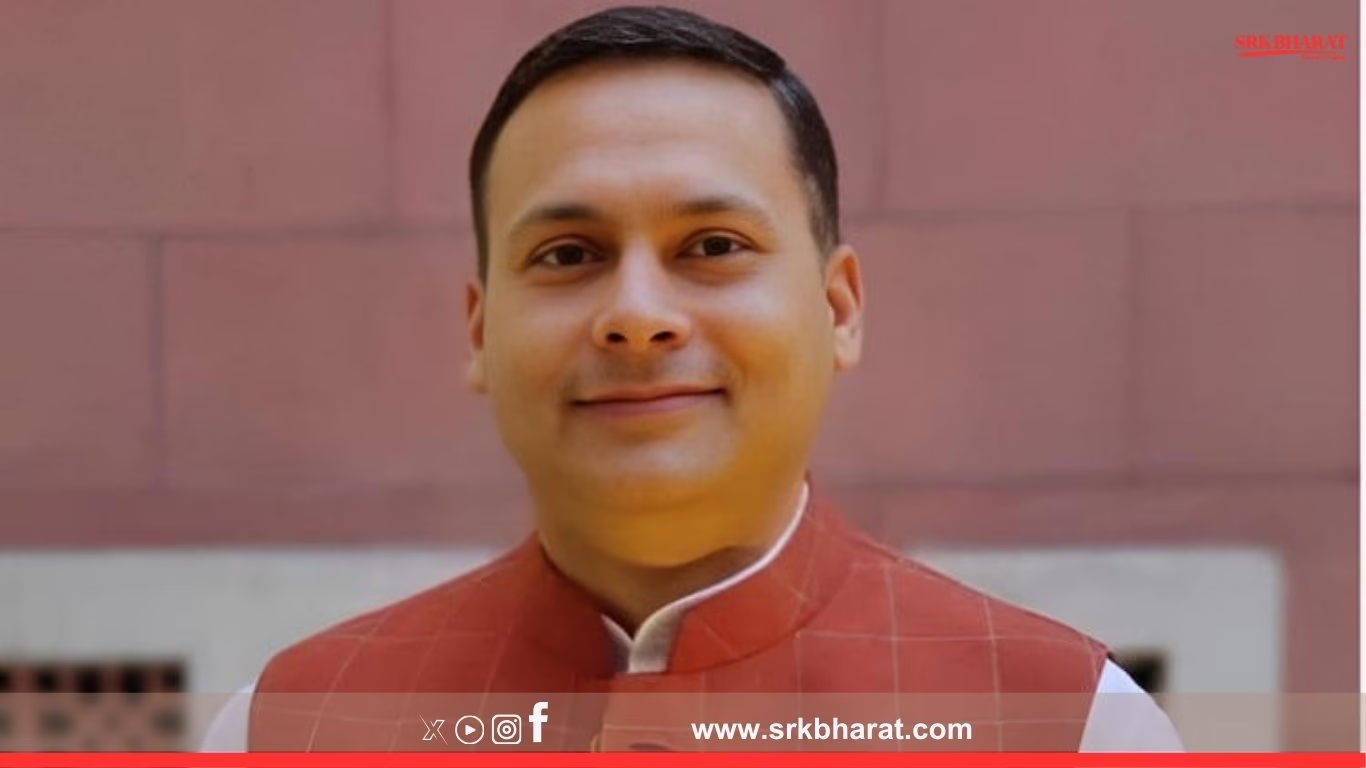
The political debate over India’s Goods and Services Tax (GST) reforms intensified this week after Congress president Mallikarjun Kharge criticized the recent rate cuts, accusing the Modi government of burdening the middle class and distorting the original vision of “One Nation, One Tax.” In a sharp rebuttal, BJP IT cell head Amit Malviya accused Kharge of “rewriting history with lies,” asserting that the Congress had squandered a decade on GST deliberations while the NDA government implemented the reform and delivered tangible relief to consumers.
Malviya’s response, posted on social media and amplified across BJP platforms, claimed that GST was originally an NDA vision initiated under Prime Minister Atal Bihari Vajpayee in 2000, but was stalled for ten years due to Congress’s inability to build consensus with states or develop the necessary IT infrastructure. He credited Prime Minister Narendra Modi for reviving the reform, passing the Constitutional Amendment in 2016, and rolling out GST in 2017.
🧭 Key Highlights from Amit Malviya’s Counter to Kharge
| Issue Raised by Congress | BJP’s Rebuttal via Amit Malviya | Strategic Narrative |
|---|---|---|
| “One Nation, Nine Taxes” | “Congress left behind 17 taxes + 13 cesses = chaos” | GST simplified tax structure |
| Middle Class Burden | “Congress taxed essentials at 27–31%” | Modi govt reduced rates to 5–18% |
| Gabbar Singh Tax Allegation | “GST collections soared, leakages plugged” | Reform strengthened fiscal federalism |
| Delay in GST Implementation | “Congress wasted a decade, no IT backbone” | NDA built consensus and delivered reform |
| Impact on States | “Centre released ₹2.78 lakh crore during pandemic” | Compensation ensured state stability |
Malviya also cited specific examples of tax reductions under the Modi government, including soaps, toothpaste, hair oil, diagnostic kits, cement, ACs, TVs, insurance, and UHT milk.
🔍 GST Rate Comparison: Congress Era vs Modi Government
| Item Category | Tax Rate Pre-GST (Congress Era) | GST Rate Post-Reform | Latest Rate (2025) | Net Relief (%) |
|---|---|---|---|---|
| Toothpaste, Soaps | 27% | 18% | 5% | –22% |
| Chocolates, ACs | 31% | 28% | 18% | –13% |
| Cement | 29% | 28% | 18% | –11% |
| Bicycles | 22% | 12% | 5% | –17% |
| Insurance Premiums | 18% | 18% | 0% | –18% |
| UHT Milk | Exempt | 0% | 0% | No change |
Malviya argued that the Congress’s criticism ignores the fact that GST has evolved over time, with rate rationalization benefiting consumers and businesses alike.
📉 Congress’s Position on GST Reform
Congress leaders, including Kharge and Jairam Ramesh, have long advocated for a simplified GST structure. In its 2019 and 2024 manifestos, the party proposed a “GST 2.0” model with fewer slabs, reduced rates on mass consumption items, and streamlined compliance for MSMEs.
| Congress Demand | Description | Status Post 2025 Reform |
|---|---|---|
| Fewer Tax Slabs | Merge multiple rates into two or three | Achieved: 5%, 18%, and 40% sin goods |
| MSME Compliance Relief | Simplify returns and reduce penalties | E-invoicing and composition scheme expanded |
| Inverted Duty Fix | Align input and output tax rates | Addressed in textile and electronics sectors |
| Agricultural Exemptions | Remove GST on farm inputs and essentials | Partial relief granted |
| State Compensation | Extend compensation beyond 2025 | Under review by GST Council |
Kharge claimed that the Modi government imposed GST on 36 agricultural items and taxed essentials like milk, curd, flour, books, and hospital expenses, which he described as “anti-poor.”
🔥 Political Reactions and Public Sentiment
| Political Leader | Party | Statement |
|---|---|---|
| Mallikarjun Kharge | Congress | “Modi changed One Nation, One Tax to Nine Taxes” |
| Amit Malviya | BJP | “Congress is rewriting history with lies” |
| Jairam Ramesh | Congress | “GST Council has become a rubber stamp” |
| Nirmala Sitharaman | BJP | “GST reform is a work in progress” |
The debate has reignited discussions on fiscal federalism, tax equity, and the role of the GST Council in shaping India’s indirect tax regime.
🧠 Expert Commentary on GST Evolution
| Expert Name | Role | Comment |
|---|---|---|
| Meera Iyer | Tax Policy Analyst | “The GST reform has delivered relief, but the rollout was uneven.” |
| Rajiv Bansal | Economist | “Political consensus was key—both UPA and NDA contributed.” |
| Dr. Rakesh Sinha | Public Finance Scholar | “The GST journey reflects India’s complex federal structure.” |
Experts agree that while the GST has simplified taxation, its implementation required continuous calibration and political will.
📦 GST Collections and Economic Impact
| Fiscal Year | GST Collection (₹ lakh crore) | Growth Rate (%) | Compensation to States (₹ crore) |
|---|---|---|---|
| 2017–18 | 7.19 | — | 48,000 |
| 2018–19 | 11.77 | +63.7% | 83,000 |
| 2020–21 | 11.36 | –3.5% (COVID hit) | 1,10,000 |
| 2022–23 | 14.83 | +30.6% | 1,25,000 |
| 2024–25 | 16.92 | +14.1% | 1,40,000 |
Malviya highlighted that GST collections have consistently grown, leakages have been plugged, and states have received timely compensation—even during the pandemic.
📌 Conclusion
The war of words between Amit Malviya and Mallikarjun Kharge over GST reforms underscores the deep political divide on economic policy narratives. While the Congress accuses the Modi government of distorting the GST vision and burdening the middle class, the BJP counters that it inherited a chaotic tax system and delivered a unified, rational structure that benefits consumers and states alike. As India enters a new phase of GST evolution, the debate over its legacy and future will remain central to the country’s fiscal discourse.
—
Disclaimer: This article is based on publicly available political statements, media reports, and government data as of September 4, 2025. It is intended for informational purposes only and does not constitute financial or political advice.