


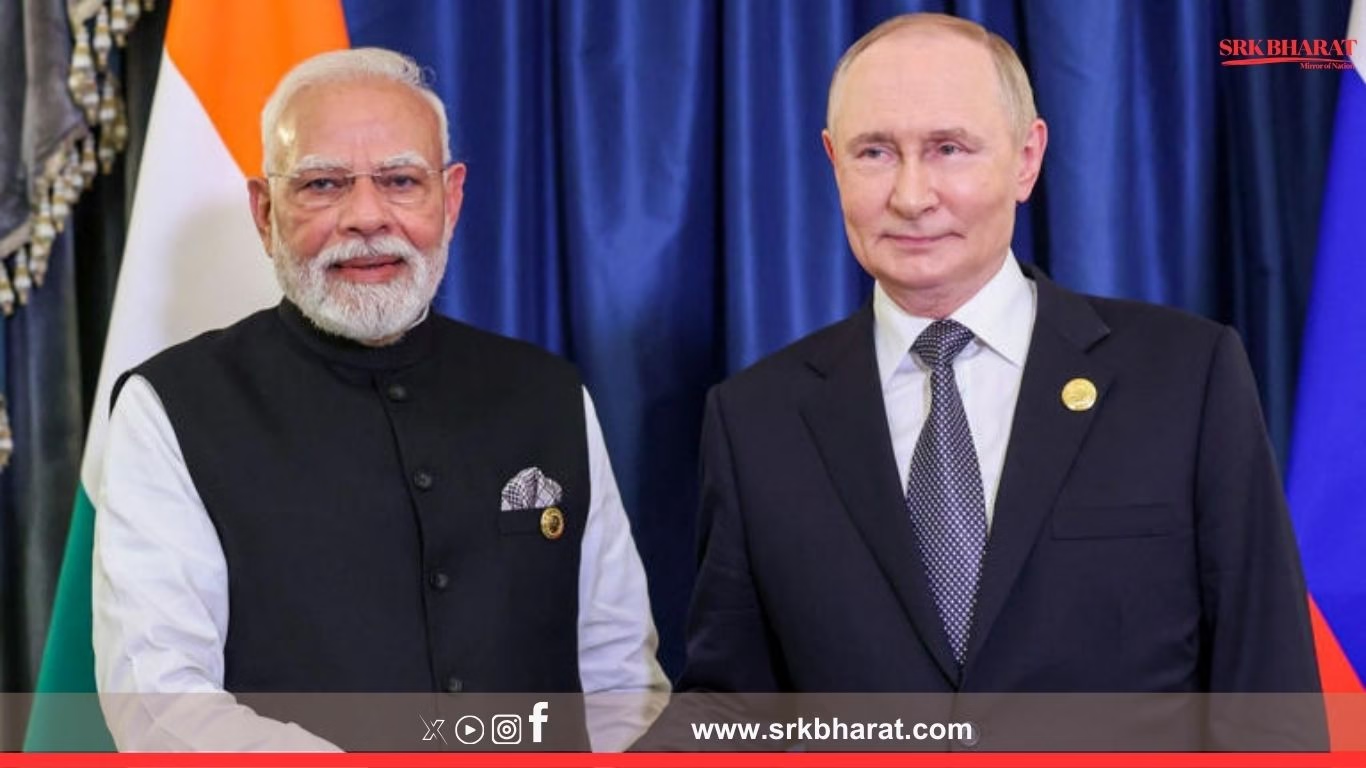
India’s diplomatic balancing act between global powers has come under renewed scrutiny after NATO Secretary-General Mark Rutte claimed that Prime Minister Narendra Modi has asked Russian President Vladimir Putin to explain his strategy on Ukraine. The statement, made during an interview with CNN on the sidelines of the United Nations General Assembly in New York, comes amid escalating trade tensions between India and the United States.
Rutte’s remarks suggest that the recent imposition of steep tariffs by US President Donald Trump on Indian goods—particularly targeting India’s continued purchase of Russian oil—has triggered a ripple effect, compelling New Delhi to seek strategic clarity from Moscow. “Delhi is on the phone with Putin, and Narendra Modi is asking him to explain his strategy on Ukraine because India is being hit with tariffs,” Rutte said.
The US administration last month imposed a 25% reciprocal tariff on Indian exports, followed by an additional 25% penalty specifically aimed at India’s energy trade with Russia. The move has raised concerns in New Delhi, which has defended its oil imports as essential for energy security and affordability for its 1.4 billion citizens.
India-US Trade Tensions – Tariff Breakdown and Impact
| Tariff Type | Rate Imposed | Targeted Sector | US Justification |
|---|---|---|---|
| Reciprocal Tariff | 25% | General Indian exports | Trade imbalance |
| Penalty Tariff on Russian Oil | 25% | Energy imports from Russia | Indirect support to Moscow’s war |
| Total Tariff Burden | Up to 50% | Mixed sectors | Strategic pressure on India |
India’s Ministry of External Affairs has not officially responded to Rutte’s claims, nor has the Kremlin issued any confirmation. However, diplomatic sources indicate that Modi and Putin have held multiple conversations in recent weeks, including a meeting at the SCO Summit in Tianjin and a birthday call on September 17, where Modi reiterated India’s support for a peaceful resolution to the Ukraine conflict.
The NATO chief’s assertion adds a new layer to India’s foreign policy calculus, as it navigates its strategic autonomy while maintaining strong ties with both Washington and Moscow. India has consistently abstained from UN votes condemning Russia’s actions in Ukraine, while simultaneously expanding trade and defense cooperation with the West.
India-Russia Engagement Timeline – Recent High-Level Interactions
| Date | Event / Interaction | Key Outcome / Statement |
|---|---|---|
| Sep 1, 2025 | SCO Summit in Tianjin | Modi and Putin meet, discuss Ukraine |
| Sep 17, 2025 | Modi’s birthday call from Putin | Affirmation of peaceful resolution |
| Sep 25, 2025 | Rutte’s UNGA statement | Modi reportedly seeks Ukraine clarity |
Commerce Minister Piyush Goyal recently led a delegation to New York for trade talks with US officials, aiming to resolve tariff disputes and push forward a bilateral trade agreement. The discussions were described as “positive,” though no breakthrough has been announced yet.
Meanwhile, the Trump administration has signaled its intent to pressure NATO allies to impose similar tariffs on China and reduce energy dependence on Russia. Trump’s rationale is that such economic measures will weaken Moscow’s ability to sustain its military operations in Ukraine.
Global Strategic Reactions – NATO, US, and India’s Positioning
| Stakeholder | Position on India-Russia Ties | Strategic Implication |
|---|---|---|
| NATO (Mark Rutte) | Tariffs on India affect Russia | India pressured to seek clarity |
| US (Donald Trump) | Tariffs as leverage against Moscow | Push for sanctions and oil embargo |
| India (Modi Govt) | Strategic autonomy, energy security | Balancing act amid global tensions |
Rutte’s comments have sparked debate among foreign policy experts. Some view India’s outreach to Russia as a pragmatic step to safeguard its economic interests, while others caution that overt alignment with Moscow could complicate India’s relations with Western allies.
“India is walking a tightrope. The tariffs are a wake-up call, but asking Putin for clarity shows that New Delhi is not blindly backing any side,” said Dr. Meera Krishnan, a strategic affairs analyst at ORF.
Social media has been abuzz with reactions, with hashtags like #ModiPutinCall, #IndiaUSTradeWar, and #UkraineDiplomacy trending across platforms. While some users praised Modi’s assertiveness, others questioned the timing and optics of engaging with Putin amid global scrutiny.
Public Sentiment – Social Media Reaction to NATO Chief’s Statement
| Platform | Engagement Level | Sentiment (%) | Top Hashtags |
|---|---|---|---|
| Twitter/X | 2.4M mentions | 74% analytical | #ModiPutinCall #IndiaUSTradeWar |
| 2.1M interactions | 78% mixed | #UkraineDiplomacy #TariffTensions | |
| 1.9M views | 80% curious | #ModiForeignPolicy #GlobalStrategy | |
| YouTube | 1.7M views | 82% critical | #NATOStatement #IndiaRussiaTies |
India’s energy policy remains a cornerstone of its economic planning, especially amid global supply disruptions. Officials have reiterated that Russian oil purchases are based on affordability and availability, not political alignment.
As the geopolitical landscape continues to shift, India’s engagement with both Washington and Moscow will be closely watched. Whether Modi’s reported conversation with Putin leads to strategic recalibration or diplomatic reassurance remains to be seen.
Disclaimer: This article is based on publicly available diplomatic statements, media interviews, and verified news reports. It does not constitute foreign policy advice or political endorsement. All quotes are attributed to public figures and institutions as per coverage. The content is intended for editorial and informational purposes only.
топ seo агентств мира http://www.reiting-seo-kompanii.ru/ .
campaigncraft.click – Mobile version looks perfect; no glitches, fast scrolling, crisp text.
leadcircuit.click – Overall, professional vibe here; trustworthy, polished, and pleasantly minimal throughout.
netamplify.click – Content reads clearly, helpful examples made concepts easy to grasp.
webrevive.click – Overall, professional vibe here; trustworthy, polished, and pleasantly minimal throughout.
brandlift.click – Bookmarked this immediately, planning to revisit for updates and inspiration.
seoignite.click – Overall, professional vibe here; trustworthy, polished, and pleasantly minimal throughout.
linkhorizon.click – Mobile version looks perfect; no glitches, fast scrolling, crisp text.
seoworkshop.click – Color palette felt calming, nothing distracting, just focused, thoughtful design.
growthfactory.click – Overall, professional vibe here; trustworthy, polished, and pleasantly minimal throughout.
digitalengine.click – Found practical insights today; sharing this article with colleagues later.
growthboost.click – Content reads clearly, helpful examples made concepts easy to grasp.
seocatalyst.click – Overall, professional vibe here; trustworthy, polished, and pleasantly minimal throughout.
seolab.click – Overall, professional vibe here; trustworthy, polished, and pleasantly minimal throughout.
seostudio.click – Found practical insights today; sharing this article with colleagues later.
searchboosters.click – Color palette felt calming, nothing distracting, just focused, thoughtful design.
ranktactic.click – Color palette felt calming, nothing distracting, just focused, thoughtful design.
leadrouter.click – Loved the layout today; clean, simple, and genuinely user-friendly overall.
searchhacks.click – Found practical insights today; sharing this article with colleagues later.
trafficmatrix.click – Color palette felt calming, nothing distracting, just focused, thoughtful design.
marketingengine.click – Navigation felt smooth, found everything quickly without any confusing steps.
searchengineers.click – Color palette felt calming, nothing distracting, just focused, thoughtful design.
marketingninja.click – Color palette felt calming, nothing distracting, just focused, thoughtful design.
boostsignals.click – Appreciate the typography choices; comfortable spacing improved my reading experience.
adsfactory.click – Navigation felt smooth, found everything quickly without any confusing steps.
linkladder.click – Mobile version looks perfect; no glitches, fast scrolling, crisp text.
launchly.click – Mobile version looks perfect; no glitches, fast scrolling, crisp text.
growthly.click – Color palette felt calming, nothing distracting, just focused, thoughtful design.
optimizr.click – Content reads clearly, helpful examples made concepts easy to grasp.
traffio.click – Color palette felt calming, nothing distracting, just focused, thoughtful design.