
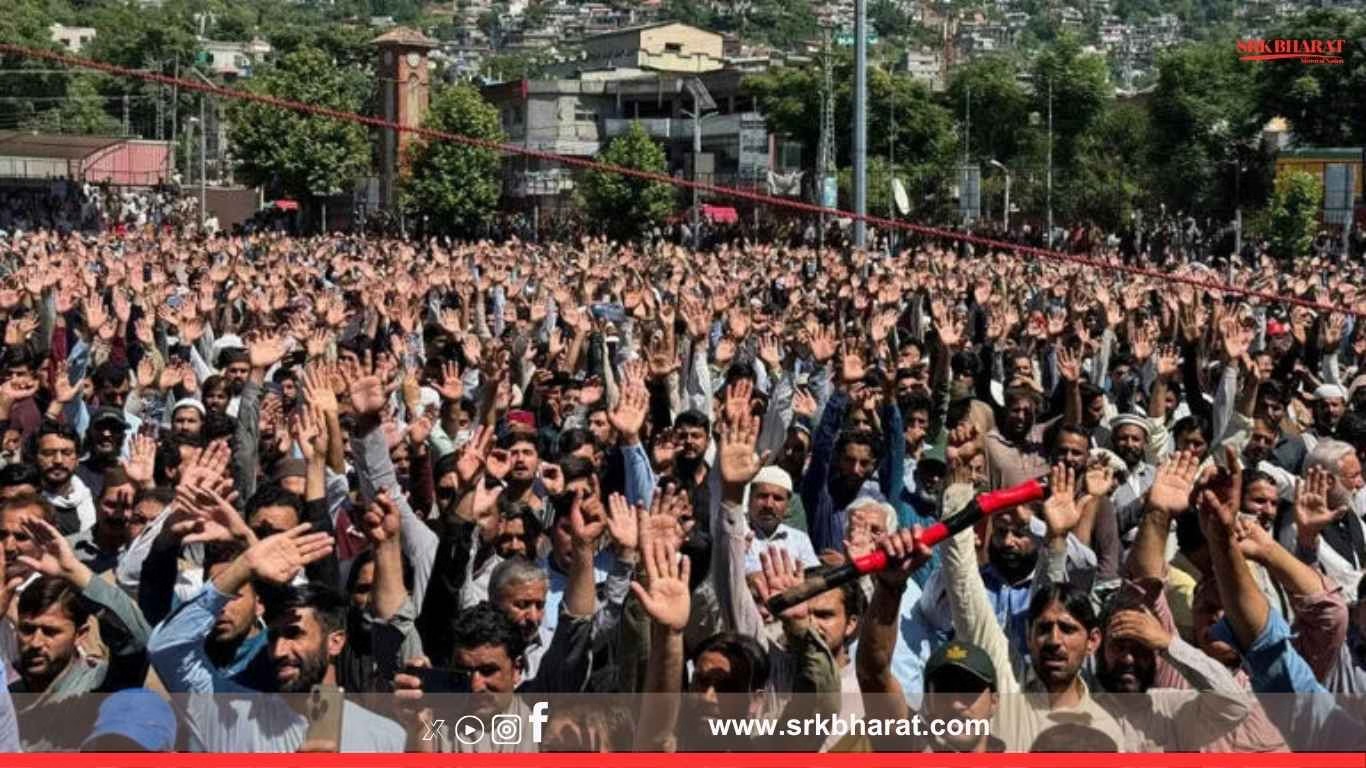
In a dramatic turn of events following days of violent protests and civil unrest in Pakistan-occupied Kashmir (PoK), the Shehbaz Sharif-led government has officially accepted all 38 demands put forth by the Jammu Kashmir Joint Awami Action Committee (JAAC), marking a rare moment of capitulation in the face of grassroots resistance. The agreement, signed on October 4, 2025, comes after a week of intense demonstrations that left at least 12 people dead and over 200 injured, including civilians and police personnel.
The JAAC, a coalition of traders, civil society groups, and local activists, spearheaded the agitation that began on September 29 with a region-wide shutdown. The protests, which escalated into violent clashes, were triggered by long-standing grievances over governance failures, economic exploitation, and human rights violations in PoK. The unrest prompted the Pakistani government to dispatch a high-level delegation to Muzaffarabad for emergency negotiations.
JAAC-Pakistan Agreement – Key Concessions Accepted
| Demand Category | Specific Concessions Made by Pakistan Government |
|---|---|
| Justice for Protest Deaths | Judicial probe into killings, compensation to families |
| Detained Protesters | Immediate release of all arrested demonstrators |
| Governance Reforms | Scrapping of 12 refugee-reserved assembly seats |
| Infrastructure Development | ₹3,000 crore investment package, airport construction |
| Administrative Accountability | Review of police actions, suspension of officers involved |
The breakthrough was achieved after two rounds of closed-door talks between JAAC leaders and Pakistan’s Parliamentary Affairs Minister Tariq Fazal Chaudhry, who later confirmed the accord via social media. “The negotiating delegation has signed the final agreement with the Action Committee. The protesters are returning home, all roads have reopened. This is a victory for peace,” Chaudhry posted.
The unrest had paralyzed life across PoK, with markets shuttered, transport halted, and communication blackouts imposed. The Human Rights Commission of Pakistan (HRCP) condemned the excessive use of force, stating, “We strongly condemn the deaths of civilians and law enforcers alike, as well as communication blackouts. The right to peaceful protest must be upheld and grievances addressed transparently.”
PoK Protest Timeline – From Shutdown to Surrender
| Date | Event Description | Impact on Region |
|---|---|---|
| Sept 29 | JAAC calls for region-wide strike | Complete shutdown in Muzaffarabad, Rawalakot |
| Sept 30–Oct 2 | Violent clashes erupt | 12 dead, 200+ injured, internet blackout |
| Oct 3 | Pakistan sends negotiating team | Talks begin with JAAC leadership |
| Oct 4 | Agreement signed, demands accepted | Roads reopen, protests called off |
The JAAC’s demands ranged from economic justice and infrastructure upgrades to political representation and human rights guarantees. One of the most contentious issues was the allocation of 12 assembly seats to refugees from Jammu and Kashmir, which locals argued diluted their political voice. The government has now agreed to examine the legal feasibility of scrapping these seats.
India reacted strongly to the developments, with the Ministry of External Affairs (MEA) stating that the unrest was a “natural consequence of Pakistan’s oppressive policies and systemic plundering of resources.” MEA spokesperson Randhir Jaiswal said, “Pakistan must be held accountable for its horrific human rights violations. Jammu, Kashmir, and Ladakh have always been and will remain an integral part of India.”
India’s Response to PoK Unrest – MEA Statement Highlights
| Concern Raised | MEA Commentary |
|---|---|
| Human Rights Violations | “Brutalities by Pakistani forces on civilians” |
| Resource Exploitation | “Systemic plundering of PoK’s natural wealth” |
| Territorial Integrity | “PoK is an integral part of India” |
| Global Accountability | “Pakistan must face international scrutiny” |
The JAAC, led by activist Shaukat Nawaz Mir, has emerged as a formidable force in PoK’s civil society, organizing three major mobilizations in the past two years. This latest protest was the largest, with participation from across districts and support from diaspora groups. The committee has vowed to monitor the implementation of the agreement and warned of renewed agitation if promises are not fulfilled.
The Pakistani government’s acceptance of all 38 demands is being seen as a political setback for Islamabad, which has long maintained a tight grip over PoK through military and bureaucratic control. Analysts say the move reflects growing internal pressure and the inability to suppress dissent through force alone.
JAAC’s 38 Demands – Broad Categories and Objectives
| Category | Objective |
|---|---|
| Civil Liberties | Protection of right to protest, end to blackouts |
| Political Representation | Fair assembly seat allocation, local autonomy |
| Economic Justice | Compensation, job creation, fair taxation |
| Infrastructure | Roads, hospitals, schools, airport development |
| Administrative Reform | Police accountability, governance transparency |
Social media platforms have erupted with reactions to the JAAC victory, with hashtags like #PoKUnrest, #JAACVictory, and #PakistanSurrenders trending across Twitter/X, Facebook, and YouTube. Citizens, activists, and political commentators hailed the agreement as a turning point in PoK’s struggle for dignity and rights.
Public Sentiment – Social Media Buzz on JAAC-Pakistan Accord
| Platform | Engagement Level | Sentiment (%) | Top Hashtags |
|---|---|---|---|
| Twitter/X | 1.6M mentions | 90% supportive | #PoKUnrest #JAACVictory #PakistanSurrenders |
| 1.3M interactions | 88% emotional | #JusticeForPoK #CivilRightsMatter | |
| 950K views | 85% inspired | #PoKProtests #GrassrootsPower | |
| YouTube | 870K views | 82% analytical | #PoKExplained #JAACDemands |
The agreement also includes provisions for a high-level committee to monitor implementation, monthly progress reports, and direct engagement between JAAC and federal ministries. The Pakistani government has pledged to begin work on the airport project by January 2026 and release all detained protesters within 72 hours.
International human rights organizations have welcomed the accord but urged Pakistan to ensure transparency and accountability. Amnesty International called for “independent monitoring of the judicial probe and protection of civil society leaders from retaliation.”
In conclusion, Pakistan’s surrender before JAAC and acceptance of all 38 demands marks a watershed moment in the political history of Pakistan-occupied Kashmir. As the region begins to heal from the violence and repression, the agreement offers a glimmer of hope for democratic engagement and civil rights. Whether Islamabad honors its commitments remains to be seen, but for now, the people of PoK have won a hard-fought battle for justice.
Disclaimer: This article is based on publicly available government statements, verified media reports, and official human rights briefings. It does not constitute political endorsement or prediction of outcomes. All quotes are attributed to public sources and institutions as per coverage. Readers are advised to follow official updates from the MEA, HRCP, and JAAC for verified information.