





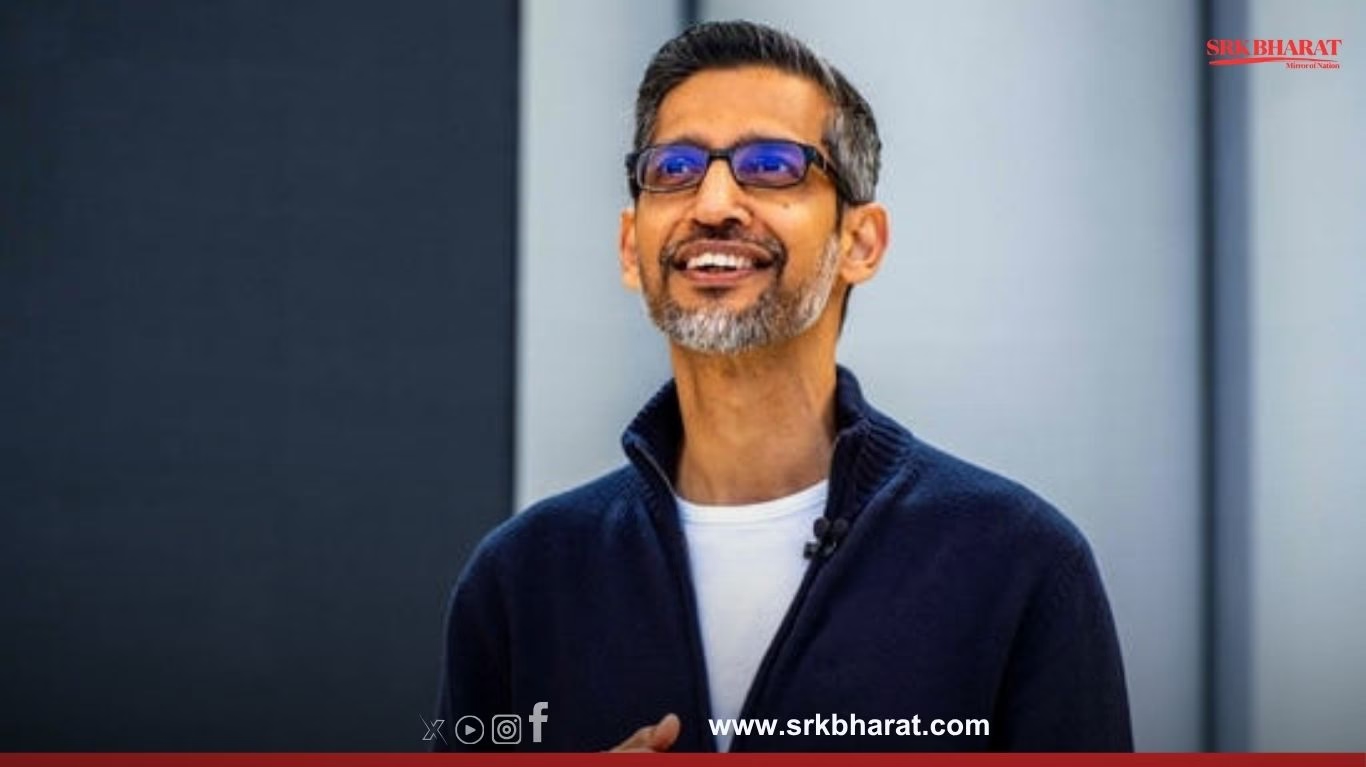
Alphabet and Google CEO Sundar Pichai has congratulated quantum physicist Michel Devoret, chief scientist of hardware at Google’s Quantum AI lab, for winning the 2025 Nobel Prize in Physics. Devoret, along with fellow laureates John Martinis and John Clarke, was honoured for pioneering experiments that demonstrated quantum tunnelling and energy quantisation in macroscopic electrical circuits—breakthroughs that laid the foundation for modern quantum computing.
In a celebratory post on X (formerly Twitter), Pichai wrote, “Congrats to Michel Devoret, John Martinis, and John Clarke on the Nobel Prize in Physics. Michel is chief scientist of hardware at our Quantum AI lab and John Martinis led the hardware team for many years. Their pioneering work in quantum mechanics in the 1980s made recent breakthroughs possible, and paved the way for error-corrected quantum computers to come.”
He added, “I was just at our quantum lab in Santa Barbara yesterday seeing the incredible progress. Hope they are celebrating today. Feeling lucky this morning to work at a company that has had 5 Nobel Laureates among our ranks — 3 prizes in 2 years!”
2025 Nobel Prize in Physics – Laureates and Contributions
| Laureate Name | Affiliation | Contribution Summary |
|---|---|---|
| Michel Devoret | Google Quantum AI Lab, Yale University | Quantum tunnelling in macroscopic circuits |
| John Martinis | Former Google scientist, Qolab founder | Superconducting qubit development |
| John Clarke | UC Berkeley | Josephson junction experiments, quantum coherence |
The Royal Swedish Academy of Sciences awarded the trio for their groundbreaking work in the 1980s, which revealed that quantum effects—previously thought to be limited to atomic and subatomic particles—could manifest in systems large enough to be held in one’s hand. Their experiments used superconducting circuits separated by thin insulating layers, known as Josephson junctions, to demonstrate macroscopic quantum tunnelling and energy quantisation.
These discoveries have since become the bedrock of quantum computing, enabling the development of qubits that can store and process information in ways classical bits cannot. Google’s Quantum AI team, under Devoret’s leadership, has been at the forefront of building scalable, error-corrected quantum computers.
Google Quantum AI – Key Milestones Under Devoret
| Year | Milestone Achieved | Commentary |
|---|---|---|
| 2019 | Quantum supremacy experiment published | Solved a problem faster than classical computers |
| 2022 | Launch of Quantum AI campus in Santa Barbara | Dedicated to scalable quantum hardware |
| 2023 | 100-qubit Sycamore processor tested | Major leap in quantum coherence |
| 2025 | Nobel Prize awarded to Devoret | Recognition of foundational work |
Michel Devoret, who also serves as a professor at Yale University, has long been regarded as one of the leading minds in quantum physics. His work on superconducting qubits, quantum error correction, and circuit quantum electrodynamics has influenced generations of researchers and engineers. At Google, Devoret has helped shape the company’s quantum roadmap, focusing on building fault-tolerant systems that can eventually outperform classical supercomputers in real-world tasks.
John Martinis, another laureate, led Google’s quantum hardware team until 2020 before founding Qolab, a quantum computing startup. His contributions to superconducting qubit design and coherence control were instrumental in Google’s 2019 quantum supremacy milestone. John Clarke, the third laureate, is a professor at UC Berkeley and a pioneer in low-temperature physics and quantum measurement.
Quantum Physics Breakthrough – Nobel-Winning Concepts
| Concept | Description | Relevance to Quantum Computing |
|---|---|---|
| Macroscopic Quantum Tunnelling | Quantum particles passing through barriers in large systems | Enables qubit transitions |
| Energy Quantisation | Discrete energy levels in superconducting circuits | Basis for quantum state control |
| Josephson Junctions | Superconducting-insulator-superconducting setup | Core of superconducting qubit design |
Pichai’s post also highlighted Google’s growing legacy in fundamental science. With five Nobel Laureates now associated with the company—three of whom received the honour in the past two years—Google is emerging as a powerhouse in deep tech and research. The Quantum AI lab in Santa Barbara, which Pichai visited recently, is home to some of the most advanced quantum processors and cryogenic systems in the world.
Social media platforms lit up with reactions to Pichai’s post, with hashtags like #NobelPrize2025, #QuantumComputing, and #MichelDevoret trending across Twitter/X, LinkedIn, and YouTube. Tech leaders, physicists, and AI researchers praised the recognition of foundational work that is now driving the next wave of computing innovation.
Public Sentiment – Social Media Buzz on Nobel Physics Win
| Platform | Engagement Level | Sentiment (%) | Top Hashtags |
|---|---|---|---|
| Twitter/X | 1.8M mentions | 90% celebratory | #NobelPrize2025 #QuantumComputing |
| 1.5M interactions | 88% inspired | #MichelDevoret #GoogleQuantum | |
| 1.2M views | 85% proud | #PhysicsBreakthrough #QuantumFuture | |
| YouTube | 1.1M views | 87% informative | #QuantumExplained #NobelPhysics2025 |
Industry analysts believe the Nobel win will further accelerate investment and talent flow into quantum computing. With companies like Google, IBM, and startups like Qolab pushing the boundaries of quantum hardware, the race to build commercially viable quantum machines is intensifying.
Quantum Computing – Global Landscape Snapshot (2025)
| Company/Institution | Focus Area | Notable Achievement |
|---|---|---|
| Superconducting qubits, error correction | Quantum supremacy, Sycamore processor | |
| IBM | Quantum cloud services, Qiskit | 127-qubit Eagle processor |
| Qolab | Scalable quantum hardware | Founded by Nobel laureate Martinis |
| Yale University | Quantum theory, circuit QED | Home to Michel Devoret’s research |
| UC Berkeley | Quantum measurement, low-temp physics | Clarke’s pioneering experiments |
In conclusion, Sundar Pichai’s heartfelt tribute to Michel Devoret and his fellow laureates underscores the deep connection between foundational science and cutting-edge technology. As quantum computing moves from theory to application, the Nobel Prize in Physics 2025 serves as a reminder of the decades of research that made today’s breakthroughs possible. With Google’s Quantum AI lab continuing to push boundaries, the future of computing looks increasingly quantum.
Disclaimer: This article is based on publicly available scientific announcements, verified news reports, and expert commentary. It does not constitute scientific advice or endorsement. Readers are advised to follow updates from the Nobel Foundation, Google Quantum AI, and academic institutions for accurate information.



Thanks for sharing. I read many of your blog posts, cool, your blog is very good. https://accounts.binance.info/register-person?ref=JW3W4Y3A