



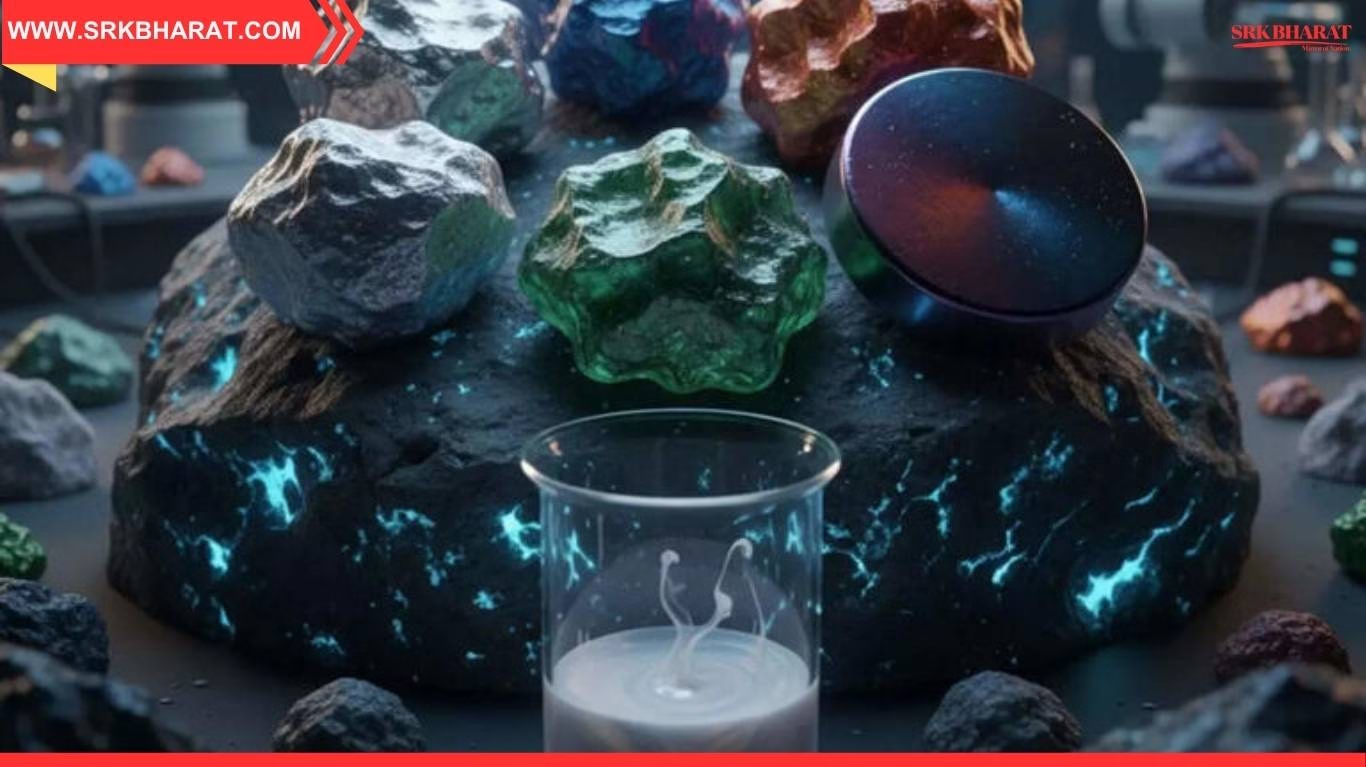
China has tightened its grip on the global rare earth market with sweeping new export restrictions, triggering alarm across industries dependent on these critical minerals. The move, announced by the Chinese Ministry of Commerce on October 9, 2025, mandates stricter licensing for exports of rare earth elements, magnets, processing technologies, and even recycled materials. The rules specifically target sectors like defence, aerospace, semiconductors, and green energy, where rare earths are indispensable.
The world now stares at an uncertain future as China, which controls over 60% of global rare earth production and nearly 90% of processing capacity, signals a strategic pivot. India, despite its geological potential, finds itself underprepared, lacking both infrastructure and policy clarity to respond swiftly.
🧠 What China’s New Rare Earth Rules Mean
| Regulation Area | New Requirement |
|---|---|
| Export Licensing | Mandatory for all rare earth shipments |
| End-Use Verification | Must be for civilian or approved industrial use |
| Technology Transfer | Restricted for mining and processing tech |
| Overseas Ventures | Requires prior approval from Beijing |
| Military Applications | Explicitly banned |
These rules are designed to prevent rare earths from being diverted to military use and to tighten China’s control over global supply chains. The timing—ahead of a scheduled Trump-Xi summit—adds geopolitical weight to the announcement.
📊 Global Rare Earth Dependency Snapshot
| Country/Region | Rare Earth Dependency | Strategic Response |
|---|---|---|
| United States | 80% import from China | Stockpiling, recycling push |
| European Union | 98% import from China | Green Deal minerals strategy |
| Japan | 60% import from China | Diversification via Vietnam |
| India | 70% import from China | Policy lag, exploration gaps |
India’s reliance on Chinese rare earths is particularly concerning given its ambitions in EV manufacturing, solar energy, and defence electronics. The new rules could delay projects and inflate costs.
🧾 India’s Rare Earth Landscape: Challenges and Gaps
| Challenge Area | Current Status |
|---|---|
| Mining Infrastructure | Limited to monazite sands in Kerala |
| Processing Capability | No commercial-scale separation plants |
| Policy Framework | Fragmented between ministries |
| Private Sector Role | Minimal participation |
| Strategic Stockpile | Non-existent |
India’s rare earth reserves are estimated to be significant, especially in Andhra Pradesh, Jharkhand, and Tamil Nadu, but remain largely untapped due to regulatory hurdles and lack of investment.
🧭 What India Must Do Now
- Establish a National Rare Earth Mission: Similar to the Semiconductor Mission, with inter-ministerial coordination.
- Fast-track Exploration and Licensing: Simplify approvals for private and public sector mining.
- Build Processing Plants: Invest in separation and refining technologies with global partners.
- Create Strategic Stockpiles: For defence, energy, and electronics sectors.
- Sign Bilateral Agreements: With countries like Australia, Vietnam, and Brazil for supply diversification.
India’s Department of Atomic Energy and Ministry of Mines must align their mandates to avoid duplication and delays.
🗣️ Industry and Strategic Reactions
- NITI Aayog Advisor: “India must treat rare earths as a strategic asset, not just a commodity.”
- Defence Analyst: “Our missile and radar systems depend on rare earth magnets. This is a wake-up call.”
- EV Manufacturer: “Battery costs will rise if supply tightens. We need domestic sourcing.”
The Indian government is reportedly reviewing its Critical Minerals Policy, but no formal announcement has been made yet.
Disclaimer
This news content is based on verified government announcements, industry data, and expert commentary as of October 11, 2025. It is intended for editorial use and public awareness. The information does not constitute investment advice, diplomatic analysis, or policy endorsement and adheres to ethical journalism standards.