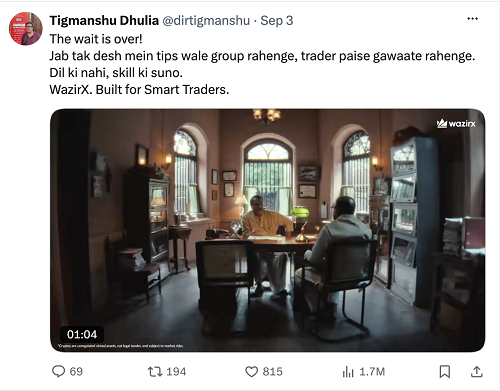

WazirX has turned to the world of director Anurag Kashyap’s iconic two-part film, Gangs of Wasseypur for its latest campaign. It has brought back Tigmanshu Dhulia as the formidable Ramadhir Singh – this time recast as ‘Bauji’, a figure of hard-earned trading wisdom. The 79-second film uses the visual language and father-son dynamic associated with the cult movie to address a distinctly contemporary problem – Indian crypto traders acting on unverified recommendations circulated through online tip groups. His message is: the person taking the trade bears the risk and must therefore do the thinking.
 |
Snapshot of the campaign
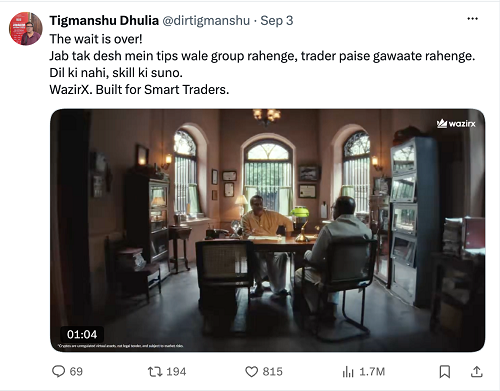
Set inside spaces reminiscent of the film’s Wasseypur universe, the ad follows Bauji’s interaction with his seemingly inept son, who appears convinced that the people sharing tips online must know how to make money. Bauji promptly dismantles that assumption, pointing out that tip providers can earn regardless of whether the trader makes a profit or suffers a loss. The campaign uses humour to highlight a familiar pattern across online trading communities, where confident calls, promised returns and urgent buy-or-sell recommendations can encourage users to enter highly leveraged positions without adequately understanding the market.
The video posted originally by Tigmanshu Dhulia has garnered over 1.6M views. The build up began with Dhulia posting about the return of his iconic character, and Anurag Kashyap chiming in about the ‘return of Ramadhir Singh’ before official announcements had begun. Speculations were rife on X with many users hoping for and anticipating a reboot of the movie or the characters in some form. The video also brings back the famous ‘Tumse na ho payega’ dialogue challenging the viewer – Kya tum se ho payega?, to rise above the temptation of trying to make a quick buck by succumbing to tips.
How the internet reacted: The ad reveal itself has garnered overwhelmingly positive response from netizens who have applauded the creativity of weaving the father-son verbal discourse into lessons about common mistakes made by crypto traders.
WazirX has chosen an instantly recognisable piece of Indian popular culture to share the message. Ramadhir Singh’s impatience with his son becomes a metaphor for the frustration of watching traders repeatedly outsource their judgment to faceless tip groups.
“In fast-moving markets, especially futures, blindly following anonymous tips can be disastrous. Through this campaign, we wanted to communicate a serious message in a culturally familiar and entertaining way: traders must build their own understanding before taking a position. With transparent pricing, intuitive trading tools, and WazirX AI supporting market research, our goal is to equip users to make more informed decisions,” said WazirX founder, Nischal Shetty.
By pairing a cult Bollywood character with India’s growing interest in crypto futures, the campaign seeks to make a risk-awareness message entertaining without diluting its seriousness. The creative also taps into the meme-like afterlife of Gangs of Wasseypur, whose characters and dialogues continue to remain part of online conversations more than a decade after the film’s release.
WazirX Futures was launched this May, with a maker fee of 0.02% and a taker fee of 0.04%. Among Indian crypto exchanges, this is the lowest fee, with no volume threshold required to access it. WazirX has also made available WazirX AI, an intelligent trading assistant designed to help users research crypto markets, understand their portfolios and act on trading opportunities in real time without moving between charts, news feeds, signal groups and trading screens. These create a favourable environment for crypto trading in the Indian market, making it easier for traders to do their own research instead of relying on unverified sources.
About WazirX
WazirX is a leading Indian cryptocurrency exchange established in 2018, offering INR-based access to crypto through spot and perpetual futures markets. Users can buy and sell crypto in spot markets and trade INR-settled perpetual futures with features such as leverage, stop-loss and take-profit orders. WazirX has partnered with BitGo and integrated Fireblocks’ technology to strengthen digital asset security. WazirX supports INR deposits and withdrawals through verified bank accounts and is available on web, Android and iOS. The platform is registered as a Reporting Entity with the Financial Intelligence Unit, India (FIU-IND) and follows KYC and AML processes.
For more information about WazirX, please visit: wazirx.com