

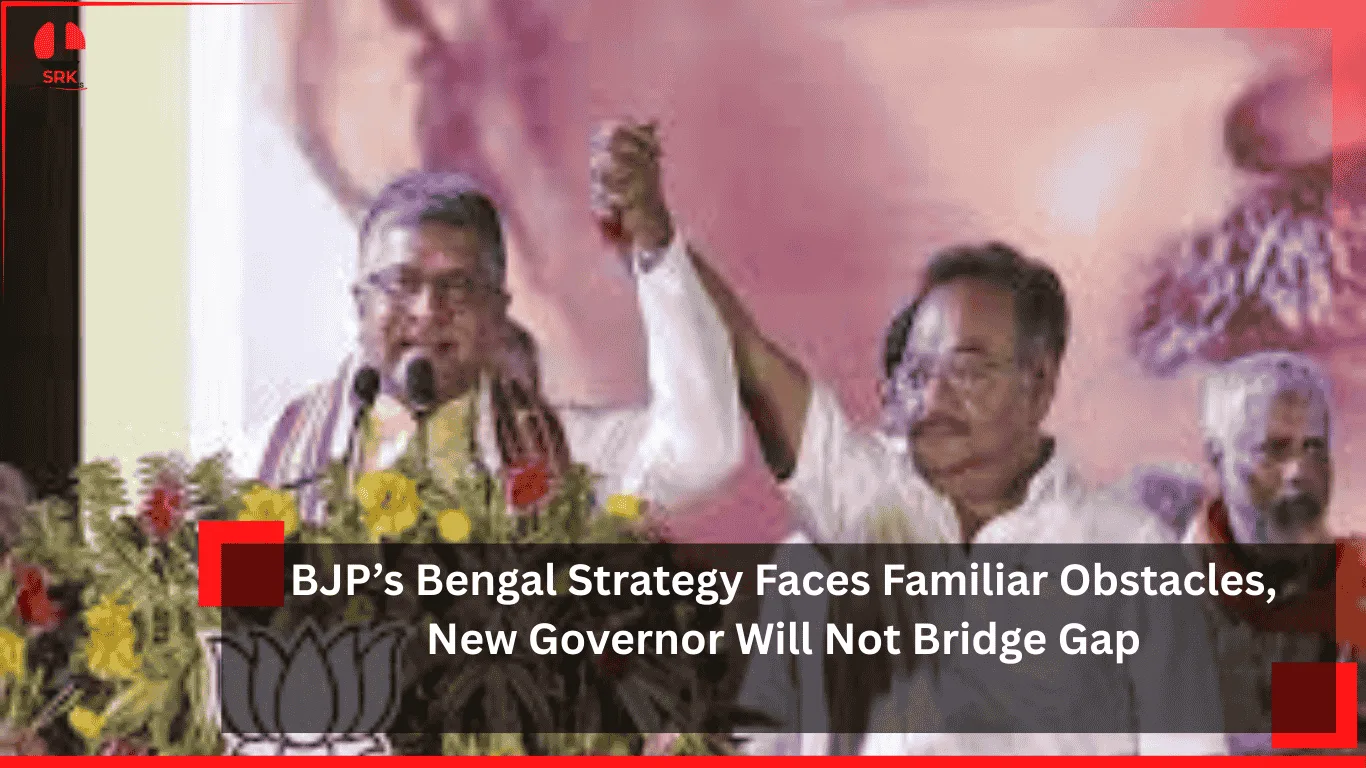
The Bharatiya Janata Party (BJP) continues to face challenges in West Bengal despite recent political developments, including the appointment of a new governor. While the party has made significant inroads in the state over the past decade, its strategy still encounters familiar obstacles: entrenched grassroots networks of the Trinamool Congress (TMC), cultural resistance to BJP’s ideological messaging, and organizational gaps in rural areas. Analysts argue that the new governor’s presence will not fundamentally alter these dynamics.
🌍 Background of BJP’s Bengal Strategy
BJP’s rise in Bengal has been one of the most closely watched political stories in India. From being a marginal player, the party surged to prominence in the 2019 Lok Sabha elections, winning 18 seats. However, the 2021 Assembly elections revealed the limits of its expansion, as TMC retained power with a sweeping majority.
The appointment of a new governor was seen by some as an opportunity to reset the BJP’s approach, but experts caution that constitutional roles are limited, and governance issues cannot substitute for grassroots mobilization.
🏛️ Key Obstacles Facing BJP
- TMC’s Grassroots Strength: The ruling party maintains a strong cadre base, particularly in rural Bengal, where local networks dominate.
- Cultural Resistance: Bengal’s political culture has historically leaned toward regional identity and secular narratives, making BJP’s Hindutva messaging less effective.
- Organizational Challenges: Despite gains, BJP struggles with internal factionalism and limited penetration in villages.
- Governor’s Role: The governor’s constitutional position does not directly influence electoral outcomes, limiting expectations of bridging political divides.
📊 Comparative Analysis of BJP’s Performance in Bengal
| Election Year | BJP Seats Won | TMC Seats Won | Key Takeaway |
|---|---|---|---|
| 2016 Assembly | 3 | 211 | BJP marginal presence |
| 2019 Lok Sabha | 18 | 22 | BJP emerges as major challenger |
| 2021 Assembly | 77 | 213 | TMC dominance continues |
| 2024 Lok Sabha | Moderate gains | Strong TMC presence | BJP struggles to convert momentum |
📈 Pivot Analysis: Governor’s Appointment vs Ground Reality
| Factor | Governor’s Appointment | Ground Reality |
|---|---|---|
| Symbolic Value | High | Limited |
| Electoral Impact | Minimal | Determined by grassroots |
| Administrative Influence | Moderate | Often contested |
| Long-Term Strategy | Weak | Requires cadre building |
This analysis shows that while symbolic appointments may energize party workers, they do not substitute for sustained organizational work at the grassroots level.
🔎 Broader Implications
- Political Polarization: The BJP-TMC rivalry continues to deepen, with little sign of reconciliation.
- Electoral Strategy: BJP must focus on building local leadership and addressing regional issues rather than relying on central narratives.
- Governor’s Limitations: The constitutional role of the governor cannot bridge political divides, making grassroots engagement essential.
🗣️ Expert Opinions
- Political Analysts: Stress that BJP’s Bengal strategy requires long-term investment in local leadership rather than symbolic gestures.
- Sociologists: Highlight cultural resistance to BJP’s ideological messaging as a key barrier.
- Economists: Note that economic issues, including unemployment and rural distress, remain central to Bengal’s political discourse.
🌐 Impact on BJP’s National Strategy
West Bengal remains a crucial state for BJP’s national ambitions. Success in Bengal would symbolize penetration into regions historically resistant to its ideology. However, repeated obstacles suggest that the party must recalibrate its approach, focusing on regional narratives and grassroots mobilization rather than relying on constitutional appointments.
📝 Conclusion
BJP’s Bengal strategy continues to face familiar obstacles, and the appointment of a new governor will not bridge the political gap. The party’s challenge lies in overcoming TMC’s entrenched grassroots networks, addressing cultural resistance, and building sustainable local leadership. Without these efforts, symbolic gestures will remain insufficient in altering Bengal’s political landscape.
Disclaimer
This article is an analytical piece based on public commentary and political perspectives. It does not represent endorsement of any political party or leader. The content is intended for informational and educational purposes only, highlighting the complexities of electoral strategy and governance in West Bengal. Readers are encouraged to consult multiple viewpoints for a comprehensive understanding.