





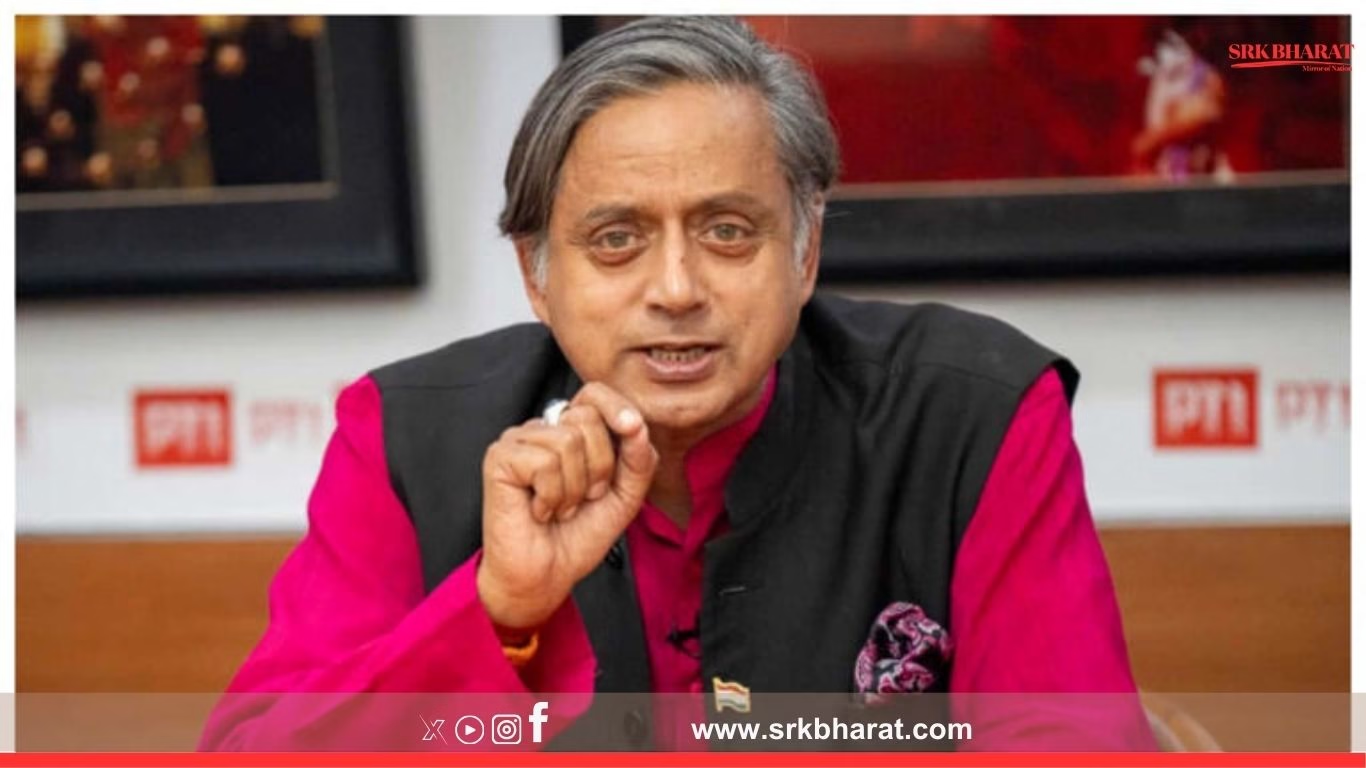
Congress MP Shashi Tharoor has stirred debate within his own party and across Parliament by expressing support for the controversial bills introduced by Union Home Minister Amit Shah that propose the removal of sitting Prime Ministers, Chief Ministers, and Union Ministers if they are arrested and held in custody for 30 consecutive days on serious criminal charges. While most opposition leaders have condemned the bills as “draconian” and “anti-democratic,” Tharoor said the proposal “seems reasonable” and that it’s “difficult to find a problem” with the intent behind the legislation.
His remarks came during the monsoon session of Parliament on August 20, 2025, just hours after the Constitution (130th Amendment) Bill, the Jammu & Kashmir Reorganisation (Amendment) Bill, and the Government of Union Territories (Amendment) Bill were tabled and referred to a Joint Parliamentary Committee.
🧠 Tharoor’s Stand: A Rare Dissent Within Congress
Tharoor, known for his independent views and nuanced positions, told ANI:
“On the face of it, it’s difficult to find a problem. Obviously, if someone has done something wrong, they should not remain a minister. I haven’t studied the bill carefully enough, but it seems reasonable.”
He added that more detailed scrutiny should ideally be carried out by a standing committee, but reiterated that the principle of removing ministers held on serious criminal charges aligns with common sense.
| Shashi Tharoor’s Key Statements | Interpretation |
|---|---|
| “Difficult to find a problem” | Supports the bill’s intent |
| “Seems reasonable” | Endorses principle of accountability |
| “Should not remain a minister if arrested” | Advocates ethical standards in public office |
| “Needs detailed scrutiny” | Calls for procedural review |
Tharoor’s stance contrasts sharply with other Congress leaders, including Priyanka Gandhi Vadra, who called the bills “draconian” and warned of misuse against opposition leaders.
📜 What the Bills Propose
The three bills introduced by Amit Shah aim to disqualify elected officials from holding office if they are arrested for 30 consecutive days on charges that carry a minimum sentence of five years. The bills do not require a conviction, raising concerns about due process and political misuse.
| Bill Name | Key Provision | Applies To |
|---|---|---|
| Constitution (130th Amendment) Bill | Removal of PM, CMs, and Ministers after 30-day arrest | All constitutional office holders |
| J&K Reorganisation (Amendment) Bill | Similar clause for J&K leadership | CM and Ministers of J&K |
| Govt of Union Territories (Amendment) Bill | Applies to UTs including Delhi | CM and Ministers of UTs |
The bills have been referred to a Joint Committee comprising 31 members from both Houses, with a report expected before the Winter Session.
🔍 Opposition Reactions: Unified Resistance
While Tharoor backed the bills in principle, most opposition leaders have condemned them. Congress MPs tore copies of the bills in Parliament, accusing the government of attempting to weaponize law enforcement agencies to target political rivals.
| Leader | Party | Statement Summary |
|---|---|---|
| Priyanka Gandhi Vadra | Congress | “Completely draconian and unconstitutional” |
| Mamata Banerjee | TMC | “More than a super-Emergency” |
| Asaduddin Owaisi | AIMIM | “Violates separation of powers” |
| Abhishek Manu Singhvi | Congress | “No ruling party CM will ever be touched” |
| Manish Tewari | Congress | “Politically motivated legislation” |
The bills have also reignited debate over the arrest of former Delhi CM Arvind Kejriwal, who was jailed for over five months without trial in connection with the excise policy case.
📊 Comparative View: Tharoor vs Congress
| Issue | Shashi Tharoor’s View | Congress Party’s View |
|---|---|---|
| Removal of arrested ministers | Reasonable, common sense | Draconian, unconstitutional |
| Need for scrutiny | Should go to standing committee | Should be withdrawn entirely |
| Risk of misuse | Not explicitly addressed | High risk of political targeting |
| Public accountability | Supports ethical standards | Supports due process and fairness |
Tharoor’s divergence from the party line is not unprecedented. He previously supported Operation Sindoor and praised the government’s foreign policy initiatives, often drawing criticism from party colleagues.
🧠 Legal and Constitutional Concerns
Legal experts remain divided on the bills. While some argue that the legislation promotes accountability, others warn that it undermines the presumption of innocence and violates Articles 14 and 21 of the Constitution.
| Legal Principle | Potential Violation |
|---|---|
| Presumption of Innocence | Removal without conviction undermines this |
| Separation of Powers | Parliament overriding judicial process |
| Federalism | Central authority interfering in state matters |
| Due Process | Arbitrary removal without trial |
Senior advocates have indicated that the bills, if passed, could be challenged in the Supreme Court for violating the basic structure doctrine.
🧠 Public Sentiment and Media Coverage
Tharoor’s remarks have sparked mixed reactions online. While some praised his independent thinking, others criticized him for not aligning with the party’s stance. Social media platforms saw a surge in commentary, with hashtags like #TharoorOnBills and #DemocracyDebate trending.
| Platform | Trending Hashtags | Sentiment Analysis |
|---|---|---|
| Twitter (X) | #TharoorOnBills, #PMRemovalBill | Mixed: thoughtful and critical |
| Reels and quotes from session | Mostly supportive | |
| YouTube Shorts | Panel discussions, reactions | High engagement |
Political analysts believe Tharoor’s comments may influence centrist voters and intellectual circles, but could also deepen rifts within the Congress party.
📌 Conclusion
Shashi Tharoor’s endorsement of the PM and CM removal bills—despite opposition uproar—adds a complex layer to the ongoing debate on accountability and democratic norms. His assertion that it’s “difficult to find a problem” with the bills reflects a principled stance on ethical governance, but also raises questions about procedural fairness and political misuse.
As the bills undergo scrutiny by a Joint Parliamentary Committee, the divide between intent and implementation remains at the heart of the controversy. Whether Tharoor’s view gains traction or remains a solitary voice within the Congress will shape the discourse in the weeks ahead.
—
Disclaimer: This article is based on publicly available parliamentary proceedings, political statements, and media reports as of August 21, 2025. It is intended for informational purposes only and does not constitute legal or political advice.

блог seo агентства statyi-o-marketinge7.ru .