




In a landmark decision that could reshape India’s indirect tax regime, the Group of Ministers (GoM) on Goods and Services Tax (GST) has approved the Centre’s proposal to eliminate the 12% and 28% tax slabs. The move, aimed at simplifying the GST structure and making it more transparent and growth-oriented, will introduce a streamlined two-tier system comprising 5% and 18% rates, along with a special 40% slab for ultra-luxury and sin goods.
The GoM, chaired by Bihar Deputy Chief Minister Samrat Choudhary, reached consensus after reviewing proposals submitted by the Finance Ministry. The panel included finance ministers and senior officials from Uttar Pradesh, Rajasthan, West Bengal, Karnataka, and Kerala. The decision marks the first major step toward implementing the “next-generation GST” reforms announced by Prime Minister Narendra Modi in his Independence Day 2025 address.
🧭 Why the GST Restructuring Was Needed
The current GST framework consists of four primary slabs—5%, 12%, 18%, and 28%—along with zero-rated and exempt categories. Over time, this multi-tiered system has led to confusion, classification disputes, and compliance challenges for businesses, especially MSMEs.
| Existing GST Slabs | Issues Identified |
|---|---|
| 5% | Essential goods, low revenue yield |
| 12% | Overlapping with 18%, classification issues |
| 18% | Standard goods, widely used |
| 28% | Luxury and sin goods, high compliance cost |
The new structure aims to simplify tax rates, reduce litigation, and make the system more user-friendly for consumers and businesses alike.
📊 Proposed GST Structure: What Changes
Under the new framework, the 12% and 28% slabs will be scrapped. Most goods currently taxed at 12% will move to the 5% slab, while nearly 90% of items in the 28% category will shift to 18%. A special 40% rate will be levied on ultra-luxury and harmful products such as tobacco, pan masala, and luxury cars.
| New GST Slab | Applicable Goods and Services | Impact on Prices |
|---|---|---|
| 0% or 5% | Food items, medicines, footwear, clothing | Prices likely to drop |
| 18% | Consumer durables, electronics, services | Moderate price reduction |
| 40% | Tobacco, pan masala, luxury cars | No change or slight increase |
The restructuring is expected to make 90% of goods cheaper, benefiting middle-class households and small businesses.
🧠 Finance Minister’s Statement
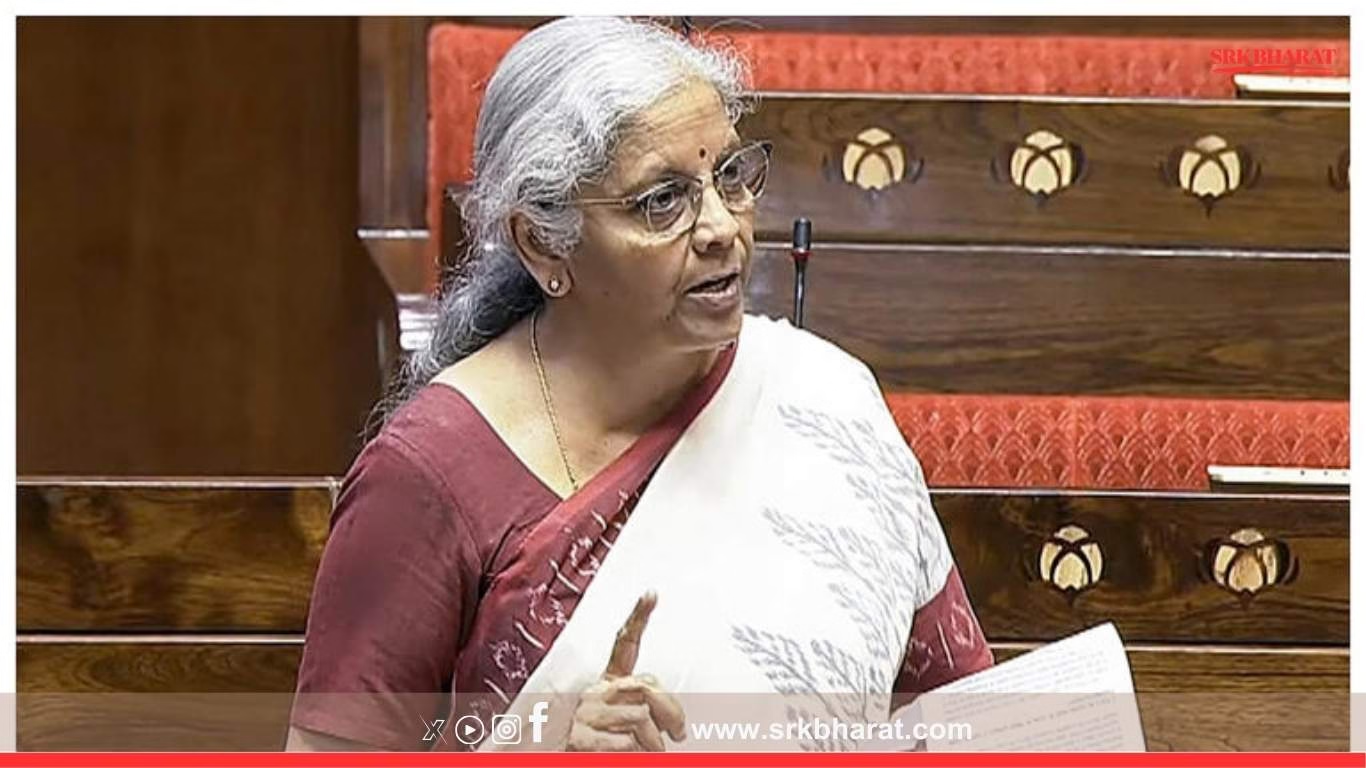
Finance Minister Nirmala Sitharaman welcomed the GoM’s decision, stating that the rate rationalisation will “provide greater relief to the common man, farmers, the middle class, and MSMEs.” She added that the simplified structure will enhance transparency, reduce compliance burden, and promote economic growth.
The Finance Ministry also projected that the new GST regime will improve tax buoyancy and reduce revenue leakages, especially in high-value segments.
🔍 Impact on Key Sectors
The GST overhaul is expected to have a transformative impact across multiple sectors. Here’s how some industries will be affected:
| Sector | Current GST Rate | New GST Rate | Expected Outcome |
|---|---|---|---|
| Pharmaceuticals | 12% | 5% | Lower medicine costs |
| Processed Food | 12% | 5% | Affordable packaged goods |
| Electronics | 28% | 18% | Cheaper TVs, refrigerators, ACs |
| Automobiles | 28% + cess | 18% or 40% | Mid-range cars cheaper, luxury unchanged |
| Insurance Premiums | 18% | Proposed exemption | Potential savings for policyholders |
The GoM also discussed exempting health and life insurance premiums from GST, a move that could cost the exchequer ₹9,700 crore annually but offer significant relief to individuals.
🧠 State-Level Concerns and Compensation Demands
While most states supported the rate rationalisation, some expressed concerns about potential revenue losses. West Bengal Finance Minister Chandrima Bhattacharya urged the Centre to provide compensation guarantees to states whose revenues may dip post-reform.
| State Concern | Proposed Safeguard |
|---|---|
| Revenue Loss | Compensation mechanism for 3 years |
| Tax Incidence | Additional levy on ultra-luxury goods |
| Compliance Burden | Simplified filing and audit procedures |
The GST Council is expected to deliberate on these safeguards in its upcoming meeting before final approval and rollout.
📉 Business and Consumer Sentiment
Industry bodies and consumer advocacy groups have largely welcomed the proposed changes. The Confederation of Indian Industry (CII) and Federation of Indian Chambers of Commerce & Industry (FICCI) hailed the move as “long overdue,” citing reduced complexity and improved ease of doing business.
| Stakeholder Group | Reaction Summary |
|---|---|
| MSMEs | Positive, expect lower compliance costs |
| Retailers | Anticipate price drops, higher demand |
| Tax Consultants | Support simplification, seek clarity |
| Consumers | Hope for reduced prices and transparency |
The new structure is also expected to reduce classification disputes and litigation, which have plagued the GST regime since its inception in 2017.
🧠 Expert Commentary
Tax experts believe the two-slab structure will bring India closer to global best practices. Dr. Radhika Menon, a senior economist, said:
“This is a bold and necessary reform. A simplified GST structure will improve compliance, reduce tax evasion, and enhance consumer trust.”
Chartered accountant Rakesh Sharma added:
“The 40% slab for sin goods is a smart move. It maintains revenue neutrality while discouraging harmful consumption.”
These insights reflect broad consensus on the need for reform, even as implementation challenges remain.
📌 Conclusion
The GoM’s approval to scrap the 12% and 28% GST slabs marks a watershed moment in India’s tax reform journey. By moving toward a simplified two-tier structure, the government aims to make GST more transparent, equitable, and growth-friendly.
As the proposal heads to the GST Council for final ratification, stakeholders across the spectrum are gearing up for a new era of tax administration—one that promises relief for consumers, clarity for businesses, and efficiency for the exchequer.
—
Disclaimer: This article is based on publicly available government statements and media reports as of August 21, 2025. It is intended for informational purposes only and does not constitute financial or legal advice.