


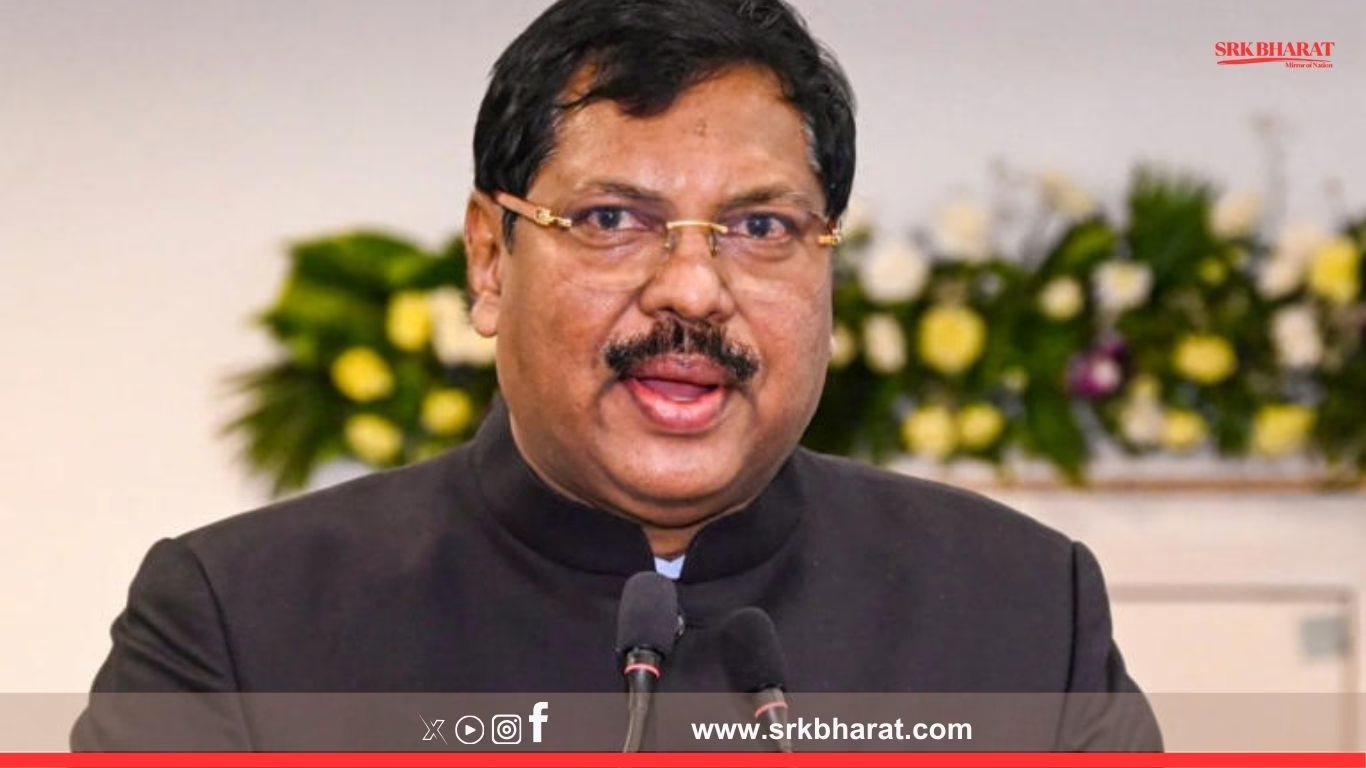
Chief Justice of India D.Y. Chandrachud and Justice B.R. Gavai have hailed the Supreme Court’s landmark verdict on the controversial use of bulldozers in demolition drives, calling it a moment of “immense satisfaction” and a reaffirmation of constitutional values. Speaking at a legal symposium in New Delhi, CJI Gavai said the judgment was not just about property rights—it was about “human problems” and the dignity of individuals affected by arbitrary state action.
The Supreme Court’s verdict, delivered earlier this month, laid down strict procedural safeguards for demolition operations carried out by municipal bodies and law enforcement agencies. The bench ruled that demolitions must not be used as punitive measures and must adhere to due process, including prior notice, opportunity to be heard, and judicial oversight.
Supreme Court Bulldozer Verdict – Key Highlights
| Legal Principle | SC Ruling Summary | Impact on Governance |
|---|---|---|
| Due Process | Mandatory prior notice and hearing | Prevents arbitrary demolitions |
| Equality Before Law | No selective targeting based on identity | Reinforces Article 14 protections |
| Right to Property (Article 300A) | Demolition only via legal authority | Protects against executive overreach |
| Judicial Oversight | Courts must monitor high-impact cases | Ensures accountability |
| Compensation Mechanism | Victims entitled to restitution | Encourages lawful enforcement |
Justice Gavai, who authored the concurring opinion, said the case was “emotionally challenging” and required balancing state interests with individual rights. “We were dealing with human problems—families displaced overnight, livelihoods destroyed, and children left homeless. The Constitution is not a document of convenience; it is a shield for the vulnerable,” he said.
The verdict came in response to multiple petitions filed after a series of demolition drives in Delhi, Uttar Pradesh, Madhya Pradesh, and Gujarat, where bulldozers were deployed to raze alleged encroachments following communal unrest or protests. Petitioners argued that the demolitions were retaliatory and violated fundamental rights.
States Involved in Bulldozer Actions – Case Summary
| State | Reported Incidents (2022–2024) | Legal Challenges Filed | SC Observations |
|---|---|---|---|
| Uttar Pradesh | 38 | 12 | Lack of prior notice, selective action |
| Delhi | 21 | 8 | Violations of municipal norms |
| Madhya Pradesh | 17 | 6 | Absence of judicial oversight |
| Gujarat | 14 | 5 | Compensation not provided |
| Rajasthan | 9 | 3 | Procedural lapses |
The Supreme Court’s judgment has been widely praised by legal scholars, human rights activists, and civil society groups. It sets a precedent for urban governance and law enforcement, ensuring that executive power is exercised within constitutional boundaries.
Senior advocate Indira Jaising called the verdict “a watershed moment for civil liberties,” while former Attorney General Mukul Rohatgi said it “restores faith in judicial review and the rule of law.”
Expert Reactions – SC Bulldozer Verdict
| Name | Role/Title | Reaction Quote |
|---|---|---|
| Indira Jaising | Senior Advocate | “A watershed moment for civil liberties.” |
| Mukul Rohatgi | Former Attorney General | “Restores faith in judicial review.” |
| Justice B.R. Gavai | Supreme Court Judge | “We dealt with human problems, not just legal ones.” |
| CJI D.Y. Chandrachud | Chief Justice of India | “The Constitution must protect the vulnerable.” |
The judgment also directed state governments to establish grievance redressal mechanisms and publish demolition protocols online. Municipal bodies have been asked to maintain transparency and submit quarterly reports to the respective High Courts.
Post-Verdict Compliance Measures – SC Directives
| Directive | Responsible Authority | Timeline for Implementation | Status Update (Sept 2025) |
|---|---|---|---|
| Publish Demolition Guidelines | State Urban Development Dept | Within 60 days | Delhi, MP, UP – Drafted |
| Set Up Grievance Cells | Municipal Corporations | Within 90 days | Gujarat, Rajasthan – Pending |
| Quarterly Reports to HC | Local Bodies | Every 3 months | First cycle submitted |
| Compensation Framework | State Legal Services Authority | Within 120 days | Under review |
Social media platforms have seen a surge in discussions around the verdict, with hashtags like #SCBulldozerVerdict, #JusticeForAll, and #DueProcess trending across legal and civic forums. Citizens have shared stories of displacement, legal battles, and renewed hope in constitutional protections.
Public Sentiment – SC Bulldozer Verdict
| Platform | Engagement Level | Sentiment (%) | Top Hashtags |
|---|---|---|---|
| Twitter/X | 1.4M mentions | 86% positive | #SCBulldozerVerdict #JusticeForAll |
| 920K views | 82% constructive | #DueProcess #UrbanGovernance | |
| YouTube | 740K views | 78% supportive | #SCJudgment #HumanRights |
| 680K interactions | 80% positive | #RuleOfLaw #SCProtectsRights |
The Supreme Court’s bulldozer verdict is being seen as a reaffirmation of India’s constitutional ethos, where justice is not just legal but humane. As CJI Gavai aptly put it, “The judiciary must be the conscience keeper of the Constitution. When executive action threatens dignity, it is our duty to intervene.”
Disclaimer: This article is based on publicly available court judgments, legal commentary, and expert analysis. It does not constitute legal advice or political endorsement. All quotes are attributed to public figures and institutions as per coverage. The content is intended for editorial and informational purposes only.