


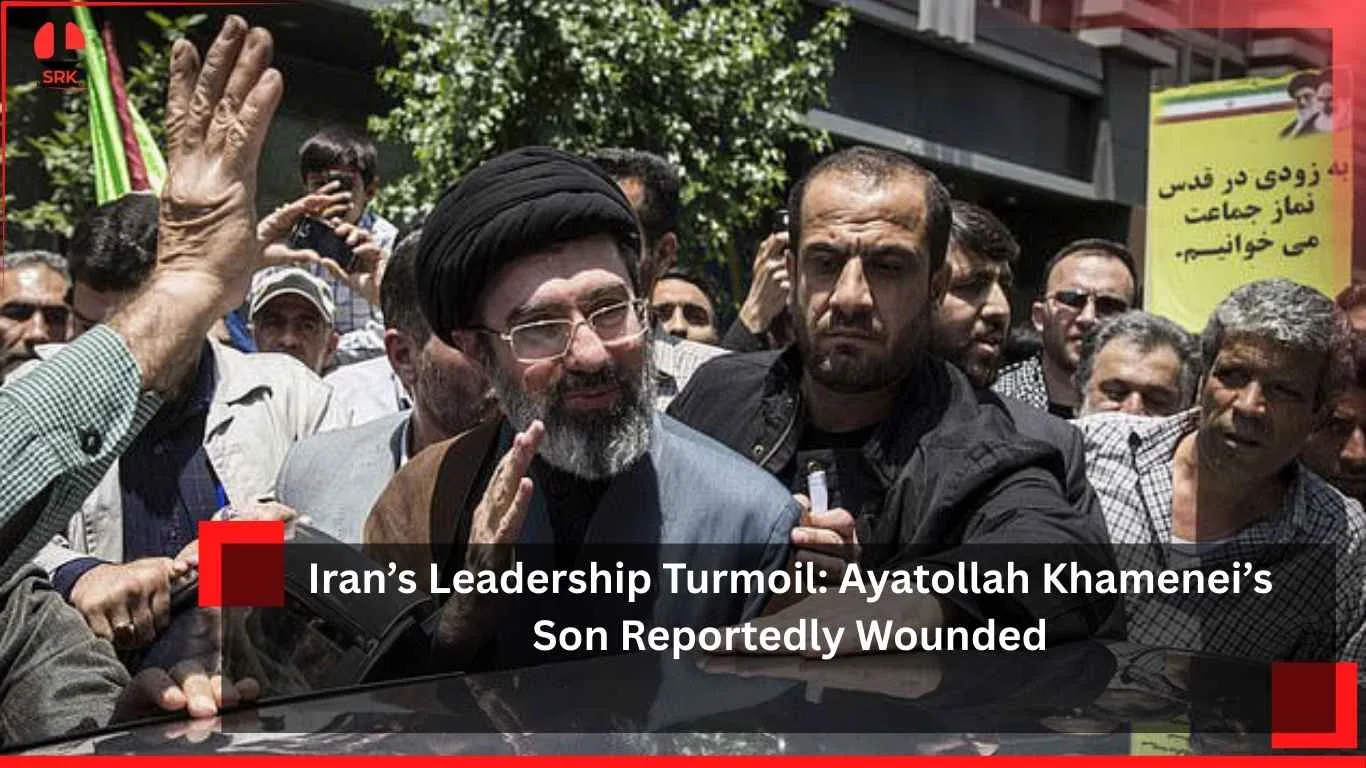
Iran is facing a new wave of uncertainty after reports surfaced that the son of Supreme Leader Ayatollah Ali Khamenei has sustained a mysterious injury. This development has sparked speculation about succession, internal power struggles, and the future of Iran’s political landscape. The incident comes at a time when the country is already grappling with economic challenges, regional tensions, and questions about leadership continuity.
Background: The Role of Khamenei’s Son
Mojtaba Khamenei, the influential son of Ayatollah Ali Khamenei, has long been considered a potential successor to his father. Though he has never held an official government position, Mojtaba is believed to wield significant influence behind the scenes, particularly within the Revolutionary Guard and clerical networks.
Reports of his injury—described as sudden and unexplained—have raised questions about whether it was accidental, deliberate, or linked to internal rivalries. The secrecy surrounding the incident has fueled speculation both inside Iran and internationally.
Political Implications
The reported injury of Mojtaba Khamenei could have far-reaching consequences for Iran’s leadership structure.
Key Implications:
- Succession Uncertainty: Ayatollah Ali Khamenei is in his late 80s, and succession planning has been a sensitive issue. Mojtaba’s injury could weaken his chances of becoming Supreme Leader.
- Factional Rivalries: Different clerical and military factions may use this moment to push alternative candidates.
- Regional Impact: Any instability in Iran’s leadership could affect its foreign policy, particularly in relation to Israel, Saudi Arabia, and the United States.
- Domestic Reaction: Ordinary Iranians may view this as another sign of elite struggles disconnected from public needs.
Comparative Leadership Succession Models
| Country | Leadership Transition | Key Challenges | Stability Outcome |
|---|---|---|---|
| Iran | Supreme Leader succession via Assembly of Experts | Factional rivalries, clerical influence | Uncertain |
| Saudi Arabia | Hereditary monarchy | Balancing royal factions | Stable but contested |
| China | Communist Party leadership handover | Internal party politics | Controlled |
| United States | Electoral process | Polarization, partisanship | Institutional stability |
This comparison shows that Iran’s succession process is uniquely opaque, heavily influenced by clerical authority and military elites.
Pivot Analysis: Potential Scenarios
| Scenario | Likelihood | Impact |
|---|---|---|
| Mojtaba recovers and remains contender | Moderate | Continuity of current power networks |
| Injury sidelines Mojtaba permanently | High | Opens door for rival clerics |
| Assembly of Experts accelerates succession planning | Moderate | Could trigger factional disputes |
| Revolutionary Guard asserts greater influence | High | Militarization of leadership |
Historical Context of Succession in Iran
Iran’s political system, established after the 1979 Islamic Revolution, places the Supreme Leader at the apex of power. The Assembly of Experts formally selects the leader, but in practice, clerical alliances and military influence play decisive roles.
Ayatollah Khamenei himself succeeded Ayatollah Khomeini in 1989, a transition marked by behind-the-scenes maneuvering. Mojtaba’s injury recalls those earlier struggles, highlighting the fragility of succession politics in Iran.
Regional and Global Reactions
- Israel: Analysts in Tel Aviv are closely monitoring the situation, viewing leadership instability as both a risk and an opportunity.
- Saudi Arabia: Riyadh may see this as a chance to exploit divisions within Iran’s leadership.
- United States: Washington is likely to reassess its approach to Iran, particularly regarding nuclear negotiations and sanctions.
- Europe: European powers may push harder for diplomatic engagement to prevent escalation.
Domestic Sentiment
Inside Iran, ordinary citizens are more concerned with economic hardship, inflation, and unemployment than elite succession battles. However, leadership uncertainty could exacerbate public frustration, especially if rival factions use the situation to consolidate power rather than address social needs.
Conclusion
The reported injury of Ayatollah Khamenei’s son, Mojtaba, introduces new uncertainty into Iran’s political future. Whether this incident sidelines him permanently or strengthens rival factions, the implications for succession, regional stability, and global diplomacy are profound. As Iran navigates this turbulent moment, the world watches closely for signs of how its leadership crisis will unfold.
Disclaimer
This article is based on publicly available reports and expert analysis. It does not confirm the exact nature of Mojtaba Khamenei’s injury or speculate beyond verified information. Readers should note that leadership developments in Iran are often shrouded in secrecy, and interpretations may vary across sources.