





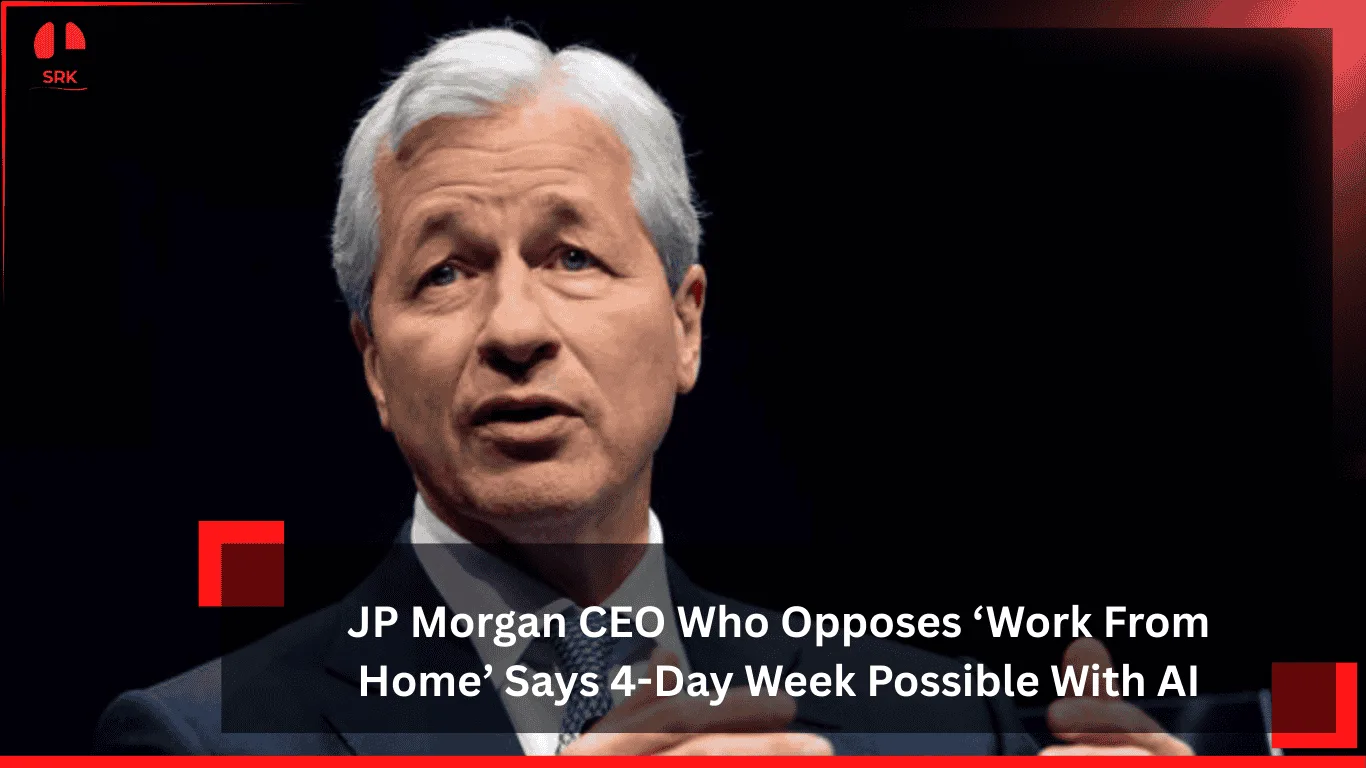
JP Morgan CEO Jamie Dimon, who has openly voiced his disagreement with the concept of permanent work-from-home arrangements, has now suggested that artificial intelligence (AI) could make a four-day work week possible in the near future. His remarks highlight the transformative potential of AI in reshaping productivity, workforce dynamics, and corporate culture.
Dimon’s Stance on Work Culture
- Against Work From Home: Dimon has consistently argued that remote work undermines collaboration, innovation, and mentorship.
- AI’s Role: Despite his opposition to WFH, he acknowledges that AI could revolutionize efficiency, enabling employees to achieve more in fewer days.
- Corporate Strategy: JP Morgan is investing heavily in AI-driven tools to streamline operations, reduce redundancies, and enhance decision-making.
Strategic Importance of AI in Work Transformation
- Productivity Gains: AI can automate repetitive tasks, freeing employees to focus on strategic and creative work.
- Work-Life Balance: A four-day week could improve employee satisfaction, reduce burnout, and attract top talent.
- Economic Impact: Shorter work weeks may reshape labor markets, consumer behavior, and corporate profitability.
- Cultural Shift: AI adoption could redefine traditional notions of work, challenging long-held corporate norms.
Comparative Analysis of Work Models
| Work Model | Key Features | Advantages | Challenges |
|---|---|---|---|
| Traditional 5-Day Week | Standard corporate schedule | Predictable, structured | High burnout risk |
| Remote Work | Flexibility, location freedom | Better work-life balance | Collaboration issues |
| Hybrid Work | Mix of office & remote | Balanced flexibility | Complex management |
| AI-Enabled 4-Day Week | Efficiency-driven | Higher productivity, satisfaction | Transition challenges |
Business Impact Projection
| Factor | Short-Term Impact | Long-Term Impact |
|---|---|---|
| Employee Productivity | Boost from AI tools | Sustainable efficiency |
| Corporate Culture | Resistance to change | New norms of work |
| Talent Acquisition | Attraction of skilled workers | Retention through better balance |
| Global Economy | Adjustments in labor markets | Potential redefinition of work standards |
Industry Context
- Global Experiments: Several companies worldwide have already tested four-day work weeks, reporting positive outcomes in productivity and employee morale.
- AI Integration: Financial institutions, including JP Morgan, are leveraging AI for risk management, fraud detection, and customer service.
- Future of Work: AI-driven automation is expected to reshape industries, making shorter work weeks more feasible.
Expert Insights
Analysts believe Dimon’s remarks reflect a pragmatic recognition of AI’s potential. While he remains skeptical of remote work, his openness to a four-day week suggests that corporate leaders are preparing for a future where technology fundamentally alters work structures.
Future Outlook
- Corporate Adoption: More firms may experiment with AI-enabled shorter work weeks to attract talent.
- Policy Implications: Governments may need to adapt labor laws to accommodate evolving work models.
- Global Competition: Countries embracing AI-driven efficiency could gain competitive advantages in productivity.
Conclusion
Jamie Dimon’s acknowledgment that AI could make a four-day work week possible marks a significant shift in corporate discourse. While he continues to oppose permanent work-from-home arrangements, his recognition of AI’s transformative power highlights the evolving nature of work in the digital age. The future may see a balance between technological efficiency and human well-being, redefining how companies and employees approach productivity.
Disclaimer
This article is intended for informational purposes only and should not be construed as financial or employment advice. Work models and corporate strategies are subject to change based on technological advancements, market conditions, and organizational priorities. Readers are encouraged to follow official updates and consult experts before making career or business decisions.