


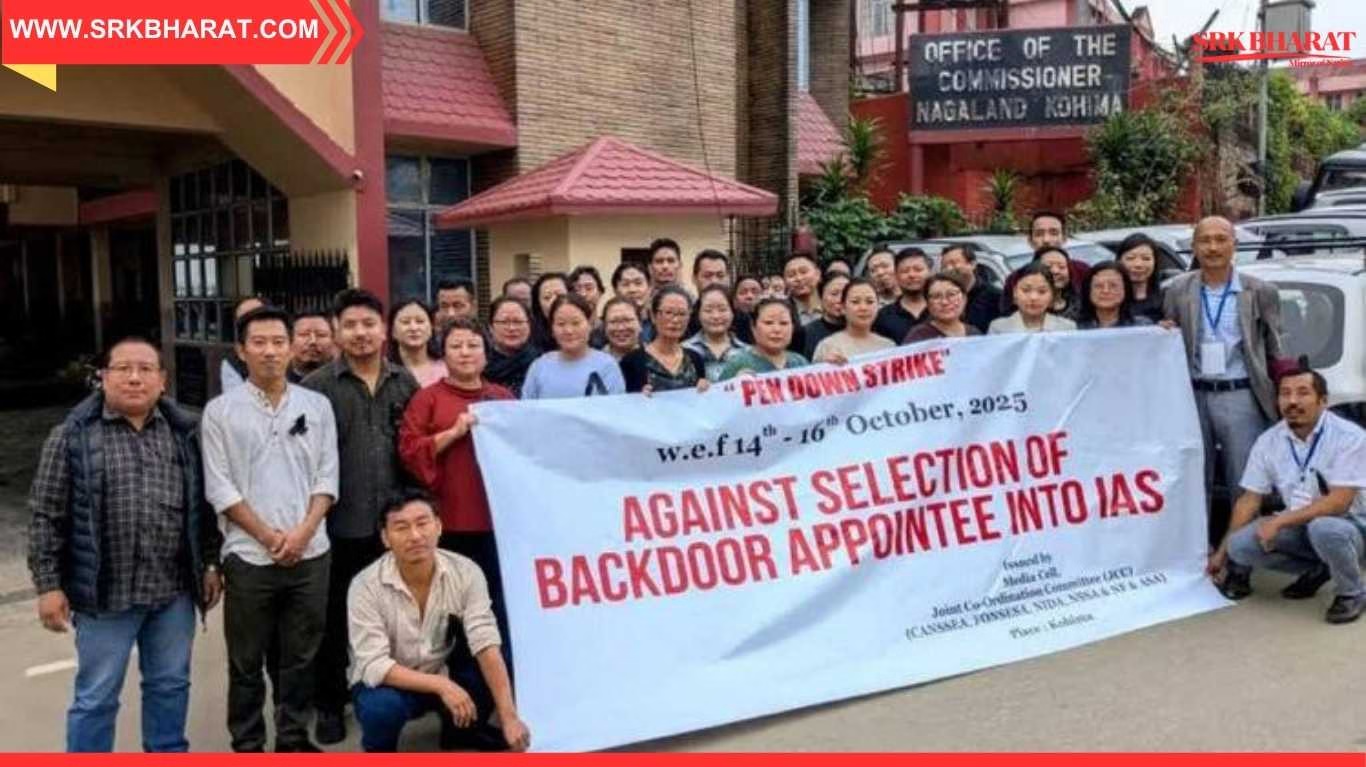
The political and administrative landscape in Nagaland remains tense as five major service associations under the Joint Coordination Committee (JCC) continue their statewide protest against the alleged irregularities in the induction of non-State Civil Service (non-SCS) officers into the Indian Administrative Service (IAS). The protest, which began with symbolic black ribbon demonstrations in September 2025, has now escalated into a full-fledged pen-down strike, severely impacting government functioning across departments.
The JCC comprises the Confederation of All Nagaland State Services Employees Association (CANSSEA), Federation of Nagaland State Engineers Service Association (FONSESA), Nagaland In-Service Doctors’ Association (NIDA), Nagaland Secretariat Service Association (NSSA), and Nagaland Forest Service Association (NF&ASA). These associations have accused the state government of bypassing constitutional norms and Supreme Court directives in its attempt to induct a non-SCS officer into the IAS cadre through a controversial selection process initiated in March 2025.
📊 Timeline of the IAS Induction Controversy in Nagaland
| Date | Event Description | Outcome |
|---|---|---|
| Mar 10, 2025 | Advertisement issued for IAS induction from SCS quota | Later challenged by JCC |
| Sep 25, 2025 | Black ribbon protest begins | Symbolic dissent initiated |
| Oct 16, 2025 | Cabinet sub-committee formed to address grievances | No resolution reached |
| Oct 29, 2025 | JCC appeals for public support | Protest gains momentum |
| Nov 1, 2025 | State government urges JCC to call off strike | Protest continues |
Despite multiple rounds of dialogue, the JCC has refused to back down, citing procedural lapses and violation of the IAS (Appointment by Selection) Regulations, 1997.
🧠 Core Issues Raised by the JCC
| Allegation | Details |
|---|---|
| Violation of DoPT Guidelines | Ignoring Office Memorandum dated Oct 7, 2020 on merit-based appointments |
| Bypassing SCS Quota | Attempt to induct non-SCS officer despite availability of eligible SCS officers |
| Lack of Transparency | No public disclosure of selection criteria or candidate evaluation |
| Constitutional Breach | Alleged disregard for Article 309 and Supreme Court rulings |
The JCC maintains that its protest is not against any individual but against the erosion of meritocracy and institutional integrity.
🗣️ Reactions from Government and Civil Society
| Stakeholder | Response Summary |
|---|---|
| CM Neiphiu Rio | Silent on specifics; appeals for administrative normalcy |
| Power Minister K.G. Kenye | Defends government action as constitutionally valid |
| Civil Society Groups | Mixed reactions; some support JCC, others urge resolution |
| Public Sentiment | Growing concern over disruption of essential services |
The government has warned that prolonged disruption may force it to invoke disciplinary measures.
📈 Impact of the Protest on Governance
| Sector | Effect Summary |
|---|---|
| Health Services | Routine operations affected in government hospitals |
| Secretariat Operations | File movement and decision-making stalled |
| Engineering Projects | Delays in infrastructure execution |
| Forest and Environment | Monitoring and field activities disrupted |
The pen-down strike has paralyzed administrative machinery, prompting calls for urgent resolution.
🧭 Legal and Constitutional Context
| Provision/Guideline | Relevance to Controversy |
|---|---|
| IAS Regulations, 1997 | Governs selection from SCS officers |
| DoPT Office Memo (2020) | Reinforces merit-based selection norms |
| Supreme Court Judgments | Emphasize transparency and fairness in appointments |
| Article 309 of Constitution | Empowers legislature to regulate recruitment |
Legal experts suggest that any deviation from these norms could invite judicial scrutiny.
📌 Conclusion
The ongoing protest by Nagaland’s service associations over alleged IAS recruitment irregularities has emerged as a litmus test for administrative transparency and constitutional adherence in the state. As the JCC continues its agitation and the government struggles to restore normalcy, the need for a fair, merit-based resolution becomes increasingly urgent. With public services disrupted and trust in governance at stake, the outcome of this standoff could have long-term implications for bureaucratic integrity in Nagaland.
Disclaimer: This article is based on publicly available news reports, official statements, and legal documents. It is intended for informational and editorial purposes only and does not constitute legal advice or political endorsement.