



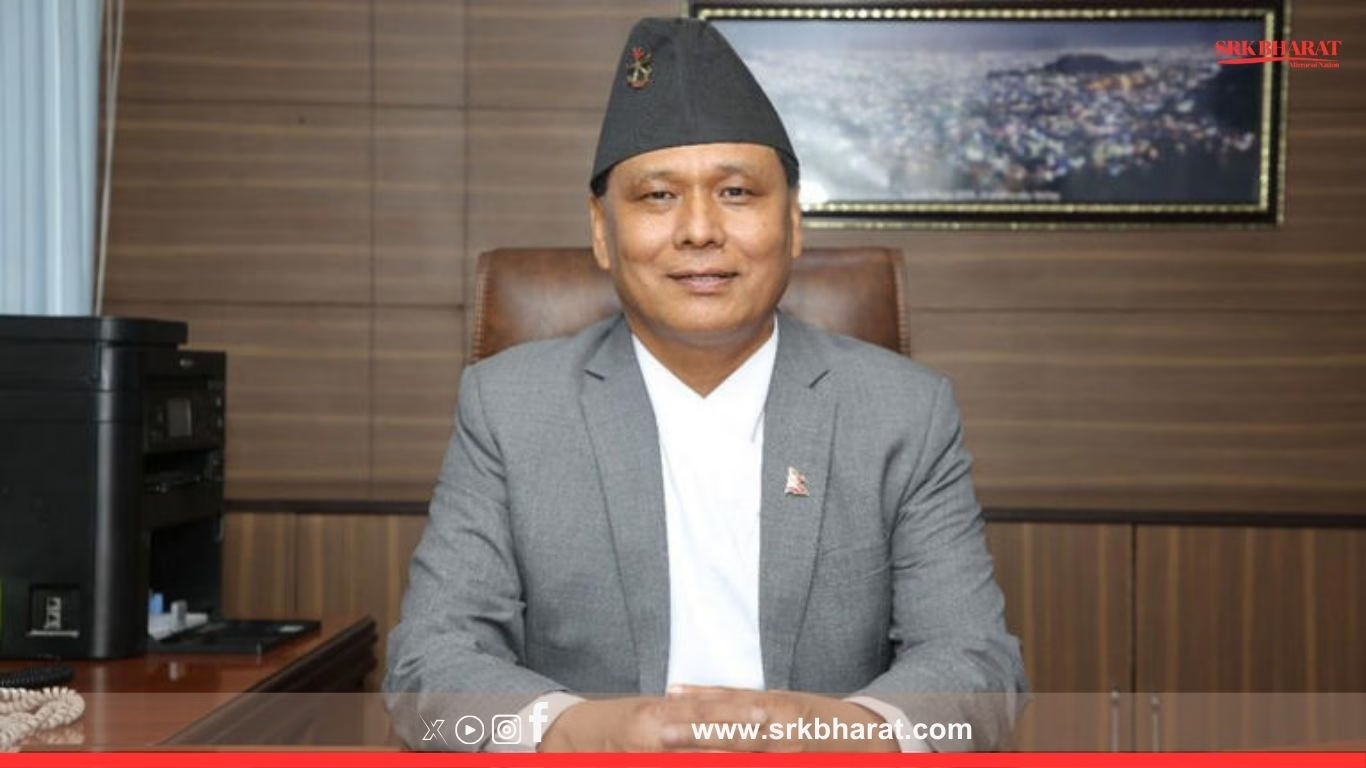
Nepal’s ongoing political turmoil has taken a dramatic new turn as the country’s younger generation, popularly referred to as Gen Z, has thrown its weight behind Kulman Ghising, the celebrated energy reformer, to head an interim government. This development comes after two major contenders, Kathmandu Mayor Balen Shah and former Chief Justice Sushila Karki, announced their withdrawal from the race, leaving Ghising as the most widely supported candidate.
The unprecedented shift in Nepal’s power dynamics is being seen as a youth-led political reset, reflecting frustration with the traditional political elite that has dominated Nepal’s governance for decades.
A Youth-Driven Push for Change
The political vacuum in Nepal has widened over the past few months, with disagreements among established parties, coalition collapses, and widespread public disillusionment. Gen Z, armed with social media activism and grassroots movements, has emerged as a decisive force in shaping the national discourse.
- Balen Shah, a rapper-turned-mayor, initially seemed like a natural youth icon but announced his withdrawal citing his ongoing commitments to Kathmandu’s development projects.
- Sushila Karki, Nepal’s first female Chief Justice, was viewed as a strong candidate with credibility in judicial reform, but she too stepped aside, citing personal reasons.
- Kulman Ghising, best known for ending Nepal’s chronic power blackouts as head of the Nepal Electricity Authority (NEA), has now become the consensus choice for the interim leadership.
For many young Nepalis, Ghising represents a non-political technocrat with proven administrative skills rather than another career politician tied to patronage networks.
Why Kulman Ghising?
Kulman Ghising’s rise is not accidental. He enjoys widespread popularity across demographics due to his track record in energy reforms and governance transparency.
Key reasons for his selection:
- Technocratic Expertise: Ghising is seen as someone who can prioritize governance and reforms without political baggage.
- Youth Backing: His popularity among students, professionals, and urban youth has surged, especially through digital campaigns.
- Symbol of Integrity: Unlike traditional leaders accused of corruption, Ghising is regarded as an honest administrator.
- Crisis-Management Skills: His handling of the power crisis gave him a reputation as a problem-solver.
Impact of Balen Shah and Sushila Karki’s Withdrawal
The withdrawal of two high-profile names significantly reshaped the interim government race.
| Candidate | Background | Current Status | Impact on Race |
|---|---|---|---|
| Balen Shah | Mayor of Kathmandu, youth icon | Withdrawn | Strengthened Ghising’s bid by removing main youth rival |
| Sushila Karki | Ex-Chief Justice, reform advocate | Withdrawn | Boosted Ghising’s credibility as sole consensus candidate |
| Kulman Ghising | Former NEA Chief, technocrat | Active | Now leading interim govt discussions |
This pivot consolidated Gen Z’s movement, with student groups, civil society, and digital platforms mobilizing in favor of Ghising.
Public Sentiment: Gen Z Takes Center Stage
The generational divide is clear in Nepal’s politics. While older parties like the Nepali Congress, UML, and Maoists continue to rely on traditional networks, the younger population increasingly wants fresh leadership and accountability.
- Surveys conducted by independent civic groups show 65% of Nepali youth prefer a technocrat-led interim government.
- Online polls and trending hashtags reflect Ghising as the front-runner for interim leadership.
- Street demonstrations across Kathmandu, Pokhara, and Biratnagar have amplified demands for a corruption-free administration.
This momentum suggests that Nepal’s interim government could be the first in South Asia heavily influenced by Gen Z activism.
Pivot Analysis: Nepal’s Transition Choices
| Factor | Traditional Political Route | Gen Z-Led Interim Govt (Ghising Model) |
|---|---|---|
| Leadership | Party veterans, coalition politics | Technocratic, non-political leadership |
| Public Trust | Low due to corruption and instability | Higher due to clean image of Ghising |
| International Perception | Seen as unstable, faction-driven | Viewed as reform-driven, pragmatic |
| Economic Stability | Stagnant, plagued by inefficiency | Potential boost with technocratic policies |
| Youth Participation | Limited influence in decision-making | Direct involvement in agenda-setting |
This table shows the stark differences between the old and new approaches, with Ghising representing a break from the past.
Regional and International Implications
Nepal’s political crisis and Gen Z’s intervention could have regional ripples.
- India: Will watch closely as Ghising has no strong political alignment, potentially easing bilateral tensions.
- China: Interested in continuity of projects under the Belt and Road Initiative.
- Global Partners: Western allies may see Ghising as a stable interim choice who can deliver governance reforms.
International observers have noted that a youth-backed technocrat-led government in Nepal could become a model for other politically gridlocked nations.
Challenges Ahead for Ghising
Despite the strong public backing, Ghising’s path will not be easy.
- Resistance from traditional parties unwilling to cede power.
- Fragile coalition-building required to give legitimacy to the interim government.
- Pressure from civil society to deliver quick results.
- Economic headwinds, including inflation, youth unemployment, and debt management.
Failure to deliver within a short timeframe could risk eroding the public trust that has elevated him to this position.
Conclusion
Nepal stands at a historic crossroads. The rise of Kulman Ghising as the Gen Z-backed interim leader represents a seismic shift in the country’s politics, driven by the frustration of a young generation eager to break free from the cycle of corruption, instability, and party-driven politics.
With Balen Shah and Sushila Karki stepping aside, the momentum is firmly behind Ghising, symbolizing a youth-driven demand for accountability and reform. Whether this experiment will translate into long-term political stability remains to be seen, but for now, Nepal’s Gen Z has shown its ability to shape the national narrative in unprecedented ways.
Disclaimer: This article is based on emerging political developments, civic movements, and public discourse in Nepal. The situation remains fluid, and details may evolve as negotiations progress.


pin up ilova ishlamayapti http://pinup5010.ru
пинап https://pinup5009.ru/
пин ап приложение не работает pinup5012.ru
pin up uzcard orqali pul olish https://www.pinup5011.ru
pin up qanday pul yechiladi pin up qanday pul yechiladi
pin up depozit bonusi http://pinup5014.ru
что можно сделать с бонусным счетом 1win что можно сделать с бонусным счетом 1win
1win yangi bonus 2025 http://www.1win5511.ru
pin up aviator strategiyasi https://pinup5015.ru
1win ro‘yxatdan o‘tish orqali bonus http://1win5512.ru/
1win ro‘yxatdan qanday o‘tish https://1win5513.ru/
мелбет партнерс http://www.melbet5001.ru
1вин бонус без депозита уз http://www.1win5514.ru
1win вход с компьютера 1win12045.ru
скачать бк мелбет бесплатно скачать бк мелбет бесплатно
букмекерская контора теннесси скачать mostbet2029.help
скачать mostbet kg скачать mostbet kg
букмекер кыргызстан http://mostbet2030.help/
mostbet com вход [url=https://mostbet2032.help/]https://mostbet2032.help/[/url]
мостбет казино [url=mostbet2033.help]mostbet2033.help[/url]
1win jetx http://1win3002.mobi
1win chile http://1win3001.mobi/
1win akkaunt yaratish MAQOLALAR.UZ
1win demo slotlar http://www.SPORT-PROGRAMMING.UZ
1win 1win12046.ru
1win.pro http://www.1win12047.ru
1win uganda http://1win5741.help
1win bet uganda 1win bet uganda
1win depozit bonusu http://1win5761.help
1win idman mərcləri 1win idman mərcləri