
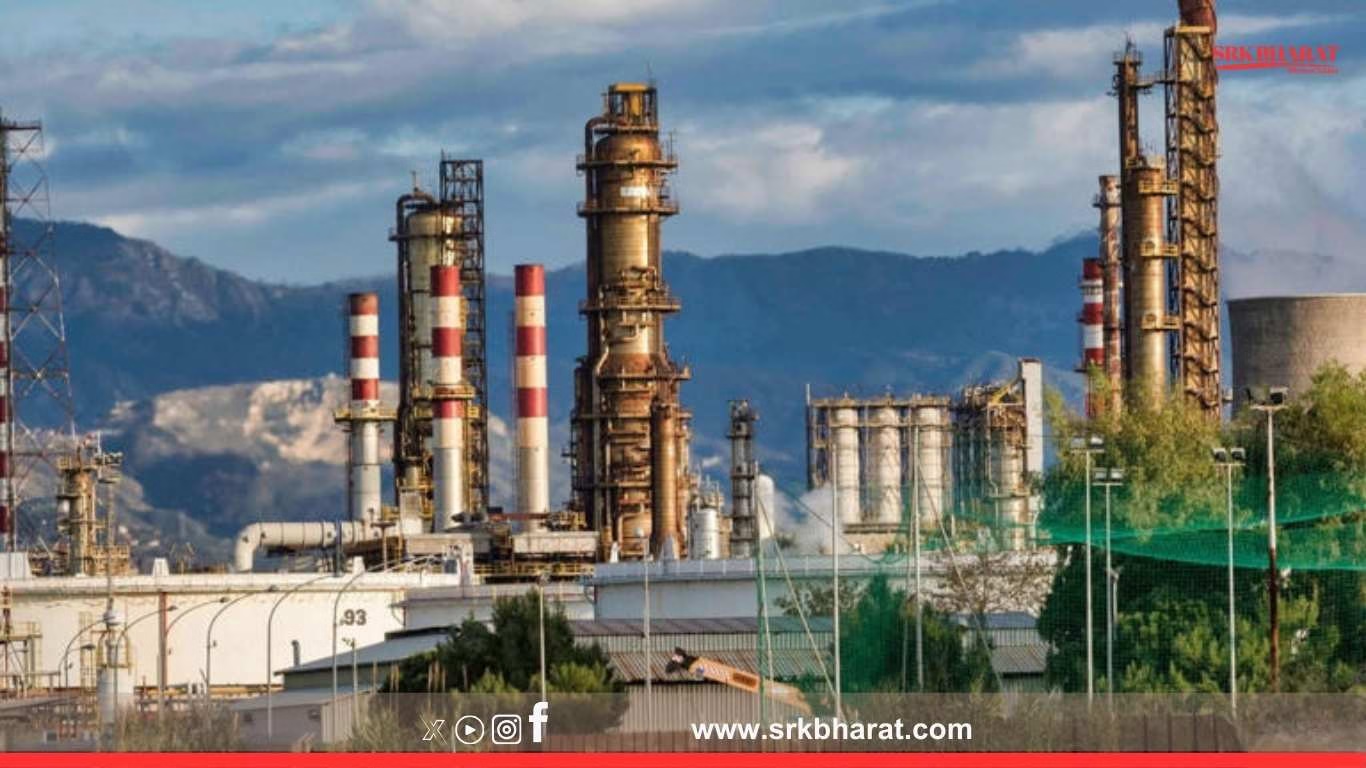
India’s state-owned energy major Oil and Natural Gas Corporation (ONGC) has reaffirmed its commitment to purchasing Russian crude oil, stating that its group refiners will continue to buy “every available drop” as long as it remains commercially viable. The announcement was made by ONGC Chairman and CEO Arun Kumar Singh during the company’s Annual General Meeting held on August 29, 2025.
Singh emphasized that Russian oil is not under international sanctions and that ONGC’s subsidiaries—Hindustan Petroleum Corporation Ltd (HPCL) and Mangalore Refinery and Petrochemicals Ltd (MRPL)—will keep sourcing crude from Moscow based on refinery configurations and market economics.
🧭 Strategic Rationale Behind ONGC’s Russian Oil Purchases
| Factor | Description | Strategic Benefit |
|---|---|---|
| Price Competitiveness | Russian crude offered at discounted rates | Reduces input costs for refiners |
| No Sanctions on Russian Oil | Not subject to embargoes or trade restrictions | Ensures uninterrupted supply |
| Refinery Configuration | ONGC refineries optimized for Russian blends | Enhances operational efficiency |
| Market Stability | Diversifies supply amid global volatility | Strengthens energy security |
| Government Policy | No directive to curtail Russian imports | Allows autonomy in procurement decisions |
Singh stated, “As long as it is economical, we will keep buying every drop that comes to the market. Our strategy is dictated by commercial and economic considerations, not political rhetoric”.
📊 ONGC Group Refining Capacity and Russian Oil Share
| Refinery Name | Capacity (mtpa) | Russian Crude Share (%) | Ownership Structure |
|---|---|---|---|
| HPCL (Standalone) | 20.6 | ~35% | ONGC Subsidiary |
| MRPL | 15.0 | ~40% | ONGC Subsidiary |
| HPCL-Mittal Energy JV | 11.3 | ~30% | Joint Venture |
| Total ONGC Group Capacity | ~47 | ~35–40% | Public Sector |
| India’s Total Refining Capacity | 258 | ~35% from Russia | Mixed (Public + Private) |
Russian oil has emerged as India’s top crude source, accounting for nearly 40% of total imports, up from less than 2% before the Ukraine conflict began in 2022.
🔍 US Tariff Pressure and India’s Response
The ONGC chairman’s remarks come amid renewed pressure from the United States, which recently imposed an additional 25% tariff on Indian goods as a penalty for continued Russian oil imports. Despite this, Singh maintained that ONGC’s procurement strategy remains unaffected.
| Issue | US Position | India’s Response |
|---|---|---|
| Russian Oil Imports | Viewed as support for Kremlin | “Unjustified and unreasonable” |
| Tariff Action | 25% additional duty on Indian exports | Trade negotiations impacted |
| Sanctions Status | No direct sanctions on Russian crude | Imports continue under price cap conditions |
| Energy Sovereignty | India’s right to source competitively | “We buy from where we get the best deal” |
India has argued that its Russian oil imports began only after traditional suppliers diverted shipments to Europe, and that the US had initially encouraged such purchases to stabilize global energy markets.
🔥 ONGC’s Global Expansion and Asset Strategy
Beyond Russian oil, ONGC is actively scouting for overseas energy assets that offer long-term value. Singh noted that the company is open to acquiring assets in “troubled times” if the price and future outlook align with ONGC’s strategic goals.
| Region | Asset Type | Status/Interest Level |
|---|---|---|
| United States | LNG and upstream assets | Under evaluation |
| Latin America | Greenfield and brownfield | High potential, active scouting |
| Africa | Mineral-rich energy assets | Strategic interest |
| West Asia | Oil blocks and partnerships | Ongoing discussions |
| Russia | Existing projects (3) | Continued engagement |
Rajarshi Gupta, MD of ONGC Videsh, confirmed that the company is exploring opportunities in multiple geographies, including the US, Latin America, and Africa.
📉 Financial Performance Snapshot: FY 2024–25
| Metric | FY 2024–25 | FY 2023–24 | YoY Change (%) |
|---|---|---|---|
| Standalone Revenue | ₹1.37 lakh crore | ₹1.38 lakh crore | -0.72% |
| Consolidated Revenue | ₹6.75 lakh crore | ₹6.65 lakh crore | +1.50% |
| Standalone PAT | ₹35,610 crore | ₹40,526 crore | -12.10% |
| Consolidated PAT | ₹38,329 crore | ₹55,273 crore | -30.60% |
| EPS | ₹28.31 | ₹32.21 | -12.10% |
Despite global headwinds, ONGC maintains a robust credit profile, with AAA ratings from domestic agencies and investment-grade ratings from Moody’s, S&P, and Fitch.
🧠 Expert Opinions on ONGC’s Russian Oil Strategy
| Expert Name | Designation | Comment |
|---|---|---|
| Dr. Rakesh Sinha | Energy Economist | “Russian oil offers India a pricing edge.” |
| Prof. Meera Iyer | Geopolitical Analyst | “India’s stance reflects pragmatic diplomacy.” |
| Lt. Gen. (Retd.) A. Singh | Strategic Advisor | “Energy security must override political noise.” |
Experts agree that ONGC’s approach is driven by economic logic and national interest, not ideological alignment.
📌 Conclusion
ONGC’s declaration to continue buying Russian crude oil “as long as it is economical” underscores India’s pragmatic energy strategy amid global geopolitical tensions. Chairman AK Singh’s remarks reflect a clear commitment to commercial viability, energy sovereignty, and strategic autonomy.
With Russian oil now a cornerstone of India’s import basket, and ONGC’s refineries optimized for its processing, the company’s stance is likely to remain unchanged unless directed otherwise by the government. As Singh aptly put it, “Troubled times do not last long—but strategic decisions made during them can define the future.”
—
Disclaimer: This article is based on publicly available news reports and official statements as of August 30, 2025. It is intended for informational purposes only and does not constitute financial, political, or investment advice.