






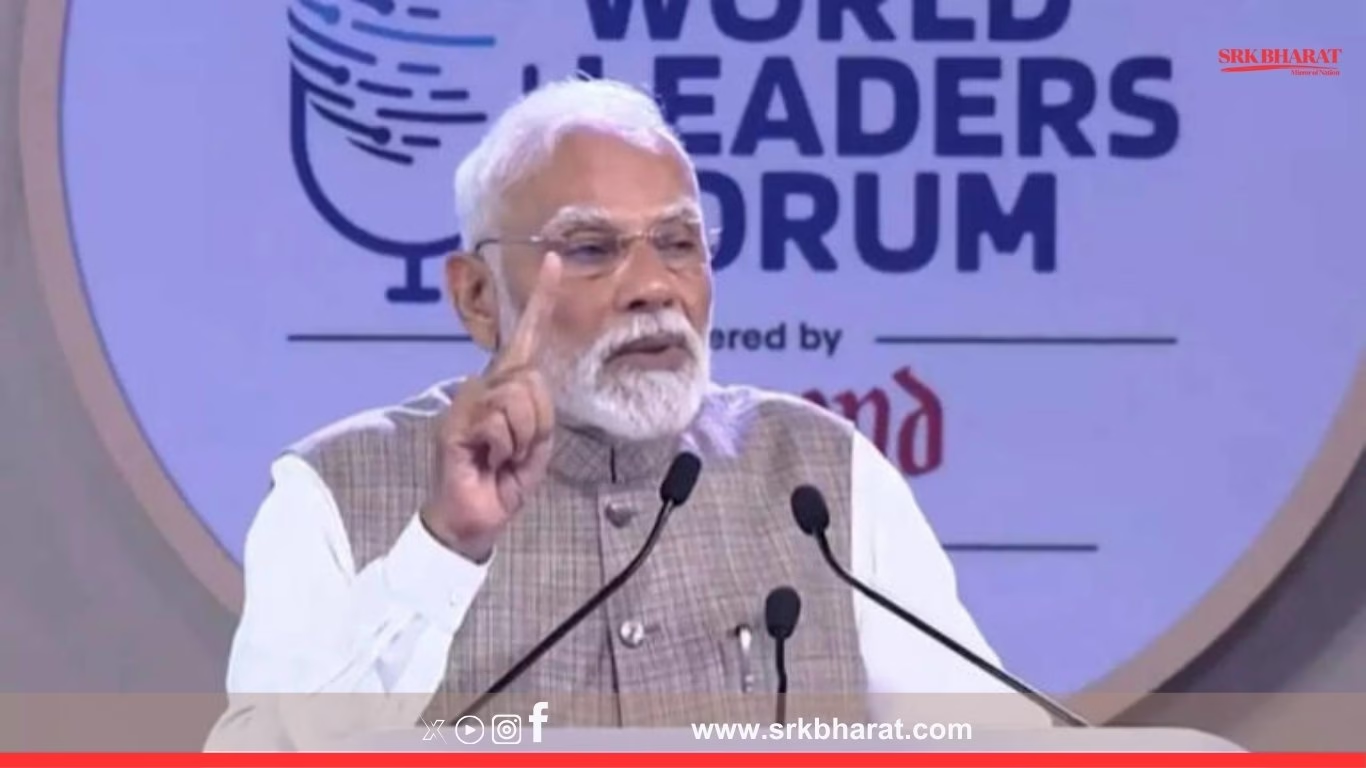
Prime Minister Narendra Modi has pledged a sweeping new wave of reforms aimed at energizing India’s economy, simplifying governance, and boosting employment, following the successful passage of the Income Tax Bill 2025 and the upcoming rollout of next-generation GST reforms. Speaking at the Economic Times World Leaders Forum in New Delhi on August 23, 2025, Modi declared that his government is preparing an “arsenal of reforms” to propel India into a new era of growth and global leadership.
The Prime Minister emphasized that reforms are not driven by crisis or compulsion but by conviction and commitment. “We are not here for incremental change. We are aiming for a quantum jump,” he said, outlining a multi-sectoral roadmap that includes legal simplification, digital governance, manufacturing incentives, and consumption-led growth.
🧭 Reform Milestones: From GST to Income Tax Overhaul
| Reform Initiative | Status/Timeline | Key Impact Area |
|---|---|---|
| Income Tax Bill 2025 | Passed in Monsoon Session | Simplified tax code, reduced litigation |
| GST Overhaul | To be implemented by Diwali | Rate rationalization, lower consumer taxes |
| Jan Vishwas Bill 2.0 | Passed | Decriminalization of 300+ minor offences |
| Reform Task Force | Announced | Policy review for startups, MSMEs |
| Digital Approvals Framework | Under rollout | Ease of doing business |
Modi’s announcement builds on his Independence Day speech, where he promised a “Diwali gift” in the form of GST reforms that would reduce the tax burden on essential goods and services.
📊 GST Reform: Two-Slab Structure and Consumer Relief
The next-generation GST reforms will replace the current four-slab system (5%, 12%, 18%, 28%) with a simplified two-slab structure—5% and 18%—alongside a special 40% rate for sin and luxury goods. This move is expected to make everyday items more affordable and boost consumption.
| GST Slab Change | Current Rate | Proposed Rate | Affected Goods |
|---|---|---|---|
| Essentials (groceries, medicines) | 5% | 5% | No change |
| Packaged food, household items | 12% | 5% | Condensed milk, namkeens, utensils |
| Electronics, appliances | 28% | 18% | Refrigerators, ACs, washing machines |
| Sin goods (tobacco, alcohol) | 28% + cess | 40% | Cigarettes, pan masala, beer |
The Finance Ministry has confirmed that nearly 99% of goods in the 12% slab will move to 5%, while 90% of items in the 28% slab will shift to 18%, delivering direct relief to households and MSMEs.
🔍 Income Tax Bill 2025: Simplification and Transparency
The newly passed Income Tax Bill 2025 replaces outdated provisions with a streamlined code aimed at reducing litigation and improving compliance. Key features include:
- Unified tax slabs for salaried and non-salaried individuals
- Digital-first filing and refund system
- Enhanced deductions for health, education, and housing
- Reduced corporate tax for startups and green enterprises
| Taxpayer Category | Previous Regime | New Regime Highlights |
|---|---|---|
| Salaried Individuals | Multiple slabs | Simplified 3-slab system |
| MSMEs | 25–30% tax | Flat 22% with incentives |
| Startups | Variable | 15% with R&D credits |
| Senior Citizens | Limited benefits | Expanded health and pension deductions |
The bill is expected to increase transparency, reduce compliance costs, and encourage formalization of the economy.
🧠 Reform Task Force and Sectoral Overhauls
Modi announced the formation of a dedicated Reform Task Force to accelerate policy modernization across sectors. The task force will review laws affecting startups, MSMEs, and entrepreneurs, with a focus on:
- Cutting red tape
- Decriminalizing minor offences
- Digitizing approvals and registrations
- Aligning regulations with global standards
| Sector Focus | Reform Objective |
|---|---|
| Startups | Simplify incorporation, tax compliance |
| MSMEs | Reduce cost of compliance, boost credit |
| Manufacturing | Incentivize domestic production |
| Services | Enhance digital infrastructure |
The Prime Minister reiterated that reforms are not reactive but proactive, stating, “We are preparing for the future. We are working on several fronts for this”.
📉 Economic Indicators and Global Positioning
Modi cited EPFO data showing 2.2 million formal jobs added in June 2025—an all-time record. He also highlighted India’s contribution to nearly 20% of global growth and S&P’s sovereign rating upgrade after 18 years as signs of resilience and investor confidence.
| Indicator | Value (June 2025) | Trend/Impact |
|---|---|---|
| EPFO Formal Jobs Added | 2.2 million | Record high, employment boost |
| GDP Growth Forecast | 7.2% | Among highest globally |
| S&P Sovereign Rating | Upgraded to BBB+ | Improved investment climate |
| FDI Inflows | $85 billion (FY25) | Manufacturing, fintech, semiconductors |
Modi also announced that India’s first Made-in-India semiconductor chip will hit the market by December 2025, with 6G development already underway.
🧠 Political Messaging and Vision for Viksit Bharat
Modi’s speech carried strong political undertones, contrasting his government’s reform-driven approach with previous regimes. He accused earlier governments of “missing the bus” on technology and reforms, stating, “We were dependent on other nations for 3G, 4G. How long will we keep doing this?”
He positioned Atmanirbhar Bharat as the foundation of Viksit Bharat 2047, built on speed, scale, and scope. The reforms are designed to:
- Energize industry
- Boost consumption
- Create jobs
- Simplify governance
| Vision Pillar | Reform Strategy |
|---|---|
| Speed | Fast-track approvals, digital systems |
| Scale | Expand manufacturing, infrastructure |
| Scope | Inclusive growth, sectoral modernization |
Modi concluded by saying, “Reforms are not a compulsion for us, nor are they crisis-driven. It is our commitment, our conviction”.
📌 Conclusion
Prime Minister Narendra Modi’s pledge of an “arsenal of reforms” signals a transformative phase in India’s economic and governance landscape. With the GST overhaul and Income Tax Bill already in motion, the next wave of reforms promises to simplify laws, energize industries, and empower citizens.
As India positions itself to lead global growth, the reform roadmap unveiled by Modi reflects a bold vision—one that seeks not just to catch up, but to drive the future.
—
Disclaimer: This article is based on publicly available news reports and official statements as of August 24, 2025. It is intended for informational purposes only and does not constitute financial, legal, or political advice.


список seo агентств https://www.reiting-seo-kompaniy.ru .