


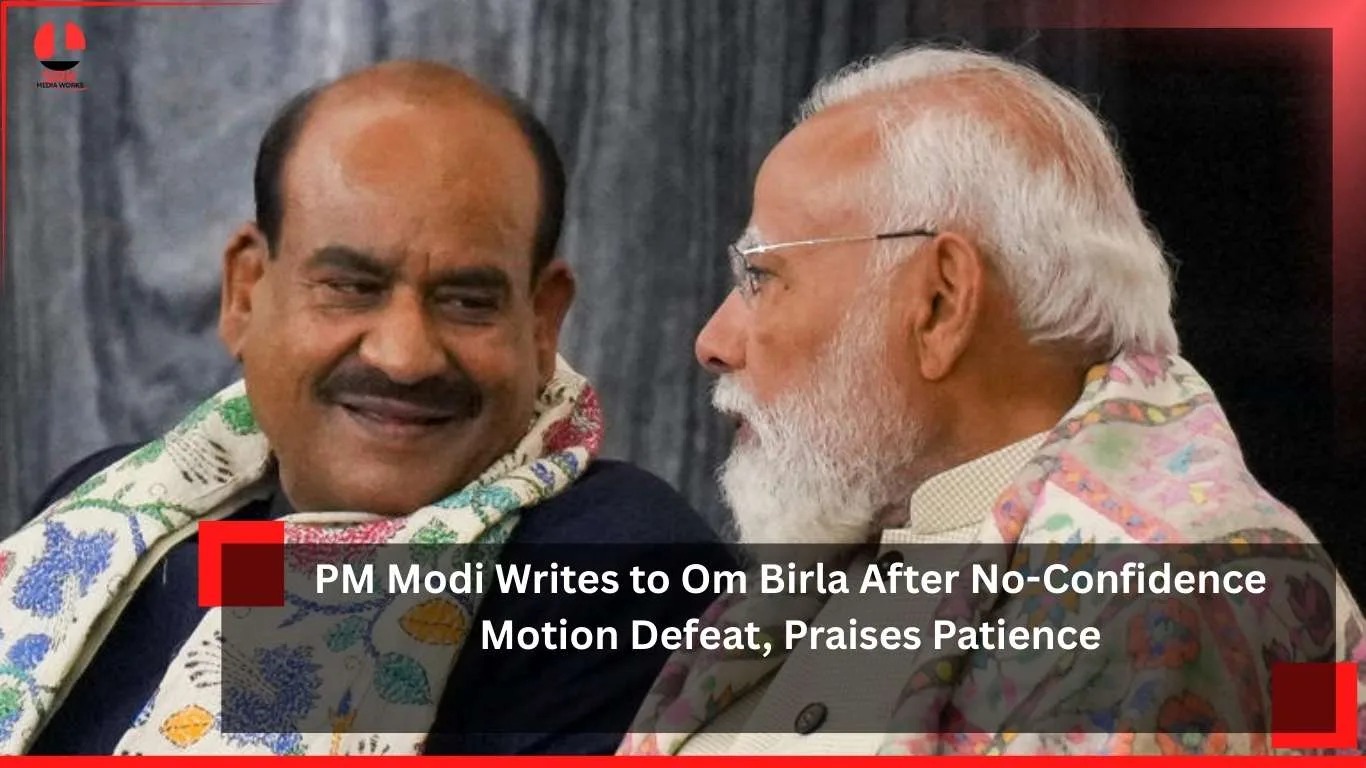
Prime Minister Narendra Modi has written a letter to Lok Sabha Speaker Om Birla following the defeat of the no-confidence motion in Parliament, praising his patience and composure during heated debates. The letter comes at a time when political tensions were running high, and Modi’s acknowledgment of Birla’s role highlights the importance of maintaining dignity and order in the House.
Context of the No-Confidence Motion
The no-confidence motion was brought forward by opposition parties, aiming to challenge the government’s performance on various fronts, including economic management, social policies, and national security. Despite intense debates and sharp criticism, the motion was defeated, reaffirming the government’s majority in the Lok Sabha.
- Opposition’s Aim: To question the government’s accountability and highlight alleged shortcomings.
- Government’s Response: Defended its record, citing achievements in infrastructure, welfare schemes, and foreign policy.
- Outcome: The motion was defeated, strengthening the ruling party’s position.
Modi’s Letter to Om Birla
In his letter, Modi praised Om Birla for his patience and impartiality during the debates. He acknowledged the challenges of presiding over heated discussions and commended Birla for ensuring that parliamentary decorum was maintained.
Key highlights of the letter:
- Praise for Patience: Modi noted Birla’s ability to remain calm amid intense exchanges.
- Acknowledgment of Role: He emphasized the importance of the Speaker in safeguarding democratic processes.
- Encouragement: Modi encouraged Birla to continue his efforts in strengthening parliamentary traditions.
Political Reactions
The letter has sparked varied reactions across the political spectrum:
| Stakeholder Group | Reaction Type | Key Observations |
|---|---|---|
| Ruling Party Leaders | Supportive | Welcomed Modi’s acknowledgment of Birla |
| Opposition Parties | Critical | Claimed the letter was symbolic, not substantive |
| Parliamentary Analysts | Neutral | Saw it as recognition of Speaker’s role |
| General Public | Mixed | Some praised Modi’s gesture, others skeptical |
This table reflects the diverse interpretations of Modi’s letter, ranging from genuine appreciation to political symbolism.
Importance of the Speaker’s Role
The Speaker of the Lok Sabha plays a crucial role in maintaining order and ensuring fair debate. Om Birla’s handling of the no-confidence motion was seen as a test of his leadership.
- Neutral Arbiter: The Speaker must remain impartial, giving equal opportunity to all members.
- Maintaining Decorum: Ensuring debates do not descend into chaos.
- Strengthening Democracy: Upholding parliamentary traditions and procedures.
Historical Parallels
India has witnessed several no-confidence motions in the past, each testing the resilience of parliamentary democracy.
| Year | Prime Minister | Outcome |
|---|---|---|
| 1979 | Morarji Desai | Motion passed, government fell |
| 1999 | Atal Bihari Vajpayee | Lost by one vote, government collapsed |
| 2018 | Narendra Modi | Motion defeated, government strengthened |
| 2026 | Narendra Modi | Motion defeated, Speaker praised |
This comparison shows how no-confidence motions have historically shaped India’s political landscape.
Broader Implications
Modi’s letter carries broader implications for Indian politics:
- Strengthening Institutions: It highlights the importance of respecting parliamentary roles.
- Political Messaging: The letter serves as a signal of confidence in the government’s stability.
- Public Perception: It portrays Modi as a leader who values democratic processes.
- Opposition Strategy: The defeat of the motion may force opposition parties to rethink their approach.
Public Sentiment
Public opinion on the letter is divided. Supporters view it as a positive gesture, reinforcing respect for institutions. Critics argue it is a symbolic move aimed at diverting attention from substantive issues raised during the motion.
International Perspective
Global observers have noted the incident as a reflection of India’s robust democratic framework. The ability to debate, challenge, and ultimately reaffirm the government’s majority is seen as a sign of political maturity.
Conclusion
Prime Minister Modi’s letter to Om Birla after the defeat of the no-confidence motion underscores the importance of patience, dignity, and respect in parliamentary proceedings. While political interpretations vary, the gesture highlights the Speaker’s central role in safeguarding democracy and maintaining order during turbulent debates.
Disclaimer
This article is based on political analysis and available information. It does not confirm or deny confidential parliamentary communications and should not be interpreted as official government policy. Readers are encouraged to follow verified government statements for authoritative updates.