


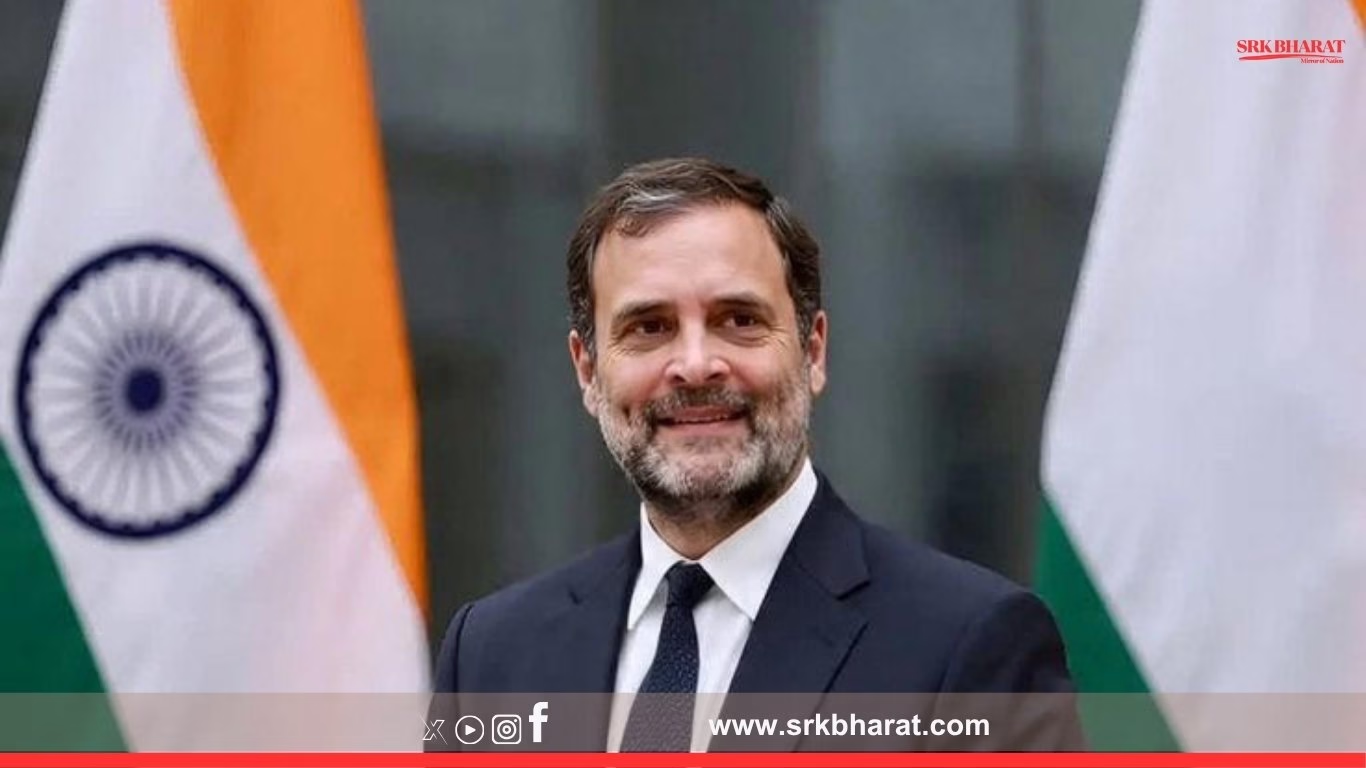
Congress leader and Leader of Opposition Rahul Gandhi has triggered a major political storm with his recent speech at EIA University in Medellín, Colombia, where he accused the Modi government of launching a “wholesale attack” on India’s democratic system. His comments, delivered during a seminar on global governance and democratic resilience, have drawn sharp reactions from the Bharatiya Janata Party (BJP), which called the remarks “irresponsible, defamatory, and anti-national.”
Speaking to a packed auditorium of students, academics, and diplomats on October 2, 2025, Gandhi said, “India is witnessing a systematic assault on its democratic foundations. The single-biggest risk to our future is the erosion of democratic space.” He further compared India’s governance model with China’s, warning against authoritarian tendencies and emphasizing the need to protect India’s pluralistic traditions.
Key Highlights – Rahul Gandhi’s Columbia Speech
| Theme | Statement Summary |
|---|---|
| Democracy Under Threat | “Wholesale attack on democratic system in India” |
| Comparison with China | “India cannot suppress people like China does” |
| Diversity and Pluralism | “India is a conversation between religions, languages” |
| Critique of RSS-BJP Ideology | “Cowardice lies at the heart of their ideology” |
| Reference to Jaishankar’s Quote | “Foreign Minister said China is stronger—this is cowardice” |
Gandhi’s remarks were part of his four-nation South America tour, aimed at engaging with global thought leaders and diaspora communities. He also met Colombian Senate President Lidio Gracia and discussed India’s role in global climate action and democratic cooperation.
However, it was his pointed criticism of the Rashtriya Swayamsevak Sangh (RSS) and BJP that ignited controversy back home. Quoting External Affairs Minister S. Jaishankar’s 2023 statement on China, Gandhi said, “At the heart of the BJP-RSS ideology is cowardice. They beat up the weak and run away from the strong.”
Political Reactions – BJP vs Congress
| Party | Reaction Summary | Spokesperson Comment |
|---|---|---|
| BJP | “Defamatory, anti-national, insult to India” | Ravi Shankar Prasad: “Rahul is a habitual offender” |
| Congress | “Truth must be spoken, even if uncomfortable” | Jairam Ramesh: “Rahul is exposing real threats” |
| JD(U) | “Should focus on domestic issues” | KC Tyagi: “Foreign speeches must be measured” |
| TMC | “Valid concerns, but timing questionable” | Derek O’Brien: “Democracy needs defenders” |
The BJP accused Gandhi of defaming India on foreign soil and undermining national interests. Union Minister Anurag Thakur said, “Rahul Gandhi’s obsession with insulting India abroad is shameful. He should apologize to the nation.”
Congress leaders defended Gandhi, stating that his remarks were rooted in facts and reflected growing concerns over institutional erosion, media control, and suppression of dissent. “Rahul Gandhi is speaking truth to power. The BJP is rattled because he’s exposing their authoritarian drift,” said Congress General Secretary Jairam Ramesh.
Rahul Gandhi’s Overseas Speeches – Controversy Timeline
| Year | Location | Key Remarks | Political Fallout |
|---|---|---|---|
| 2023 | Cambridge University | “Indian democracy under attack” | BJP demanded apology, Parliament disruption |
| 2024 | Stanford University | “Media, judiciary being pressured” | BJP called it ‘foreign propaganda’ |
| 2025 | EIA University, Colombia | “RSS ideology rooted in cowardice” | BJP accused him of defaming India abroad |
Gandhi’s speech also touched upon India’s spiritual traditions and intellectual heritage. “India has profound ideas that are relevant to the world today. We must allow these traditions to thrive, not suppress them,” he said, adding that democracy is the best method to accommodate diversity.
He emphasized that India’s strength lies in its ability to host multiple religions, languages, and cultures. “India is not one idea—it’s a conversation between many ideas. That’s why democracy is essential,” he said.
Core Themes in Rahul Gandhi’s Columbia Address
| Theme | Commentary |
|---|---|
| Democratic Resilience | Urged protection of institutions and freedoms |
| Cultural Pluralism | Highlighted India’s diversity as a strength |
| Authoritarian Risks | Warned against centralization and suppression |
| Global Engagement | Called for India to lead in climate and peace |
| Youth Empowerment | Encouraged students to question and participate |
Social media platforms exploded with reactions to Gandhi’s speech, with hashtags like #RahulInColombia, #DemocracyUnderAttack, and #RSSControversy trending across Twitter/X, Instagram, and YouTube. Supporters hailed his courage, while critics accused him of political opportunism.
Public Sentiment – Social Media Buzz on Rahul Gandhi’s Columbia Remarks
| Platform | Engagement Level | Sentiment (%) | Top Hashtags |
|---|---|---|---|
| Twitter/X | 1.5M mentions | 78% polarized | #RahulInColombia #DemocracyUnderAttack |
| 1.2M interactions | 82% supportive | #SpeakTruth #IndiaNeedsDemocracy | |
| 950K views | 75% critical | #RahulSpeech #ForeignSoilPolitics | |
| YouTube | 870K views | 80% analytical | #RahulExplained #ColombiaControversy |
Political analysts are divided on the impact of Gandhi’s remarks. While some see it as a bold assertion of opposition values, others warn that repeated foreign critiques may alienate voters and fuel nationalist backlash.
Dr. Rakesh Kumar, a political scientist at JNU, said, “Rahul Gandhi is positioning himself as a global democrat. But in India’s current political climate, foreign criticism is a double-edged sword.”
Rahul Gandhi’s Positioning – Domestic vs Global Narrative
| Arena | Strategy | Risks and Rewards |
|---|---|---|
| Domestic | Opposition to BJP-RSS ideology | May consolidate anti-incumbency, but polarize voters |
| Global | Defender of democracy and pluralism | Gains international credibility, risks nationalist backlash |
The Congress party is expected to amplify Gandhi’s message in its upcoming campaign for the 2025 Bihar and Maharashtra elections, framing the battle as one between authoritarianism and constitutional values.
Meanwhile, BJP leaders are likely to use Gandhi’s remarks to rally nationalist sentiment and portray the Congress as disconnected from ground realities.
In conclusion, Rahul Gandhi’s Columbia University speech has reignited the debate over India’s democratic health, political discourse, and the role of opposition voices on global platforms. As the political storm intensifies, the speech may become a defining moment in the run-up to the 2026 general elections.
Disclaimer: This article is based on publicly available political statements, verified media reports, and official event coverage. It does not constitute endorsement or prediction of electoral outcomes. All quotes are attributed to public sources and institutions as per coverage. Readers are advised to follow official updates from political parties and constitutional bodies for verified information.

Your point of view caught my eye and was very interesting. Thanks. I have a question for you. https://accounts.binance.info/en/register-person?ref=JHQQKNKN