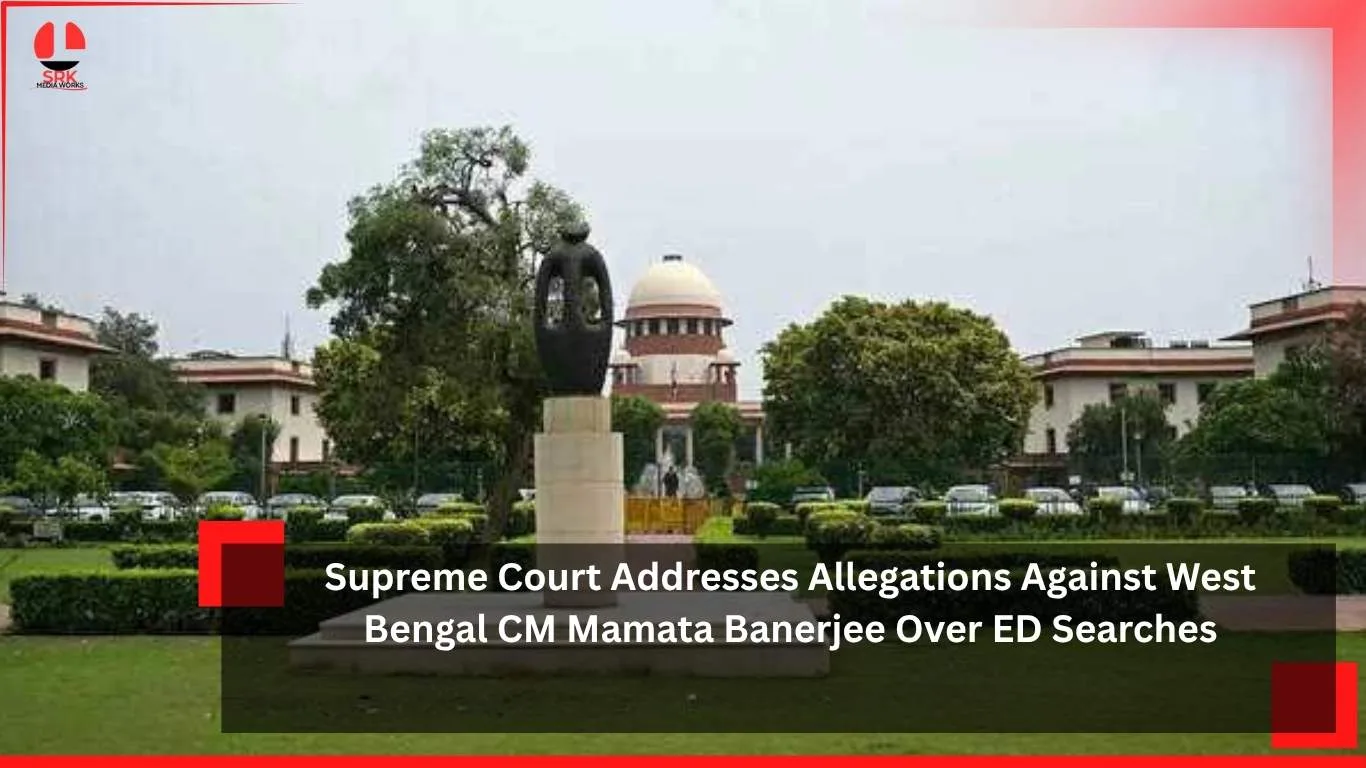






West Bengal Chief Minister Mamata Banerjee has informed the Supreme Court of India that her party retrieved confidential data from the Indian Political Action Committee (I-PAC) office with the consent of Enforcement Directorate (ED) officers. This revelation has added a new dimension to the ongoing legal and political tussle surrounding the role of I-PAC, the Trinamool Congress (TMC), and central investigative agencies.
Context of the Case
The controversy stems from allegations that confidential party data stored at the I-PAC office was accessed during an investigation. Opposition parties accused the TMC of unauthorized retrieval, while Mamata Banerjee clarified that the data was taken with the explicit permission of ED officers present during the process.
This statement was submitted to the Supreme Court as part of the ongoing hearings related to the investigation, raising questions about the conduct of investigative agencies and the political implications of data access.
Mamata Banerjee’s Stand
- Consent from ED Officers: Banerjee emphasized that the retrieval was not unilateral but carried out with ED’s approval.
- Protection of Party Interests: She argued that the data was crucial for safeguarding the party’s organizational integrity.
- Transparency in Action: The Chief Minister insisted that her party acted within the legal framework.
- Political Targeting Allegation: Banerjee reiterated that central agencies were being used to target opposition parties.
Opposition’s Reaction
- BJP Leaders: Criticized the move, alleging misuse of power and questioning the legality of retrieving confidential data.
- Congress and Left Parties: Called for clarity on whether ED officers indeed gave consent.
- Civil Society Groups: Expressed concern about the precedent this sets for political data handling.
Legal Dimensions
The Supreme Court is now tasked with examining:
- Whether ED officers had the authority to permit retrieval of confidential data.
- The implications of political parties accessing sensitive information during investigations.
- The balance between investigative transparency and political rights.
Comparative Analysis of Political Data Handling
| Case | Party Involved | Issue | Outcome |
|---|---|---|---|
| I-PAC Office (2026) | TMC | Retrieval of confidential data | Under SC review |
| Cambridge Analytica (Global) | Multiple | Misuse of voter data | Global backlash |
| Election Commission (India) | National parties | Data privacy concerns | Guidelines issued |
| Andhra Pradesh Case (2020) | Regional party | Alleged misuse of voter rolls | Investigation ordered |
Broader Implications
- For Political Parties: Raises questions about how confidential data is stored and accessed.
- For Investigative Agencies: Highlights the need for clear protocols during investigations.
- For Judiciary: Sets a precedent on the legality of consent-based data retrieval.
- For Democracy: Sparks debate on balancing transparency with privacy in political processes.
Public Sentiment
- Supporters of TMC: Viewed Banerjee’s statement as proof of transparency and accountability.
- Critics: Saw it as an attempt to deflect responsibility and politicize investigations.
- Neutral Observers: Called for stronger data protection laws to prevent similar controversies.
Conclusion
The headline “Retrieved Party’s Confidential Data from I-PAC Office with Consent of ED Officers: Mamata Banerjee to Supreme Court” reflects a complex intersection of law, politics, and data privacy. Mamata Banerjee’s assertion that the retrieval was done with ED’s consent challenges the narrative of unauthorized access, placing the spotlight on investigative protocols and political accountability.
The Supreme Court’s eventual ruling will not only determine the legality of the incident but also shape future norms around political data handling in India.
Disclaimer
This article is intended for informational and analytical purposes only. It reflects current political and legal discussions in India. The content does not represent official statements from the Supreme Court of India, the Enforcement Directorate, or the Trinamool Congress. Readers should verify facts through authoritative sources before drawing conclusions.