

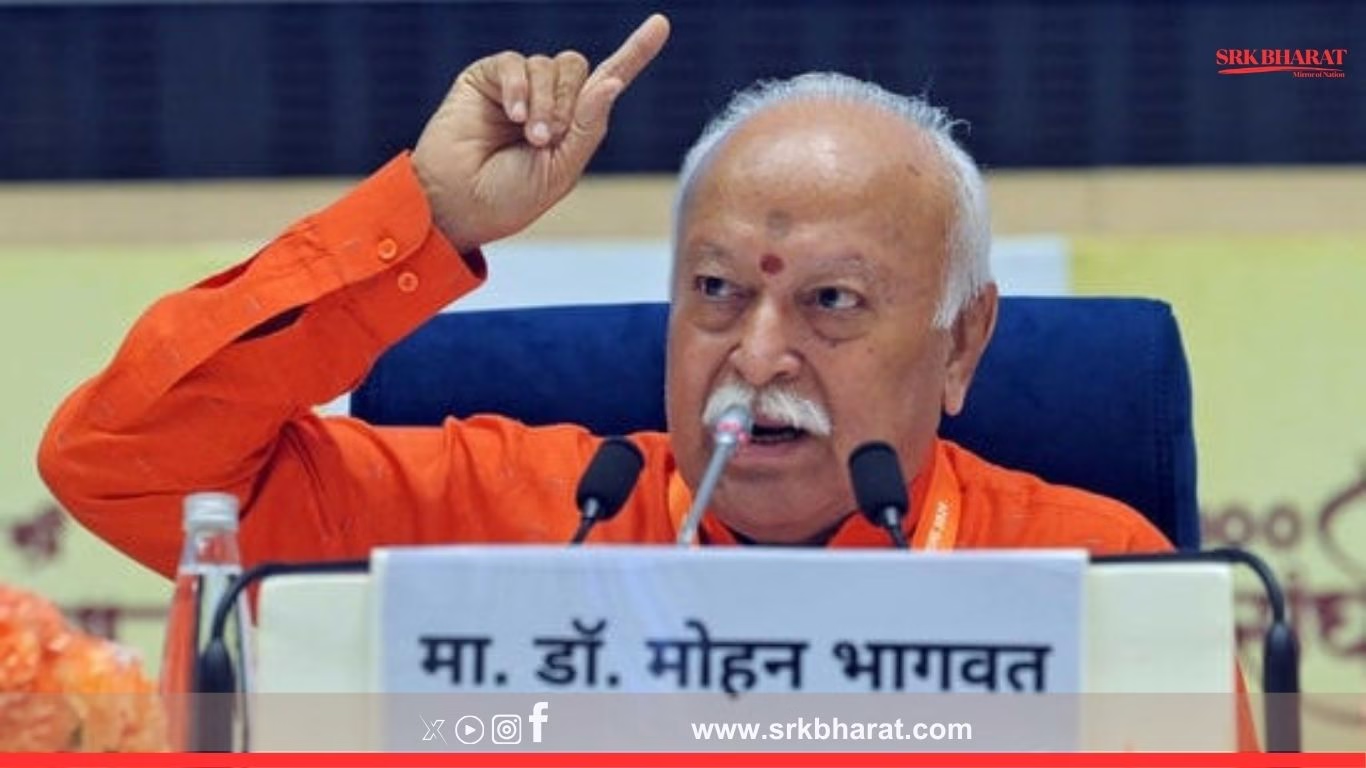
In a statement that could reshape the course of socio-political debates in India, Rashtriya Swayamsevak Sangh (RSS) chief Mohan Bhagwat made it clear that the organisation will not support movements seeking reclamation of Kashi and Mathura. The remarks come at a time when discussions around religious sites and their historical disputes are finding fresh political resonance. Bhagwat’s statement is being viewed as an attempt to strike a balance between religious sentiment and national unity, while discouraging renewed conflicts over sensitive places of worship.
Mohan Bhagwat’s Stand
Speaking at an internal gathering, Bhagwat reiterated that while faith and devotion are integral parts of India’s civilizational ethos, continuous agitation over temple-mosque disputes would only create unrest. He emphasized that the Ayodhya Ram Mandir issue, which was resolved after a decades-long legal and social struggle, should be seen as the final landmark victory in the temple movement.
“The country cannot afford fresh divisions and unrest. We will not support any campaigns demanding reclamation of Kashi or Mathura. What was achieved in Ayodhya was historic and conclusive. Now, the focus should be on unity, development, and harmony,” Bhagwat reportedly said.
Significance of the Statement
The remarks carry heavy weight because the RSS is considered the ideological backbone of the BJP. Bhagwat’s position on avoiding agitation over Gyanvapi Mosque in Kashi and Shahi Idgah in Mathura signals a cautious approach at a time when courts are still hearing related petitions.
Political observers believe that the RSS, which has long championed cultural nationalism, is deliberately adopting a restrained approach to prevent fresh fault lines in society. The idea, according to them, is to consolidate the Ayodhya achievement while avoiding political volatility in upcoming elections.
Historical Context: Ayodhya, Kashi, and Mathura
The three cities — Ayodhya, Kashi (Varanasi), and Mathura — have been at the center of religious contestations for decades.
Key Historical Landmarks
| Site | Dispute Background | Current Status |
|---|---|---|
| Ayodhya | Ram Janmabhoomi vs Babri Masjid | Supreme Court verdict led to Ram Mandir construction |
| Kashi | Gyanvapi Mosque vs Kashi Vishwanath Temple | Matter pending in courts, surveys underway |
| Mathura | Shahi Idgah vs Krishna Janmabhoomi Temple | Legal petitions filed, court hearings in progress |
While the Ayodhya dispute reached closure in 2019 with the Supreme Court verdict, both Kashi and Mathura cases remain unresolved. Bhagwat’s words, therefore, serve as a reminder that the RSS does not want a repeat of prolonged confrontations.
Political Implications
Bhagwat’s remarks are being dissected by political analysts for their timing and intent.
- For BJP: The ruling party has already reaped the political dividends of the Ram Mandir movement. With the temple inaugurated in January 2024, the BJP is expected to shift its campaign narrative towards development, governance, and welfare schemes rather than pushing new temple-related agendas.
- For Opposition: Bhagwat’s declaration offers a chance to question whether BJP leaders at state and district levels will adhere to the RSS line or continue using Kashi-Mathura disputes as rallying cries during elections.
- For Civil Society: The statement may reduce tensions by discouraging aggressive mobilization around disputed sites.
A Balancing Act: Faith vs Governance
Mohan Bhagwat’s intervention underlines the RSS strategy of balancing faith with practical governance. He cautioned against turning every religious site into a political battleground, urging the public to focus on national priorities like education, employment, social harmony, and scientific advancement.
This reflects an evolving RSS narrative — one that no longer wants to be seen merely as a cultural agitator but also as a nation-building force in sync with modern India’s aspirations.
Reactions from Stakeholders
The statement triggered diverse reactions from across the spectrum:
- Hindu religious groups: Some factions expressed disappointment, arguing that the “unfinished business” of reclaiming Kashi and Mathura should continue.
- Muslim leaders: Many welcomed Bhagwat’s stand, describing it as a step towards interfaith harmony.
- Political leaders: While BJP leaders largely avoided direct comments, opposition parties claimed that the RSS was trying to “tone down” rhetoric ahead of elections.
The Larger Message
By distancing itself from the Kashi and Mathura reclamation movements, the RSS is sending a larger message to society: that national integration and harmony should not be sacrificed at the altar of perpetual disputes. The stance also strengthens the legal process, as matters related to these sites are sub judice.
Future of Temple Politics
Experts believe that while temple politics has played a decisive role in shaping India’s electoral landscape, Bhagwat’s statement could mark the beginning of a new phase. The Ayodhya movement, which united millions and transformed Indian politics, has now reached its logical conclusion. Continuing similar movements, many argue, could risk diluting the symbolic victory already achieved.
Changing Priorities in Indian Politics
| Political Phase | Dominant Agenda | Key Outcome |
|---|---|---|
| 1980s–1992 | Ram Mandir movement | BJP’s rise as a national force |
| 2000s | Governance and economic reforms | NDA governments under Vajpayee |
| 2014–2024 | Nationalism, welfare schemes, Ram Mandir | BJP dominance consolidated |
| Post-2024 | Development, employment, social harmony | Emerging as key voter priorities |
Unity and Harmony as Central Themes
Bhagwat’s stress on avoiding fresh temple disputes underscores a broader ideological shift: moving towards nation-building through unity rather than agitation. In his words, the RSS envisions India as a land where diversity is respected, conflicts are minimized, and cultural pride is balanced with progress.
Conclusion
Mohan Bhagwat’s assertion that the RSS will not back Kashi and Mathura reclamation movements is more than just a political statement. It is a strategic recalibration of priorities that signals the end of one era and the beginning of another. While temple politics shaped the rise of the BJP and cemented the role of the RSS in national discourse, the focus now appears to be shifting towards development, governance, and unity.
As India navigates its future, the message is clear: the Ayodhya victory should be the foundation of harmony, not the beginning of endless disputes.
Disclaimer: This news content is based on public statements, political developments, and ongoing debates. It does not endorse or oppose any political party, religious group, or leader. Readers are encouraged to consider multiple perspectives while interpreting the developments.