






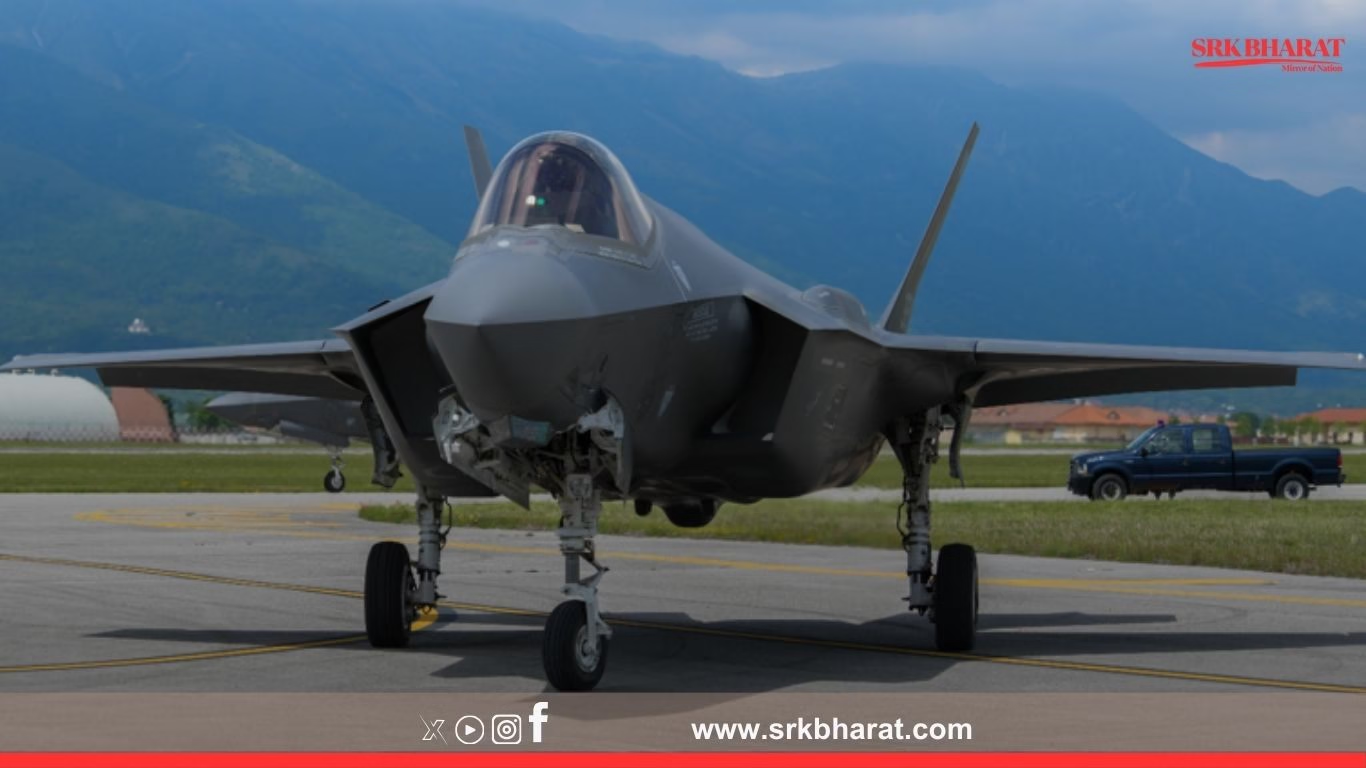
In a dramatic escalation of tensions over the Baltic Sea, three Russian MiG-31 Foxhound fighter jets violated Estonian airspace near Vaindloo Island on September 19, 2025, prompting a rapid NATO response involving Italian F-35A Lightning II and Swedish JAS 39 Gripen aircraft. The incursion, which lasted nearly 12 minutes, marks the fifth such breach of Estonian territory this year and has triggered calls for NATO Article 4 consultations by the Estonian government.
The incident underscores the growing volatility along NATO’s eastern flank and highlights the strategic importance of advanced fighter platforms in modern air defense. Here’s a breakdown of the aircraft involved and what this faceoff means for regional security.
—
Timeline of the Estonian Airspace Violation
| Time (Local) | Event |
|---|---|
| 10:42 AM | Three Russian MiG-31s enter Estonian airspace near Vaindloo Island |
| 10:45 AM | MiG-31s circle toward Tallinn, remain inside NATO airspace |
| 10:54 AM | Italian F-35A fighters scramble from Ämari Air Base |
| 10:56 AM | Swedish JAS 39 Gripen jets join interception over Baltic Sea |
| 10:58 AM | NATO aircraft maintain visual contact, escort Russian jets out |
The coordinated NATO response demonstrated alliance readiness and air policing capabilities under Operation Baltic Eagle III.
—
Aircraft Comparison: MiG-31 vs F-35 vs JAS 39 Gripen
| Feature | MiG-31 Foxhound | F-35A Lightning II | JAS 39 Gripen |
|---|---|---|---|
| Origin | Russia | USA | Sweden |
| Role | Long-range interceptor | Multirole stealth fighter | Lightweight multirole fighter |
| Max Speed | Mach 2.83 | Mach 1.6 | Mach 2.0 |
| Service Ceiling | 20,600 m | 15,240 m | 15,240 m |
| Radar Capability | Zaslon phased array | AESA radar with sensor fusion | PS-05/A radar |
| Missile Loadout | R-33, Kinzhal (hypersonic) | AIM-120, AIM-9X, JDAM | Meteor, IRIS-T, AGM-65 |
| Stealth | No | Yes | Partial |
| Crew | 2 | 1 | 1 |
Each aircraft brings unique strengths to the table, with the MiG-31 excelling in speed and altitude, the F-35 in stealth and sensor fusion, and the Gripen in agility and cost-efficiency.
—
Strategic Implications of the Baltic Airspace Violation
| Domain | Impact |
|---|---|
| NATO Air Policing | Reinforced credibility and rapid response |
| Russian Posturing | Signals readiness to challenge NATO boundaries |
| Estonian Sovereignty | Heightened diplomatic urgency and security concerns |
| EU Foreign Policy | Calls for increased sanctions and border surveillance |
| Civil Aviation | Temporary rerouting of commercial flights over Baltic Sea |
Estonia summoned Russia’s chargé d’affaires and lodged a formal protest, calling the violation “unprecedentedly brutal”.
—
MiG-31 Foxhound: Russia’s Supersonic Interceptor
The MiG-31 is designed for high-speed, high-altitude interception missions. Capable of reaching Mach 2.83, it can track multiple targets simultaneously and is often deployed to counter cruise missiles and bombers. Reports suggest the MiG-31s involved in the Estonian incursion may have been armed with Kinzhal hypersonic missiles.
Key capabilities include:
- Long-range radar detection
- Compatibility with R-33 and R-37 missiles
- Ability to operate in pairs for coordinated interception
- Range of 3,000 km with external fuel tanks
—
F-35A Lightning II: NATO’s Stealth Multirole Fighter
The F-35A represents the cutting edge of fifth-generation fighter technology. With stealth capabilities, advanced avionics, and sensor fusion, it offers unmatched situational awareness and precision strike capability. The Italian Air Force deployed F-35As from Ämari Air Base as part of NATO’s Baltic Air Policing mission.
Key features:
- Low observable stealth design
- Integrated electronic warfare systems
- Networked data sharing across platforms
- Multirole versatility: air-to-air, air-to-ground, ISR
—
JAS 39 Gripen: Sweden’s Agile Defender
The Gripen is a lightweight, cost-effective fighter known for its agility and rapid deployment. Sweden’s participation in the interception reflects its growing integration with NATO operations, especially following its formal accession to the alliance in 2024.
Key strengths:
- Quick turnaround time and low operating cost
- Advanced radar and electronic warfare systems
- Compatibility with NATO weapons and datalinks
- Proven performance in Baltic and Arctic conditions
—
NATO’s Baltic Air Policing Mission
| Operation Name | Baltic Eagle III |
|---|---|
| Base Location | Ämari Air Base, Estonia |
| Participating Nations | Italy, Sweden, Germany, Poland |
| Aircraft Deployed | F-35A, Eurofighter Typhoon, Gripen |
| Mission Objective | Defend NATO airspace, deter Russian aggression |
| Duration | July–December 2025 |
The mission ensures continuous airspace monitoring and rapid interception capability across Estonia, Latvia, and Lithuania.
—
Political Fallout and Regional Response
| Country | Reaction |
|---|---|
| Estonia | Requested NATO Article 4 consultations |
| Poland | Cited recent drone incursions, called for joint response |
| Romania | Reported repeated airspace violations, increased patrols |
| EU Commission | Announced new sanctions on Russian energy and finance |
| NATO HQ | Reaffirmed commitment to Baltic defense and deterrence |
European leaders have condemned the incursion as a deliberate provocation and called for stronger political and economic pressure on Moscow.
—
Conclusion: Baltic Skies Heat Up as Russia-NATO Tensions Escalate
The Estonian airspace violation by Russian MiG-31s and the subsequent NATO interception by F-35 and Gripen fighters mark a new flashpoint in the ongoing Russia-NATO standoff. As the Baltic region becomes increasingly militarized, the role of advanced fighter platforms and coordinated alliance response will be critical in maintaining stability.
With Estonia invoking NATO’s Article 4 and EU leaders pushing for sanctions, the geopolitical temperature is rising. The skies over the Baltic Sea are no longer just a strategic frontier—they’re a symbol of the fragile balance between deterrence and escalation.
—
Disclaimer: This article is based on publicly available defense reports, verified news coverage, and official statements. It is intended for informational purposes only and does not constitute military, diplomatic, or strategic advice. All developments are subject to change based on evolving security conditions.




продвижение сайтов в москве продвижение сайтов в москве .
контекстная реклама статьи контекстная реклама статьи .
1xbet resmi sitesi 1xbet-7.com .
оценка ущерба залив по вине управляющей компании http://www.ekspertiza-zaliva-kvartiry-5.ru/ .
пин ап пополнение через карту пин ап пополнение через карту
пин ап бонус pinup5012.ru
pin up jonli yordam http://pinup5014.ru
1win как пополнить 1win как пополнить
1вин пополнение через карту 1вин пополнение через карту
1win android yuklab olish 1win android yuklab olish
1win mobil yuklash ios https://1win5513.ru/
мелбет бонус код http://www.melbet5001.ru
1win mobil yuklash android https://1win5514.ru
1вин бет https://1win12045.ru
мелбет апк http://melbet5006.ru
мостбет букмекерская http://mostbet2029.help
mostbet online app https://www.mostbet2031.help
login mostbet login mostbet
bonus casino 1win http://www.1win3002.mobi
1win entrar http://1win3001.mobi/
1win depozit bonusi http://MAQOLALAR.UZ
1win зеркало на сегодня 1win зеркало на сегодня
aviator игра 1win скачать https://1win12047.ru/
1win uganda http://1win5741.help/
http://www.1win bet.com http://www.1win5740.help
1win mobil giriş http://1win5761.help
I don’t think the title of your article matches the content lol. Just kidding, mainly because I had some doubts after reading the article.