




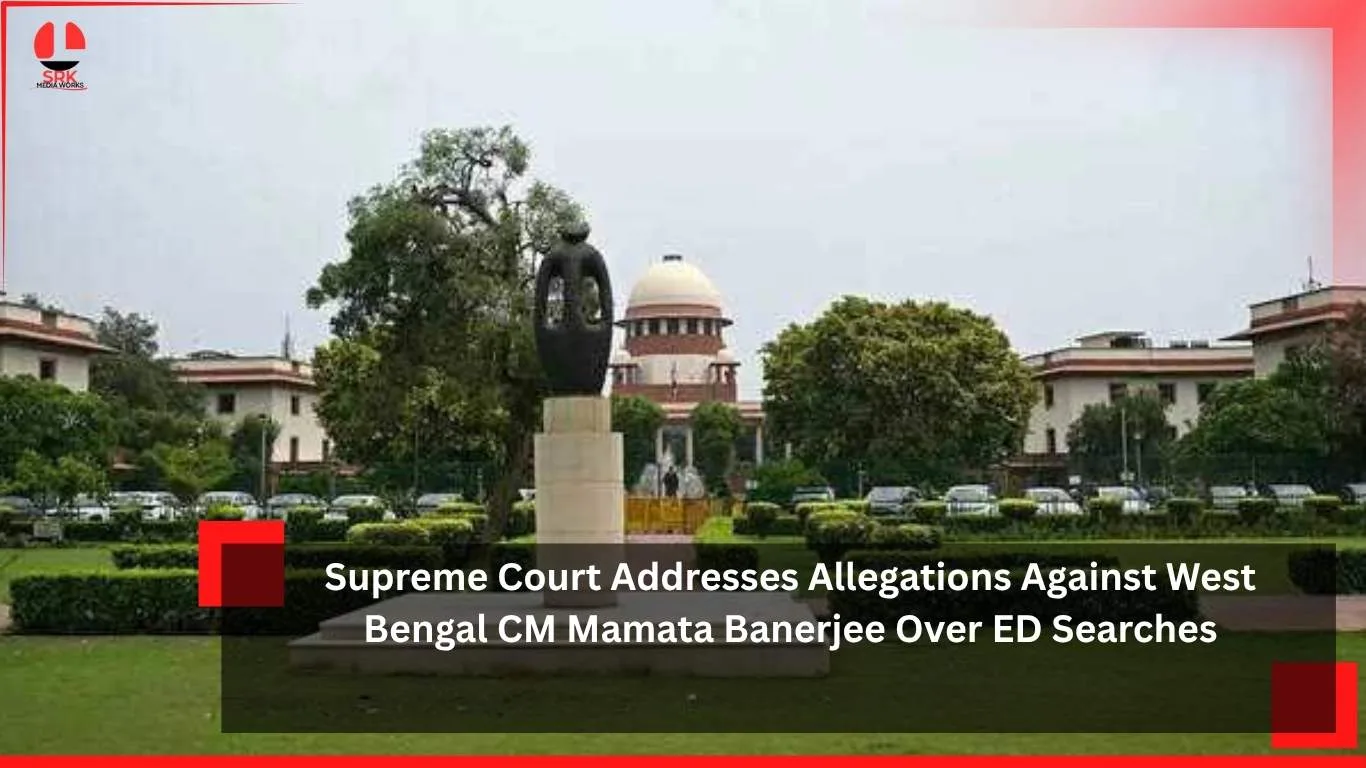
India’s Supreme Court has taken cognizance of allegations surrounding West Bengal Chief Minister Mamata Banerjee in connection with Enforcement Directorate (ED) searches. The matter has sparked intense debate across political and legal circles, as questions of accountability, federal authority, and political vendetta dominate the narrative. The apex court’s intervention underscores the seriousness of the allegations and the need for judicial clarity in a politically sensitive case.
Background of the Case
The Enforcement Directorate has been conducting searches in West Bengal linked to alleged financial irregularities and corruption cases. Opposition parties have accused the state leadership of obstructing investigations, while the ruling party in West Bengal has claimed that the ED’s actions are politically motivated.
The Supreme Court’s decision to address the allegations against Mamata Banerjee marks a significant development, as it places the matter under judicial scrutiny rather than leaving it solely to political discourse.
Key Allegations
- Obstruction of ED searches: Claims that state machinery attempted to hinder federal investigations.
- Political interference: Allegations that directives were issued to limit ED’s access.
- Misuse of power: Concerns that administrative authority was leveraged to protect individuals under investigation.
Comparative Analysis of Federal vs State Authority
| Aspect | Federal Authority (ED) | State Authority (CM) | Conflict Point |
|---|---|---|---|
| Jurisdiction | National financial crimes | State governance | Overlapping powers |
| Accountability | Parliament oversight | State assembly oversight | Political disputes |
| Enforcement | Nationwide raids | Local law enforcement | Resistance during searches |
Political Reactions
- Opposition parties: Welcomed the Supreme Court’s intervention, calling it a step toward accountability.
- Ruling party in West Bengal: Criticized the ED’s actions as politically motivated and framed the case as an attack on federalism.
- Civil society: Divided opinions, with some demanding transparency and others warning against misuse of investigative agencies.
Judicial Significance
The Supreme Court’s involvement ensures that:
- Allegations are examined within a legal framework.
- Federal agencies operate under judicial oversight.
- Political disputes are balanced against constitutional principles.
Crisis Impact Assessment
| Factor | Short-Term Impact | Long-Term Risk |
|---|---|---|
| Political stability | Heightened tensions | Erosion of trust in institutions |
| Governance | Distraction from policy issues | Weakening of state authority |
| Judicial credibility | Strengthened oversight | Risk of politicization |
| Public perception | Increased polarization | Decline in confidence in democracy |
Broader Implications
The case has implications beyond West Bengal:
- Federalism debate: Raises questions about the balance of power between central and state governments.
- Agency accountability: Highlights concerns about the independence of investigative bodies.
- Political precedent: Could set an example for how similar cases are handled in other states.
Analytical Summary
The Supreme Court’s decision to address allegations against West Bengal CM Mamata Banerjee over ED searches is a pivotal moment in India’s political and judicial landscape. It reflects the tension between federal authority and state governance, while also emphasizing the need for transparency and accountability. The outcome of this case will not only affect West Bengal’s politics but could also reshape the broader discourse on federalism and the role of investigative agencies in India.
Disclaimer
This article is based on publicly available reports and analytical perspectives. It does not represent official statements from the Supreme Court of India, the Enforcement Directorate, or the West Bengal government. The content is intended for informational purposes only and should not be construed as definitive or authoritative on sensitive political or legal matters.