





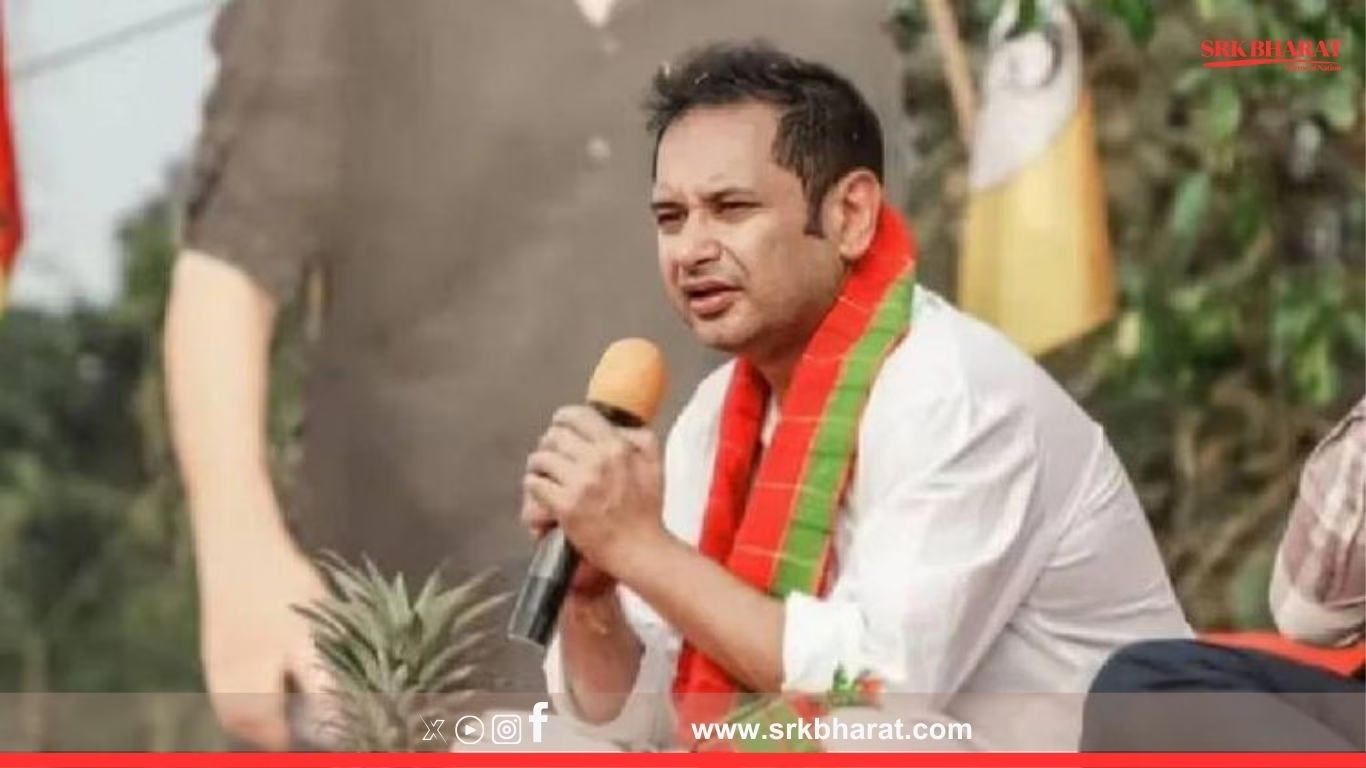
The Supreme Court of India has issued a formal notice to the Election Commission of India (ECI), Tripura State Election Commission (SEC), and the Government of Tripura over the prolonged delay in conducting Village Committee elections under the Tripura Tribal Areas Autonomous District Council (TTAADC). The apex court’s intervention comes after a writ petition filed by Tipra Motha chief and tribal rights advocate Pradyot Kishore Manikya Debbarma, who has accused the authorities of systematically denying tribal communities their constitutional right to grassroots governance.
The bench, comprising Chief Justice B.R. Gavai and Justice N.V. Anjaria, has granted four weeks for the respondents to explain why elections have not been held despite the expiry of the previous committees’ term in March 2021. The court’s notice marks a significant moment in Tripura’s tribal politics, where over 587 Village Committees—analogous to gram panchayats—have remained defunct for more than four years.
🧭 Timeline of Events Leading to Supreme Court Notice
| Year/Month | Event Description | Outcome/Impact |
|---|---|---|
| March 2021 | Term of 587 Village Committees expires | No elections held; administrator appointed |
| July 2022 | Tripura High Court orders elections by Nov 2022 | Order not implemented |
| May 2024 | SEC promises polls by Dec 2024 in contempt hearing | No progress reported |
| August 25, 2025 | Supreme Court issues notice to ECI, SEC, and State Govt | Four-week deadline for response |
Despite multiple court directives and public assurances, the elections have been repeatedly postponed, citing logistical challenges, the COVID-19 pandemic, and integration of Bru migrants into the electoral rolls.
📊 Governance Vacuum in TTAADC Areas
| Governance Unit | Status Since March 2021 | Administrative Control | Affected Population |
|---|---|---|---|
| Village Committees (587) | Defunct | Administrator under Governor | Over 12 lakh tribal residents |
| ADC Council | Functioning under Tipra Motha | Elected in 2021 | Covers 70% of Tripura’s land area |
The absence of elected Village Committees has stalled developmental projects, disrupted local administration, and deprived tribal communities of basic services such as sanitation, education, and healthcare. According to the petition, this violates Articles 243K, 243ZA, and 324 of the Constitution, which mandate timely elections to local bodies.
🔍 Pradyot Manikya’s Stand: “I Will Not Remain Silent”
Reacting to the Supreme Court’s notice, Pradyot Manikya posted on social media:
“I thank the Hon SC for issuing notice. Our people have suffered and people who have done this should be held accountable. Fear of losing the election cannot mean you can curtail the democratic rights of the indigenous people of Tripura. I am not going to remain silent.”
He later appeared on a live broadcast, reiterating that the delay in elections is a deliberate attempt to weaken tribal self-governance. “If taking this issue to the Supreme Court means sustaining political loss, I am ready for it,” he said.
| Pradyot’s Statement | Political Implication |
|---|---|
| “Fear of losing cannot justify delay” | Accuses ruling party of strategic stalling |
| “I won’t remain silent” | Signals continued legal and political pressure |
| “People must be held accountable” | Demands transparency and accountability |
Tipra Motha, which governs the TTAADC, has consistently demanded timely elections and accused the state government of undermining tribal autonomy.
🧠 Legal Arguments Presented in Court
Senior Advocate Gopal Sankarnarayan, appearing for Pradyot, argued that Village Committees are equivalent to Municipal Corporations and play a vital role in local governance. He highlighted that despite clear directions from the Tripura High Court, the SEC failed to act.
| Legal Provision Cited | Relevance to Case |
|---|---|
| Section 4 of TTAADC Act, 1994 | Mandates elections before 5-year term expiry |
| Articles 243K, 243ZA, 324 | Constitutional mandate for timely local elections |
| High Court Orders (2022) | Directed elections by November 2022 |
The petition also noted that the delay has led to non-release of funds for welfare schemes, depriving Scheduled Tribes and rural populations of essential services.
📉 Electoral Roll Revision and Bru Integration
One of the reasons cited for the delay is the integration of 21,000 Bru migrants into the electoral rolls. While the SEC has argued that revision is essential, critics point out that other elections—including Assembly and Lok Sabha polls—have been conducted during the same period.
| Electoral Roll Status | Voter Count (2021) | Voter Count (2025 est.) | Key Challenge |
|---|---|---|---|
| ADC Village Committees | 7.68 lakh | 8.65 lakh+ | Inclusion of Bru migrants |
Activists argue that the delay is politically motivated and that the SEC has failed to prioritize the democratic rights of tribal voters.
📌 Conclusion
The Supreme Court’s notice over the delay in Tripura’s Village Committee elections marks a pivotal moment for tribal governance in the state. With over 587 committees lying defunct and millions of tribal residents affected, the court’s intervention has reignited calls for accountability, transparency, and timely democratic processes.
Pradyot Manikya’s unwavering stance and legal activism have brought national attention to the issue, challenging the state’s inertia and reinforcing the constitutional rights of indigenous communities. As the ECI, SEC, and Tripura government prepare their responses, the next four weeks could determine whether grassroots democracy in TTAADC areas is finally restored—or further delayed.
—
Disclaimer: This article is based on publicly available news reports and official statements as of August 26, 2025. It is intended for informational purposes only and does not constitute legal, political, or constitutional advice.
seo компания seo компания .