


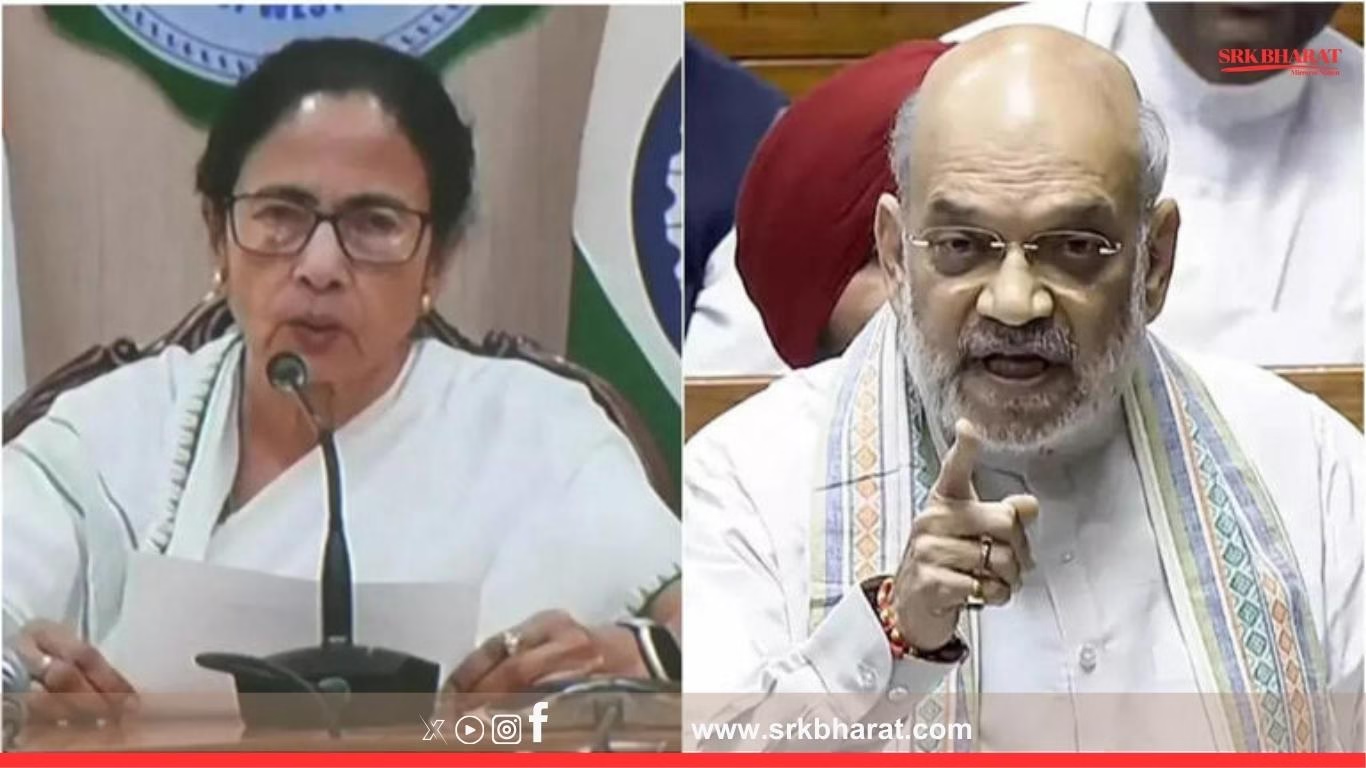
The Trinamool Congress (TMC) has launched a scathing attack on the Centre’s move to introduce three controversial bills that propose the removal of Prime Ministers, Chief Ministers, and ministers held in custody for over 30 days on serious criminal charges. The party has termed the Joint Parliamentary Committee (JPC) formed to examine the bills a “farce” and declared it will not nominate any member to the panel, intensifying political tensions in the wake of the Monsoon Session’s conclusion.
The bills in question—the Government of Union Territories (Amendment) Bill 2025, the Constitution (130th Amendment) Bill 2025, and the Jammu and Kashmir Reorganisation (Amendment) Bill 2025—were introduced in the Lok Sabha by Union Home Minister Amit Shah on August 21, 2025. The proposal to refer them to a 31-member JPC was passed amid uproar, with opposition MPs tearing copies of the bills and staging protests inside the House.
🧭 Overview of the Proposed Bills
| Bill Name | Purpose | Key Provision |
|---|---|---|
| Constitution (130th Amendment) Bill 2025 | Amendment to disqualify jailed leaders from holding office | Removal after 30 days in custody |
| Government of Union Territories (Amendment) Bill 2025 | Align UT governance with proposed disqualification norms | Applies same rule to UT ministers |
| Jammu & Kashmir Reorganisation (Amendment) Bill 2025 | Extend disqualification provision to J&K ministers | Uniformity across restructured states |
The bills aim to plug what the government calls a “glaring loophole” in the law, where elected leaders can continue to hold office despite being incarcerated for serious offences. PM Modi defended the move, saying, “Modi will not allow corrupt leaders to run governments from jail”.
📊 Composition and Mandate of the Joint Parliamentary Committee
| Committee Type | Members from Lok Sabha | Members from Rajya Sabha | Total Members | Report Deadline |
|---|---|---|---|---|
| Joint Parliamentary Committee (JPC) | 21 | 10 | 31 | Winter Session (Nov 2025) |
The JPC is tasked with reviewing the bills and submitting its recommendations before the Winter Session. However, TMC’s refusal to participate has cast doubts on the committee’s credibility and balance.
🔍 TMC’s Stand: Political Weapon or Legislative Reform?
TMC MP and national spokesperson Derek O’Brien issued a statement calling the JPC “a political weapon disguised as a committee.” The party accused the Centre of using the bills to target opposition-ruled states and leaders under investigation, including those from Bengal, Delhi, and Jharkhand.
| TMC Objection Point | Description |
|---|---|
| Timing of Bill Introduction | Introduced at end of Monsoon Session |
| Lack of Consultation | No prior discussion with opposition parties |
| Targeted Legislation | Seen as aimed at opposition leaders in jail |
| JPC Composition | Dominated by ruling party MPs |
TMC’s decision not to nominate any member to the JPC was taken at an internal meeting of the INDIA bloc, where the party reportedly urged other opposition members to boycott the panel as well.
🧠 Opposition Reactions: Divided but Concerned
While TMC has opted out, other opposition parties within the INDIA bloc are divided. Congress, DMK, and RJD are reportedly considering nominating members to ensure the government does not get a “free run” on the bills. Congress leader KC Venugopal clashed with Amit Shah in the Lok Sabha, referencing Shah’s own arrest in 2010 while serving as Gujarat’s Home Minister.
| Party Name | Position on JPC Participation | Key Concerns Raised |
|---|---|---|
| TMC | Boycott | Political misuse, lack of transparency |
| Congress | Likely to participate | Ensure scrutiny, prevent misuse |
| DMK | Undecided | Awaiting internal consensus |
| RJD | Leaning toward participation | Wants to challenge provisions legally |
The opposition fears the bills could be used to disqualify leaders like Arvind Kejriwal, Hemant Soren, and others currently facing legal proceedings.
📉 Legal and Constitutional Implications
The bills propose that any elected leader held in custody for 30 consecutive days for offences punishable with five years or more would be automatically removed from office. Critics argue this violates the principle of “innocent until proven guilty” and could be misused for political vendetta.
| Legal Concern | Description |
|---|---|
| Presumption of Innocence | Removal before conviction undermines due process |
| Judicial Review | Likely to be challenged in Supreme Court |
| Federal Structure | Interference in state governance |
| Selective Enforcement | Risk of targeting opposition leaders |
Constitutional experts have warned that the amendment could set a dangerous precedent, allowing governments to weaponize law enforcement against political rivals.
🧠 PM Modi’s Justification and Political Messaging
Prime Minister Narendra Modi defended the bills during a rally in Kolkata, citing examples of ministers running governments from jail. He referred to former Bengal ministers Partha Chatterjee and Jyoti Priya Mallick, arrested in corruption cases, and criticized the TMC for shielding them.
| Modi’s Argument | Key Message |
|---|---|
| Anti-Corruption Stand | No leader should govern from jail |
| Moral Accountability | Ministers must resign if arrested |
| Public Sentiment | Voters expect clean governance |
| Opposition Resistance | “They are scared of facing punishment” |
Modi emphasized that the bills aim to bring parity between government employees—who are suspended upon arrest—and elected officials, who currently face no such automatic disqualification.
📌 Conclusion
The Centre’s push to introduce legislation for the removal of jailed Prime Ministers, Chief Ministers, and ministers has triggered a fierce political storm. With the TMC branding the JPC a “farce” and refusing to participate, and other opposition parties weighing their options, the road ahead for the bills is fraught with legal, constitutional, and political challenges.
As the Winter Session approaches, the fate of the bills—and the credibility of the JPC—will depend on whether consensus can be built or whether the issue becomes another flashpoint in India’s increasingly polarized Parliament.
—
Disclaimer: This article is based on publicly available news reports and official statements as of August 24, 2025. It is intended for informational purposes only and does not constitute legal, political, or electoral advice.