

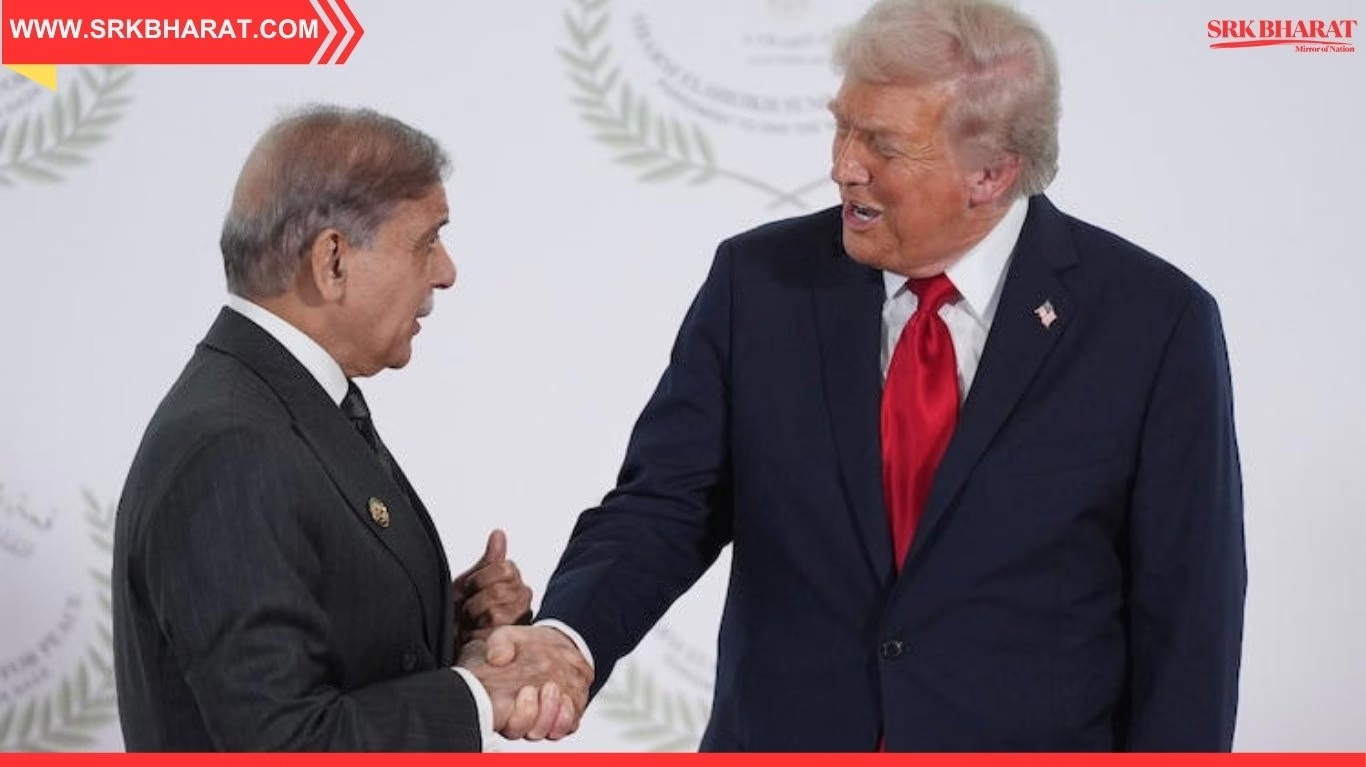
Former Indian Air Force officer Ajay Ahlawat has stirred debate with his sharp reaction to US President Donald Trump’s recent claim that Pakistan is secretly conducting nuclear weapons tests. In a social media post dated November 3, 2025, Ahlawat described Trump’s assertion as a “tough pill to swallow” for Islamabad, highlighting the diplomatic and strategic discomfort it could trigger within Pakistan’s establishment. The statement came after Trump’s interview on CBS’s “60 Minutes,” where he alleged that Pakistan, along with China, Russia, and North Korea, was engaged in covert underground nuclear testing.
Trump’s remarks have reignited global concerns over nuclear proliferation and transparency, especially in South Asia. The former IAF officer’s commentary adds a layer of military perspective to the unfolding narrative, suggesting that Pakistan now faces a dilemma: deny the claim and risk contradicting a leader they’ve previously endorsed, or accept it and face international scrutiny as a potential rogue state.
🧠 Key Highlights from Ajay Ahlawat’s Commentary
| Statement by Ahlawat | Interpretation Summary |
|---|---|
| “Tough pill to swallow for Pakis…” | Suggests diplomatic discomfort and credibility crisis |
| “They hang on to Prez T’s coattails…” | Implies selective endorsement of Trump’s statements |
| “Deny this and call Prez T a liar…” | Highlights Pakistan’s strategic communication dilemma |
| “Accept this and be called out as rogue…” | Warns of reputational damage in global forums |
Ahlawat’s post reflects a nuanced understanding of geopolitical signaling and military diplomacy.
📊 Summary of Trump’s Nuclear Testing Allegations
| Country | Alleged Activity | Trump’s Statement Context |
|---|---|---|
| Pakistan | Underground nuclear tests | “They’re testing, but they don’t talk about it.” |
| China | Secret nuclear tests | “China’s testing, but it’s not reported.” |
| Russia | Active nuclear testing | “Russia’s testing openly.” |
| North Korea | Continued testing | “North Korea never stopped.” |
| United States | Plans to resume testing | “We’ll test because they test.” |
Trump’s comments were part of a broader justification for resuming US nuclear testing.
🗣️ Reactions from Global and Regional Stakeholders
| Entity | Response Summary |
|---|---|
| Pakistani Security Official | “Pakistan will not be the first to resume nuclear tests.” |
| Indian Defence Analysts | “If true, this alters South Asia’s strategic balance.” |
| US Strategic Command | “No official confirmation on Pakistan’s testing.” |
| Chinese Foreign Ministry | “We categorically deny any secret nuclear testing.” |
The responses range from denial to cautious strategic recalibration.
📈 Strategic Implications for South Asia
| Area of Impact | Potential Consequences |
|---|---|
| India–Pakistan Relations | Increased mistrust and surveillance |
| Nuclear Non-Proliferation | Pressure on IAEA to investigate |
| Regional Stability | Risk of arms race escalation |
| Diplomatic Engagement | Strained ties with Western allies |
The allegations could prompt renewed calls for transparency and verification protocols.
📌 Conclusion
President Donald Trump’s claim that Pakistan is conducting secret nuclear tests has triggered a wave of reactions across diplomatic, military, and strategic circles. Former IAF officer Ajay Ahlawat’s pointed remarks underscore the credibility challenges Pakistan may face in navigating this narrative. As global powers weigh the implications, South Asia finds itself once again at the center of a high-stakes nuclear discourse. Whether Pakistan chooses to refute or remain silent, the spotlight on its nuclear posture is unlikely to dim anytime soon.
Disclaimer: This article is based on publicly available interviews, social media commentary, and news reports. It is intended for informational and editorial purposes only and does not constitute diplomatic or military advice.
Thank you for your sharing. I am worried that I lack creative ideas. It is your article that makes me full of hope. Thank you. But, I have a question, can you help me?