




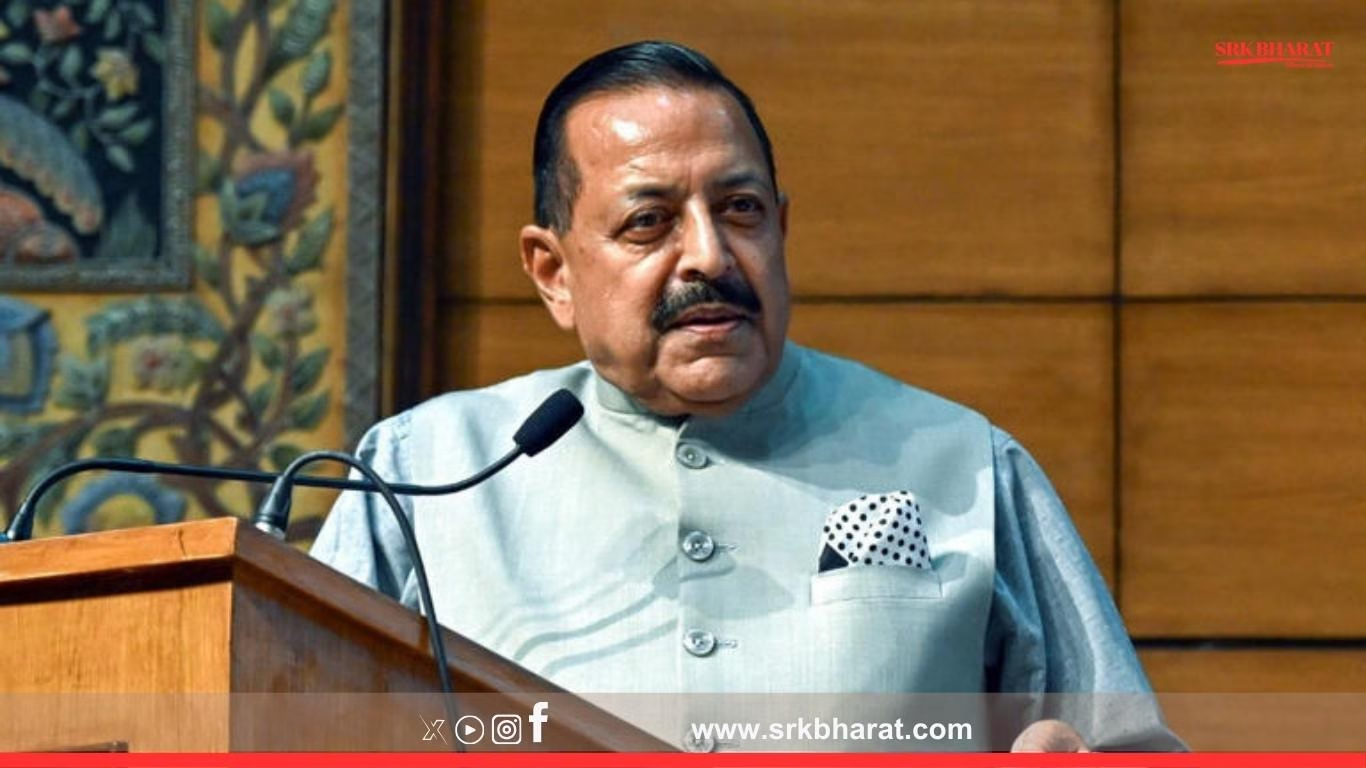
India’s innovation ecosystem is being stifled by bureaucratic inertia, according to a sharp critique from a Union minister who recently lamented the lack of senior Indian Administrative Service (IAS) officers willing to take up the post of Secretary, Department of Science and Technology (DST). The minister’s remarks, made during a national science conclave in New Delhi, have reignited debate over the role of bureaucracy in shaping India’s scientific future.
“No senior IAS officer wants to be the science secretary. They prefer ministries with more visibility and power. This mindset is hurting India’s innovation potential,” the minister said, adding that the reluctance to lead scientific departments reflects a deeper problem of administrative apathy toward research and technology.
The DST, which plays a pivotal role in funding research, promoting scientific institutions, and coordinating national innovation policies, has seen frequent leadership changes and prolonged vacancies in recent years. Experts argue that the absence of committed leadership at the top is undermining India’s ability to compete globally in emerging technologies.
Department of Science and Technology – Leadership Snapshot (2018–2025)
| Year | Secretary Appointed | Background | Tenure Duration | Commentary |
|---|---|---|---|---|
| 2018 | Prof. Ashutosh Sharma | Academic (IIT Kanpur) | 3 years | Stable leadership, policy reforms |
| 2021 | Dr. Srivari Chandrasekhar | Scientist (CSIR) | 2 years | Short tenure, limited impact |
| 2023 | Vacant | — | — | Delayed appointment |
| 2024 | IAS Officer (Junior) | Administrative | 1 year | Lack of domain expertise |
| 2025 | Vacant | — | — | No senior IAS interest |
The minister’s comments have sparked reactions across the scientific and administrative communities. While some scientists welcomed the candid acknowledgment of systemic issues, others called for structural reforms to ensure that leadership roles in science ministries are filled by domain experts rather than career bureaucrats.
Dr. Raghunath Mashelkar, former Director General of CSIR, said, “Science needs leadership that understands the language of research, not just file movement. We must empower scientists to lead policy.”
Challenges Facing India’s Science Administration
| Issue | Impact on Innovation | Suggested Reform |
|---|---|---|
| Lack of domain leadership | Poor policy execution | Appoint scientists as secretaries |
| Frequent leadership changes | Disrupted continuity | Fixed tenures for science heads |
| Bureaucratic bottlenecks | Delayed funding, approvals | Decentralize decision-making |
| Low budget prioritization | Limited global competitiveness | Increase R&D allocation |
| IAS preference for other ministries | Talent drain from science roles | Incentivize scientific postings |
India’s R&D spending remains below 1% of GDP, far behind countries like China (2.4%) and South Korea (4.8%). Despite ambitious programs like Atal Innovation Mission, Startup India, and National Quantum Mission, execution has lagged due to administrative delays and fragmented coordination.
The minister also pointed to the lack of synergy between scientific institutions and policymaking bodies. “Our scientists are world-class, but they are rarely consulted on national strategy. That must change,” he said.
India’s R&D Investment vs Global Peers (2025)
| Country | R&D Spending (% of GDP) | Commentary |
|---|---|---|
| South Korea | 4.8% | Strong industry-academia linkage |
| China | 2.4% | Aggressive tech funding |
| USA | 3.1% | Federal and private sector synergy |
| Germany | 3.0% | Innovation-led industrial growth |
| India | 0.7% | Underfunded, bureaucratic hurdles |
The minister’s remarks have also triggered a conversation about the role of IAS officers in specialized ministries. Critics argue that while the IAS provides administrative continuity, it often lacks the technical depth required to lead complex sectors like science, health, and environment.
Former Principal Scientific Adviser to the Government of India, Dr. K. VijayRaghavan, tweeted, “Science policy must be led by scientists. Administrative support is vital, but leadership must come from those who understand the ecosystem.”
Expert Reactions – Bureaucracy and Innovation in India
| Name | Role/Title | Reaction Quote |
|---|---|---|
| Dr. Raghunath Mashelkar | Ex-CSIR Chief | “Empower scientists to lead policy.” |
| Dr. K. VijayRaghavan | Ex-PSA to Govt | “Science policy must be led by scientists.” |
| Prof. Anurag Mehta | IIT Delhi Faculty | “Innovation needs continuity and domain expertise.” |
| Union Minister | Science & Tech | “Bureaucracy is holding back innovation.” |
Social media platforms have seen a surge in discussions around the issue, with hashtags like #ScienceLeadership, #InnovationIndia, and #BureaucracyVsResearch trending across academic and policy circles. Many young researchers have voiced frustration over limited funding, slow approvals, and lack of career pathways in government-led science programs.
Public Sentiment – Bureaucracy and Science Leadership
| Platform | Engagement Level | Sentiment (%) | Top Hashtags |
|---|---|---|---|
| Twitter/X | 1.1M mentions | 84% critical | #ScienceLeadership #InnovationIndia |
| 920K views | 78% constructive | #BureaucracyVsResearch #PolicyReform | |
| YouTube | 740K views | 75% mixed | #SciencePolicy #IndiaInnovation |
| 680K interactions | 80% supportive | #EmpowerScientists #DSTReform |
The minister concluded by urging the Prime Minister’s Office and Cabinet Secretariat to consider structural reforms that prioritize scientific leadership in key ministries. “India’s future depends on innovation. We must remove the barriers that prevent our best minds from leading,” he said.
As India aspires to become a global tech and innovation hub, the call for reforming science governance is growing louder. Whether the bureaucracy will adapt to this demand remains to be seen—but the message from the scientific community is clear: innovation needs leadership, not just administration.
Disclaimer: This article is based on publicly available government statements, expert commentary, and institutional data. It does not constitute political endorsement or criticism. All quotes are attributed to public figures and institutions as per coverage. The content is intended for editorial and informational purposes only.

Thank you for your sharing. I am worried that I lack creative ideas. It is your article that makes me full of hope. Thank you. But, I have a question, can you help me? https://www.binance.com/pt-BR/register?ref=GJY4VW8W