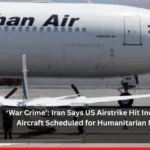



Iran has accused the United States of committing a “war crime” after an airstrike reportedly struck an aircraft bound for India that was scheduled to carry out a humanitarian mission. The incident has sparked outrage in Tehran, with officials claiming the strike violated international law and endangered civilian lives. The aircraft, according to Iranian sources, was preparing to deliver humanitarian supplies when it was targeted.
Background of the Incident
The alleged airstrike occurred amid heightened tensions between Washington and Tehran. The United States has intensified its military operations in the region, citing threats from Iranian-backed groups. Iran, however, insists that the targeted aircraft was part of a humanitarian mission, not a military operation.
This accusation adds a new dimension to the ongoing conflict, as it involves India—a country that has historically maintained balanced relations with both the U.S. and Iran.
Iran’s Response
Iranian officials condemned the strike, labeling it a deliberate act of aggression. They argued that targeting a humanitarian mission violates the Geneva Conventions and undermines international norms.
Key points from Iran’s response:
- Accusation of war crime against the United States.
- Assertion of sovereignty over its humanitarian operations.
- Warning of retaliation if such actions continue.
- Appeal to international bodies for investigation and accountability.
India’s Position
India has not yet issued a formal statement, but the incident places New Delhi in a delicate position. As a recipient of humanitarian aid and a strategic partner to both Washington and Tehran, India must navigate the fallout carefully.
Possible implications for India:
- Diplomatic balancing act between U.S. and Iran.
- Concerns over civilian safety in humanitarian missions.
- Potential disruption of aid delivery schedules.
Timeline of Events
| Date | Event | Impact |
|---|---|---|
| March 2026 | US airstrike hits Iran aircraft | Humanitarian mission disrupted |
| March 2026 | Iran labels strike a war crime | Diplomatic tensions escalate |
| March 2026 | India-bound mission halted | Aid delivery delayed |
| Ongoing | Calls for international investigation | Pressure on global institutions |
Strategic Importance of Humanitarian Missions
Humanitarian missions are critical for maintaining stability in conflict zones. They provide essential supplies such as food, medicine, and shelter. Targeting such missions not only violates international law but also exacerbates human suffering.
Comparative Analysis: Military vs. Humanitarian Targets
| Factor | Military Target | Humanitarian Target |
|---|---|---|
| Legality | Permissible under certain conditions | Prohibited under international law |
| Impact | Weakens enemy capabilities | Endangers civilians, violates norms |
| Global Reaction | Mixed, depending on context | Strong condemnation |
| Long-term Consequences | Escalation of conflict | Loss of credibility, humanitarian crisis |
International Reactions
The global community is expected to respond strongly to Iran’s accusations.
- United Nations: Likely to call for investigation.
- European Union: May urge restraint and adherence to international law.
- Russia and China: Could support Iran’s position against the U.S.
- Gulf States: Reactions may vary depending on alliances.
Broader Geopolitical Implications
The incident highlights the risks of military operations in volatile regions. By striking an aircraft allegedly on a humanitarian mission, the U.S. risks alienating neutral countries like India and undermining its global image.
Conclusion
Iran’s accusation that a U.S. airstrike hit an India-bound humanitarian aircraft has escalated tensions in the region. Labeling the incident a “war crime,” Tehran has called for accountability and warned of consequences. The fallout places India in a challenging diplomatic position and raises urgent questions about the protection of humanitarian missions in conflict zones.
Disclaimer
This article is based on reported statements and geopolitical analysis. It does not confirm or deny official military or diplomatic actions. Readers should treat the information as interpretative reporting rather than definitive government policy.