






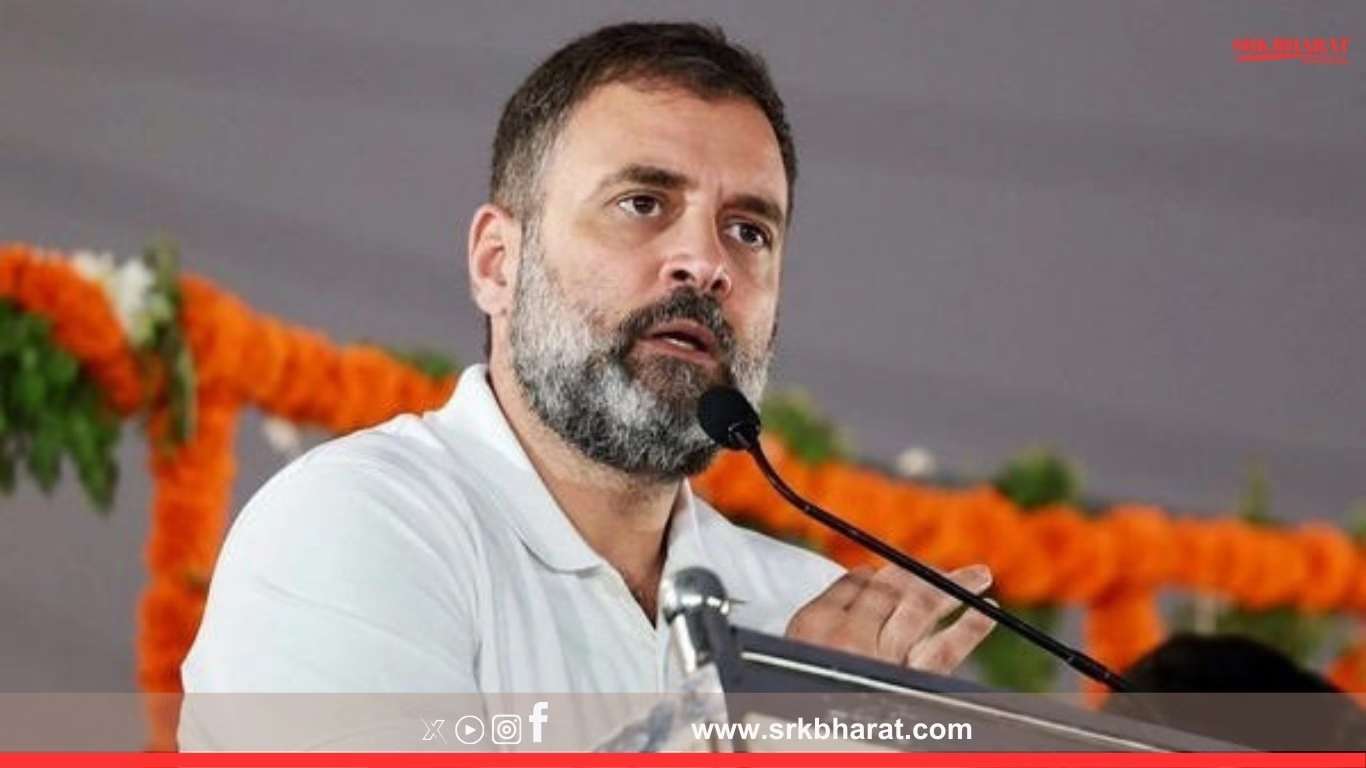
Congress leader Rahul Gandhi has once again found himself at the center of a legal and political storm, with calls intensifying for him to face criminal defamation proceedings over remarks deemed defamatory by several individuals and groups. The controversy stems from a series of public statements made by Gandhi during election campaigns and press interactions, where he allegedly linked certain surnames and communities to criminal behavior. Critics argue that such remarks not only violate the dignity of individuals but also undermine the constitutional principles of equality and justice.
Legal experts, political analysts, and civil society voices are now converging on the view that Gandhi must be held accountable under India’s criminal defamation laws to uphold the rule of law and deter reckless public discourse.
What Is Criminal Defamation Under Indian Law?
Criminal defamation is governed by Sections 499 and 500 of the Indian Penal Code (IPC). Section 499 defines defamation as any spoken or written words intended to harm the reputation of a person, while Section 500 prescribes punishment of up to two years imprisonment, a fine, or both.
| Legal Provision | Description |
|---|---|
| Section 499 IPC | Definition of defamation |
| Section 500 IPC | Punishment for defamation |
| Burden of Proof | Lies with the complainant |
| Exceptions | Truth, public good, fair criticism |
While civil defamation allows for monetary compensation, criminal defamation is pursued to penalize the act itself and deter future violations.
The Controversial Remarks: Trigger for Legal Action
Rahul Gandhi’s remarks during a 2019 election rally in Karnataka—where he allegedly said, “Why do all thieves have Modi as their surname?”—sparked outrage and led to multiple defamation complaints. The statement was perceived as targeting individuals with the surname “Modi,” including Prime Minister Narendra Modi, businessman Lalit Modi, and fugitive diamond trader Nirav Modi.
| Statement Made | Alleged Implication |
|---|---|
| “Why do all thieves have Modi as their surname?” | Generalization of criminality based on surname |
| Context | 2019 Lok Sabha campaign |
| Complaints Filed | Surat, Patna, Ahmedabad |
The most prominent case was filed by BJP MLA Purnesh Modi in Surat, Gujarat, which led to Gandhi’s conviction and subsequent disqualification from Parliament in 2023. Though his conviction was later stayed by the Supreme Court, the legal battle reignited the debate on criminal defamation.
Legal Precedents Supporting Criminal Defamation
India’s judiciary has consistently upheld the constitutionality of criminal defamation. In the landmark Subramanian Swamy v. Union of India (2016), the Supreme Court ruled that criminal defamation does not violate the right to free speech under Article 19(1)(a) and is a reasonable restriction under Article 19(2).
| Case Name | Verdict |
|---|---|
| Subramanian Swamy v. Union of India (2016) | Criminal defamation is constitutional |
| Purnesh Modi v. Rahul Gandhi (2023) | Conviction under Section 500 IPC |
| Arun Jaitley v. Arvind Kejriwal (2015) | Civil and criminal defamation pursued simultaneously |
These cases affirm that public figures must exercise restraint and responsibility in their speech, especially when it concerns identifiable individuals or communities.
Political Fallout and Public Accountability
Rahul Gandhi’s remarks have had significant political consequences. His conviction led to his disqualification from the Lok Sabha, triggering a nationwide debate on free speech versus accountability. While Congress supporters framed it as political vendetta, others viewed it as a necessary legal correction.
| Political Impact | Outcome |
|---|---|
| Disqualification from Lok Sabha | March 2023 |
| Supreme Court Stay on Conviction | August 2023 |
| Congress Narrative | “Voice of Opposition silenced” |
| BJP Narrative | “No one is above the law” |
The episode also raised questions about the role of political leaders in shaping public discourse and the limits of campaign rhetoric.
Why Criminal Defamation Is Necessary in This Case
Legal scholars argue that criminal defamation proceedings against Rahul Gandhi are essential for several reasons:
- Deterrence: Public figures must be deterred from making sweeping generalizations that malign entire communities.
- Rule of Law: No individual, regardless of political stature, should be exempt from legal scrutiny.
- Public Trust: Holding leaders accountable reinforces public faith in democratic institutions.
- Judicial Precedent: Upholding prior convictions ensures consistency in legal interpretation.
| Justification | Explanation |
|---|---|
| Deterrence | Prevents misuse of free speech |
| Rule of Law | Applies equally to all citizens |
| Public Trust | Restores faith in justice system |
| Legal Consistency | Aligns with Supreme Court rulings |
Criminal defamation, in this context, is not just a legal tool but a mechanism to uphold democratic ethics.
Counterarguments and Rebuttals
Critics of criminal defamation argue that it stifles free speech and is often used to harass dissenters. However, in Gandhi’s case, the remarks were not policy critiques but personal attacks based on identity markers.
| Counterargument | Rebuttal |
|---|---|
| Chilling effect on free speech | Law permits fair criticism and truth |
| Political vendetta | Courts have upheld conviction independently |
| Civil defamation is sufficient | Criminal defamation addresses public harm |
The distinction between dissent and defamation must be clearly maintained to protect both free speech and individual dignity.
Conclusion: Legal Accountability Is Essential for Democratic Integrity
Rahul Gandhi’s case underscores the delicate balance between free speech and legal accountability. While political leaders enjoy wide latitude in expressing opinions, they must also bear the consequences of defamatory statements that harm reputations and incite public prejudice.
Criminal defamation proceedings are not just about punishing speech—they are about preserving the integrity of public discourse, ensuring justice for aggrieved individuals, and reinforcing the principle that no one is above the law.
—
Disclaimer: This article is based on publicly available court records, verified news reports, and legal commentary. It is intended for informational purposes only and does not constitute legal advice or political endorsement. All figures and developments are subject to change based on judicial proceedings.

торкретирование бетона цена торкретирование бетона цена .
1xbet giri? g?ncel http://www.1xbet-7.com/ .
beep beep casino ?esk? republika beepbeepcasino-online.com .
melbet sports https://v-bux.ru .
battery aviator game apk battery aviator game apk .
карниз с приводом http://www.prokarniz36.ru .
акт о заливе квартиры акт о заливе квартиры .
купить курсовая работа [url=https://kupit-kursovuyu-21.ru/]https://kupit-kursovuyu-21.ru/[/url] .
pin up ilova ishlamayapti pin up ilova ishlamayapti
пин ап играть в демо авиатор https://pinup5010.ru/
пин ап новый домен http://pinup5011.ru/
пин ап способы оплаты http://pinup5012.ru/
пин ап активация бонуса https://pinup5013.ru
pin up tikish qanday qilinadi pinup5014.ru
1 win казино скачать http://www.1win5522.ru
1вин как зарегистрироваться 1вин как зарегистрироваться
пин ап скачать авиатор http://pinup5015.ru
1win uzbekistan 1win5512.ru
1win mobil tikish ilova https://1win5513.ru/
мелбет партнерка http://melbet5001.ru/
1win jonli yordam 1win5514.ru
1win что это http://1win12045.ru
мелбет кто владелец http://melbet5006.ru
скачать бк осталось только найти предпочтение подходящее скачать бк осталось только найти предпочтение подходящее
скачать мостбет скачать мостбет
mosbet [url=http://mostbet2031.help/]mosbet[/url]
motbet [url=http://mostbet2032.help]http://mostbet2032.help[/url]
mostbet aplikace [url=http://mostbet2033.help/]mostbet aplikace[/url]
1win partners [url=http://1win3002.mobi]http://1win3002.mobi[/url]
1win peru [url=1win3001.mobi]1win3001.mobi[/url]
1win basketbol tikish [url=MAQOLALAR.UZ]1win basketbol tikish[/url]
1вин поддержка [url=http://SPORT-PROGRAMMING.UZ]http://SPORT-PROGRAMMING.UZ[/url]
1win pro download [url=http://1win12046.ru/]http://1win12046.ru/[/url]
бонусы казино 1win [url=https://1win12047.ru/]https://1win12047.ru/[/url]
1win ug 1win ug
how to enter booking code on 1win how to enter booking code on 1win
1win azerbaycan qeydiyyat http://1win5761.help
1win mobil versiya 1win mobil versiya