






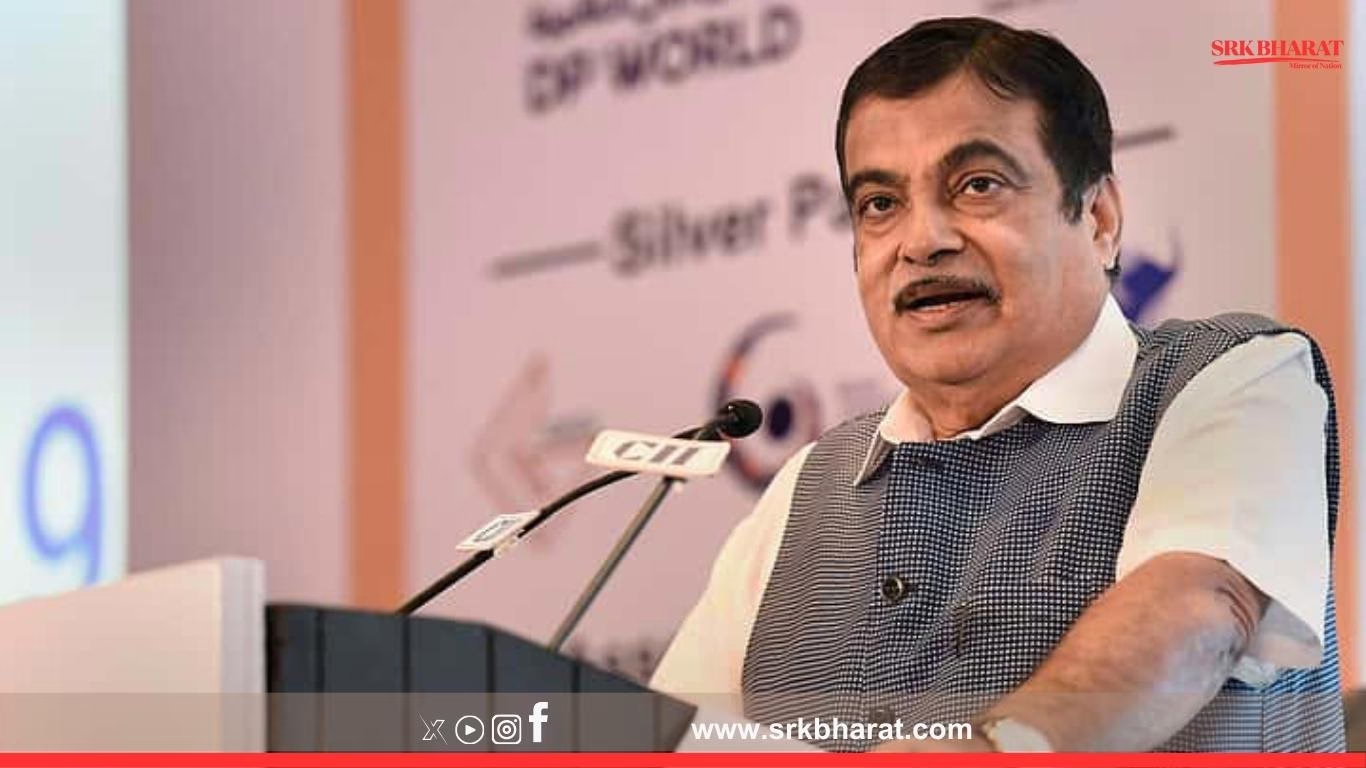
Union Minister for Road Transport and Highways Nitin Gadkari has once again emphasized the importance of India’s Vehicle Scrappage Policy, stating that scrapping nearly 97 lakh unfit vehicles across the country has the potential to generate ₹40,000 crore in Goods and Services Tax (GST) revenue and create as many as 70 lakh new jobs. The minister’s remarks highlight both the economic and environmental benefits of transitioning India’s automotive ecosystem towards sustainability and efficiency.
The policy, introduced to phase out old, polluting vehicles, is not only aimed at reducing carbon emissions and improving road safety but also at revitalizing the auto sector, boosting GST collection, and enhancing job creation opportunities across multiple industries.
Gadkari’s Vision For A Greener, Safer India
Speaking at an industry event, Gadkari underlined that vehicles older than 15–20 years not only contribute disproportionately to air pollution but also compromise fuel efficiency and road safety. He said, “The scrapping of 97 lakh unfit vehicles is not just about removing polluting vehicles from the road. It is about unlocking an opportunity for economic growth, job creation, and a cleaner future.”
The scrappage initiative is being projected as a multi-sectoral economic boost that will benefit industries ranging from steel, aluminum, electronics, and rubber to the automobile and recycling sectors.
The Economic Multiplier Effect
The government expects that dismantling old vehicles will release valuable raw materials back into the production cycle. Steel, copper, rubber, and plastics recovered from scrapped vehicles can be reused in manufacturing, reducing India’s dependency on imports.
Additionally, demand for new vehicles to replace scrapped ones will give a significant push to the automobile industry, one of the largest contributors to India’s GDP. Increased demand will in turn contribute to higher GST revenues, estimated by Gadkari at ₹40,000 crore.
Employment Opportunities
According to projections, setting up and expanding scrappage centers across the country could create 70 lakh jobs in both direct and indirect roles. These include employment in:
- Vehicle recycling plants
- Raw material recovery units
- New vehicle manufacturing and sales
- Transportation and logistics
- Ancillary industries like steel and rubber
This large-scale job creation is expected to provide opportunities, particularly for semi-skilled and unskilled workers, contributing to rural and urban employment.
Environmental Impact Of Scrapping Old Vehicles
Phasing out vehicles older than 15 years, particularly commercial vehicles, is expected to have a measurable impact on India’s air quality. Studies show that these aging vehicles contribute up to 60–65% of vehicular emissions despite representing a smaller percentage of the total fleet.
Scrapping unfit vehicles will:
- Reduce carbon dioxide (CO₂) and particulate matter (PM2.5 and PM10) emissions.
- Improve urban air quality and reduce smog levels.
- Lower India’s crude oil import bill through improved fuel efficiency.
Comparative Table: Economic & Environmental Benefits
| Parameter | With 97 Lakh Vehicles Scrapped | Without Scrappage Policy |
|---|---|---|
| Estimated GST Revenue | ₹40,000 crore | Minimal increase |
| Jobs Created | 70 lakh | Status quo |
| Steel Recovered | 15 million tonnes (approx.) | Imports remain high |
| Emissions Reduced | Up to 25% in key cities | Rising pollution |
| Auto Sector Growth | Strong demand for new vehicles | Stagnant demand |
Pivot Table: Sector-Wise Job Creation Potential
| Sector | Direct Jobs | Indirect Jobs | Total Jobs |
|---|---|---|---|
| Recycling Plants | 10 lakh | 15 lakh | 25 lakh |
| Auto Manufacturing | 12 lakh | 8 lakh | 20 lakh |
| Logistics | 5 lakh | 7 lakh | 12 lakh |
| Ancillary Industries | 6 lakh | 7 lakh | 13 lakh |
| Total | 33 lakh | 37 lakh | 70 lakh |
This pivot breakdown clearly shows that job opportunities will span across diverse sectors, ensuring widespread economic benefits.
Challenges Ahead
While the Vehicle Scrappage Policy has transformative potential, it is not without challenges:
- Public Resistance: Many vehicle owners are reluctant to give up old vehicles, either due to sentimental value or financial constraints.
- Infrastructure Gaps: India needs more authorized scrapping facilities across states to handle such a large volume.
- Implementation Delays: Effective coordination between state transport departments, recycling units, and automobile companies is crucial.
- Incentive Mechanisms: Vehicle owners need attractive financial incentives such as rebates on new vehicle purchases, waiver of registration fees, and road tax relief.
Industry Response
Automobile manufacturers and industry bodies have welcomed the policy, noting that it will accelerate the shift towards cleaner, more efficient vehicles, including electric and hybrid models. Some automakers are already offering exchange bonuses and scrappage discounts to attract customers.
Environmental groups have also praised the move, though they have urged the government to ensure strict enforcement and transparency in scrappage operations.
Global Perspective
India’s scrappage policy is modeled on similar initiatives in developed nations such as the USA, Germany, and Japan, where scrappage programs have successfully reduced emissions while revitalizing the automobile industry. If implemented efficiently, India’s initiative could serve as a benchmark for other developing economies.
Roadmap For The Future
Gadkari has urged state governments and private investors to accelerate the establishment of modern scrappage centers equipped with global best practices. The goal is to create a robust ecosystem that ensures:
- Quick deregistration of old vehicles
- Efficient material recovery
- Environmentally safe disposal practices
- Incentive-backed purchase of cleaner vehicles
The policy also aligns with India’s commitment to achieving net-zero emissions by 2070 under its climate action pledges.
Conclusion
The scrapping of 97 lakh unfit vehicles, as emphasized by Nitin Gadkari, presents a win-win scenario for India. It promises not only a substantial boost of ₹40,000 crore in GST revenue but also the creation of 70 lakh jobs, alongside cleaner air and safer roads.
If executed with urgency and efficiency, this initiative could emerge as one of India’s most impactful policies, combining economic growth with environmental sustainability. The success of this program will depend on strong political will, public participation, and industry collaboration.
Disclaimer
This news content is based on policy announcements, industry inputs, and available reports. It is intended for informational purposes only and should not be considered as official financial or governmental advice.

раскрутка сайта москва [url=optimizaciya-i-seo-prodvizhenie-sajtov-moskva-1.ru]раскрутка сайта москва[/url] .
профессиональное продвижение сайтов [url=https://optimizaciya-i-seo-prodvizhenie-sajtov-moskva.ru/]профессиональное продвижение сайтов[/url] .
электрические гардины [url=http://prokarniz36.ru/]http://prokarniz36.ru/[/url] .
филлеры для косметологии купить [url=http://filler-kupit.ru/]http://filler-kupit.ru/[/url] .
филлер купить [url=http://filler-kupit.ru/]филлер купить[/url] .
электрокранизы [url=http://elektrokarniz98.ru]http://elektrokarniz98.ru[/url] .
гидроизоляция подвала цена за м2 [url=https://gidroizolyacziya-podvala-iznutri-czena.ru/]гидроизоляция подвала цена за м2[/url] .
гидроизоляция подвалов цена [url=https://gidroizolyacziya-czena1.ru]https://gidroizolyacziya-czena1.ru[/url] .
вертикальная гидроизоляция стен подвала [url=http://gidroizolyacziya-podvala-iznutri-czena.ru/]вертикальная гидроизоляция стен подвала[/url] .
ремонт бетонных конструкций усиление [url=https://remont-betonnykh-konstrukczij-usilenie.ru]ремонт бетонных конструкций усиление[/url] .
пин ап пополнение через карту [url=https://pinup5009.ru]https://pinup5009.ru[/url]
пин ап как вывести деньги [url=http://pinup5010.ru/]пин ап как вывести деньги[/url]
pin up xavfsizmi [url=https://pinup5011.ru/]https://pinup5011.ru/[/url]
пин ап техподдержка [url=www.pinup5012.ru]пин ап техподдержка[/url]
pin up demo aviator o‘ynash [url=https://pinup5013.ru/]https://pinup5013.ru/[/url]
pin up karta orqali depozit [url=pinup5014.ru]pinup5014.ru[/url]
1вин сайт вход [url=1win5522.ru]1вин сайт вход[/url]
пин ап перевод через humo [url=https://www.pinup5015.ru]https://www.pinup5015.ru[/url]
1win aviator app uz [url=http://1win5511.ru/]http://1win5511.ru/[/url]
1win qanday pul yechiladi [url=https://1win5513.ru/]https://1win5513.ru/[/url]
1win jonli kazino [url=https://1win5512.ru]https://1win5512.ru[/url]
1win depozit bonusi [url=1win5514.ru]1win5514.ru[/url]
melbet ua [url=melbet5001.ru]melbet5001.ru[/url]
мелбет казахстан скачать [url=www.melbet5006.ru]мелбет казахстан скачать[/url]
1win бонус [url=https://1win12045.ru]https://1win12045.ru[/url]
мостбет вход на сегодня [url=http://mostbet2029.help]http://mostbet2029.help[/url]
мостбет скачать бесплатно [url=http://mostbet2030.help/]мостбет скачать бесплатно[/url]
mostbet online [url=http://mostbet2031.help]http://mostbet2031.help[/url]
мостбет скачать бесплатно [url=https://mostbet2032.help/]мостбет скачать бесплатно[/url]
descargar 1win [url=http://1win3001.mobi/]http://1win3001.mobi/[/url]
mostbet kz скачать [url=https://www.mostbet2033.help]https://www.mostbet2033.help[/url]
télécharger 1win [url=http://1win3002.mobi]télécharger 1win[/url]
1win litsenziya [url=https://MAQOLALAR.UZ]1win litsenziya[/url]
1win jonli yordam [url=https://SPORT-PROGRAMMING.UZ/]https://SPORT-PROGRAMMING.UZ/[/url]
ваучер 1win сегодня [url=www.1win12047.ru]www.1win12047.ru[/url]
1wi [url=https://1win12046.ru]https://1win12046.ru[/url]
1win bet uganda [url=1win5740.help]1win bet uganda[/url]
how to activate bonus code in 1win [url=www.1win5741.help]www.1win5741.help[/url]
1win az müsbət rəylər [url=https://www.1win5761.help]https://www.1win5761.help[/url]
1win az slotlar [url=http://1win5760.help/]http://1win5760.help/[/url]
I don’t think the title of your article matches the content lol. Just kidding, mainly because I had some doubts after reading the article.