



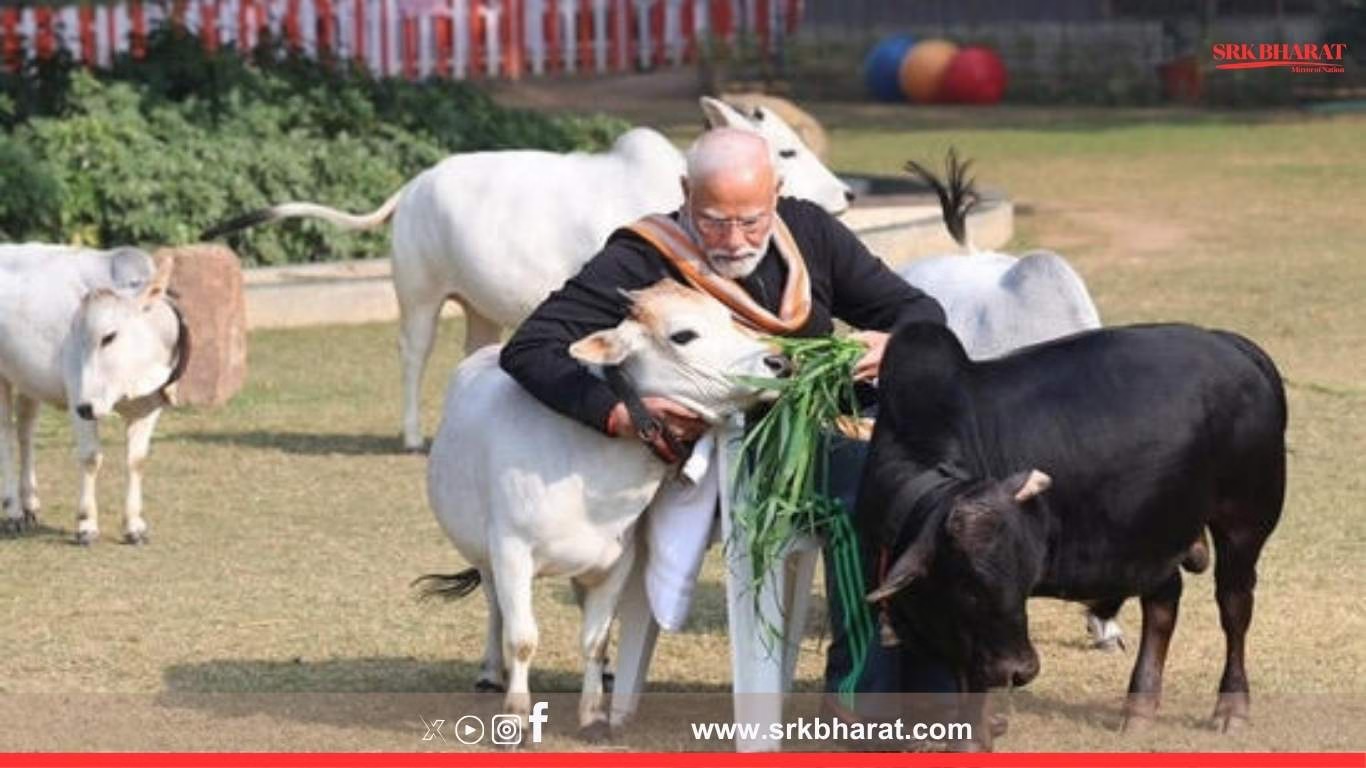
Prime Minister Narendra Modi’s recent remark—“Most animal lovers don’t consider the cow an animal”—has stirred a nationwide debate on selective compassion and animal rights. The comment, made during an event at Vigyan Bhavan in New Delhi, was a tongue-in-cheek response to the ongoing controversy surrounding the Supreme Court’s directive on the relocation of stray dogs in Delhi-NCR. Modi’s statement, delivered with characteristic wit, drew laughter from the audience and Union Culture Minister Gajendra Singh Shekhawat, but also prompted serious reflection on the cultural and ethical dimensions of animal welfare in India.
The Prime Minister’s quip was widely interpreted as a veiled critique of what he described as “selective empathy” among certain animal rights activists—those who vocally defend street dogs but remain silent on the treatment and protection of cows, which hold sacred status in Hinduism.
Context: Supreme Court’s Stray Dog Order and Public Outcry
The backdrop to Modi’s remark was a contentious Supreme Court order issued on August 11, 2025, directing civic authorities in Delhi-NCR to remove all stray dogs from public streets and confine them to shelters. The order cited rising cases of dog bites and rabies, sparking immediate backlash from animal welfare groups, celebrities, and civil society.
Following widespread protests and legal appeals, Chief Justice DY Chandrachud reassigned the matter to a three-judge bench, which modified the earlier directive. The revised order mandated sterilisation, vaccination, and deworming of stray dogs, followed by their release into the same areas from which they were picked up. Additionally, designated feeding zones were to be created, with public street feeding prohibited.
| Supreme Court Directive Timeline | Key Developments |
|---|---|
| August 11, 2025 | Initial order to remove all strays |
| August 20, 2025 | Public protests and legal petitions |
| August 28, 2025 | Case reassigned to three-judge bench |
| September 5, 2025 | Modified order: sterilisation and release |
| September 10, 2025 | Guidelines issued for feeding zones |
The verdict was welcomed by animal lovers, but also reignited debates on urban safety, compassion, and the role of civic bodies in managing street animals.
PM Modi’s Remark: A Cultural and Political Signal
Speaking at Vigyan Bhavan on September 13, PM Modi shared an anecdote about meeting animal lovers. “Recently, I met some animal lovers,” he said, pausing as the audience chuckled. “Why are you laughing? Our country has many animal lovers, and most of them do not consider the cow as an animal,” he added.
The remark was seen as a subtle jab at activists who, in Modi’s view, apply inconsistent standards of compassion. It also underscored the cultural reverence for cows in India, where they are worshipped as ‘Gau Mata’ and protected under various state laws.
| PM Modi’s Comment | Interpretation |
|---|---|
| “Most animal lovers don’t consider the cow an animal.” | Critique of selective empathy |
| Delivered at Vigyan Bhavan | National platform for policy dialogue |
| Audience reaction | Laughter and applause |
| Political undertone | Reinforcement of cultural values |
Since coming to power in 2014, the Modi government has launched several initiatives for cow protection, including the establishment of the Rashtriya Kamdhenu Aayog (RKA) in 2019. The RKA, under the Ministry of Fisheries, Animal Husbandry and Dairying, is tasked with the conservation and development of indigenous cow breeds.
Rashtriya Kamdhenu Aayog: Cow Protection in Policy
The RKA has played a central role in promoting cow welfare, including research on cow-based products, awareness campaigns, and support for gaushalas (cow shelters). It also launched the controversial “Kamdhenu Gau Vigyan Exam” in 2021 to educate citizens on the scientific and cultural significance of cows.
| Rashtriya Kamdhenu Aayog Initiatives | Description |
|---|---|
| Kamdhenu Gau Vigyan Exam | Awareness on cow science |
| Gaushala Support Scheme | Financial aid to shelters |
| Indigenous Breed Promotion | Conservation of native cows |
| Cow-Based Product Research | Ayurvedic and organic innovations |
These efforts reflect the government’s broader narrative of cultural nationalism and rural empowerment.
Public Reaction: Divided Opinions and Social Media Buzz
Modi’s comment triggered a wave of reactions on social media. Supporters praised the Prime Minister for highlighting cultural hypocrisy, while critics accused him of deflecting attention from pressing urban issues. Hashtags like #CowProtection, #StrayDogsDebate, and #AnimalRights trended across platforms.
| Public Sentiment | Reaction |
|---|---|
| Supporters | “Modi speaks truth about selective activism.” |
| Critics | “What about civic responsibility and urban safety?” |
| Animal Welfare Groups | “Compassion should be universal.” |
| Cultural Commentators | “Cows are central to Indian identity.” |
The debate also reignited discussions on the ethical treatment of all animals, regardless of religious or cultural significance.
Broader Implications: Animal Welfare and Urban Governance
Modi’s remark, while brief, touches on deeper issues of urban governance, cultural identity, and ethical consistency. The stray dog crisis in Delhi-NCR highlights the challenges of balancing public safety with animal rights. At the same time, the cow protection narrative underscores the intersection of religion, politics, and policy.
| Issue Area | Key Questions |
|---|---|
| Urban Safety | How to manage stray populations humanely? |
| Animal Rights | Is compassion being applied selectively? |
| Cultural Identity | Should religious reverence influence policy? |
| Civic Responsibility | Are municipalities equipped to handle animal welfare? |
Experts argue that India needs a comprehensive animal welfare framework that respects cultural sentiments while ensuring humane treatment and public safety.
Conclusion: A Quip That Sparked a Conversation
Prime Minister Narendra Modi’s remark—“They don’t consider cow an animal”—may have been delivered with humor, but it has sparked a serious conversation about the ethics of animal welfare, cultural reverence, and civic responsibility. As India grapples with the complexities of urban animal management and cultural preservation, the need for inclusive, consistent, and compassionate policies becomes ever more urgent.
Whether one agrees with Modi’s critique or not, the debate it has triggered is a reminder that in India, even a single sentence can open the floodgates to national introspection.
Disclaimer: This article is based on publicly available news reports, government statements, and verified sources. It is intended for informational purposes only and does not constitute political or legal advice. All figures and interpretations are subject to change based on official updates.