


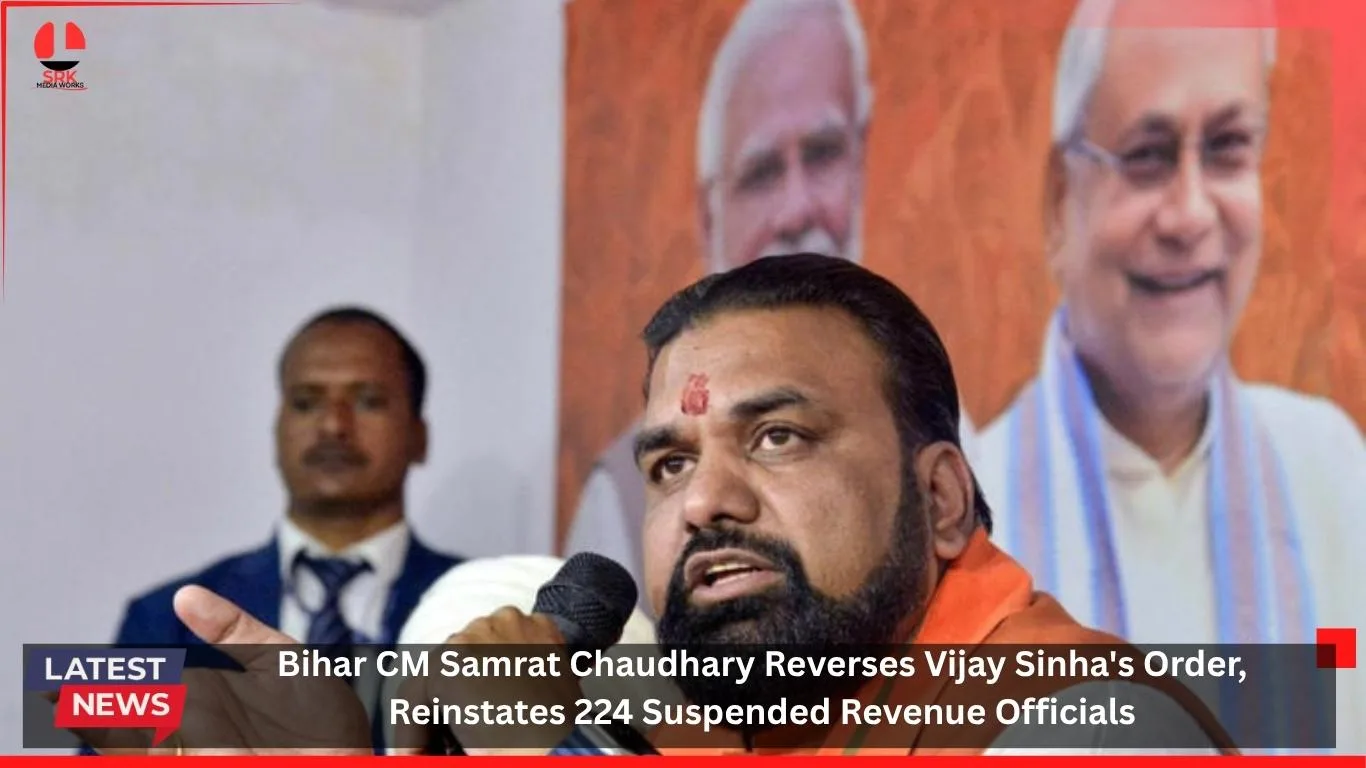
In a significant administrative decision, Bihar Chief Minister Samrat Chaudhary has reversed the earlier order issued by Assembly Speaker Vijay Sinha, reinstating 224 suspended revenue officials. This move has sparked widespread discussion across political and bureaucratic circles, highlighting the balance of power between legislative authority and executive governance in the state.
Background of the Suspension
The suspension of 224 revenue officials was initially ordered under allegations of irregularities and inefficiency in land-related matters. The decision, taken during Vijay Sinha’s tenure, was seen as a strong disciplinary measure aimed at streamlining administrative accountability. However, critics argued that the blanket suspension disrupted essential services, particularly in rural areas where revenue officials play a crucial role in land records, taxation, and dispute resolution.
CM Samrat Chaudhary’s Decision
By reinstating the officials, CM Samrat Chaudhary has emphasized the importance of maintaining administrative continuity. He stated that while accountability is necessary, mass suspensions without thorough investigation can paralyze governance. His decision reflects a pragmatic approach, balancing discipline with the need for functional bureaucracy.
Political Reactions
Supportive Voices
- Ruling Alliance Leaders: Welcomed the move, calling it a step toward restoring efficiency.
- Revenue Department Officials: Expressed relief, noting that reinstatement allows them to resume critical duties.
Critical Voices
- Opposition Parties: Accused the government of undermining disciplinary measures.
- Civil Rights Groups: Called for transparent investigations rather than blanket reinstatements.
Administrative Impact
The reinstatement is expected to have immediate effects on governance:
| Area of Governance | Impact of Reinstatement | Long-Term Outcome |
|---|---|---|
| Land Records | Faster updates and dispute resolution | Improved transparency |
| Tax Collection | Resumption of halted processes | Increased revenue flow |
| Rural Services | Restoration of local administrative support | Strengthened grassroots governance |
| Public Trust | Mixed reactions | Depends on accountability measures |
Historical Context
Bihar has witnessed several instances where mass suspensions or reinstatements of officials became political flashpoints. Past governments have often used disciplinary actions to signal reform, but reversals have highlighted the complexities of governance.
Comparative Analysis of Administrative Decisions
| Leader/Authority | Action Taken | Outcome |
|---|---|---|
| Vijay Sinha | Suspension of 224 officials | Administrative disruption, political debate |
| Samrat Chaudhary | Reinstatement of officials | Restoration of services, questions on accountability |
| Past Governments | Selective suspensions | Limited impact, less controversy |
Possible Scenarios Ahead
- Smooth Governance: Reinstated officials resume duties effectively, restoring public confidence.
- Renewed Scrutiny: Investigations may reveal irregularities, leading to selective disciplinary actions.
- Political Fallout: Opposition may use the reversal to question government’s commitment to accountability.
- Administrative Reform: The incident could trigger new guidelines for disciplinary measures.
Expert Opinions
Administrative experts argue that while reinstatement ensures continuity, it must be accompanied by transparent reviews of individual cases. Political analysts note that the decision reflects CM Samrat Chaudhary’s intent to assert executive authority over legislative interventions.
Conclusion
The reinstatement of 224 suspended revenue officials by Bihar CM Samrat Chaudhary marks a pivotal moment in the state’s governance. It underscores the delicate balance between enforcing accountability and ensuring administrative functionality. Whether this decision strengthens governance or fuels further controversy will depend on how effectively the government manages transparency and discipline in the coming months.
Disclaimer
This article is a journalistic analysis based on current political and administrative developments. It does not endorse or oppose any political leader or party. Readers are encouraged to follow official updates and consider multiple perspectives for a comprehensive understanding of the situation.


