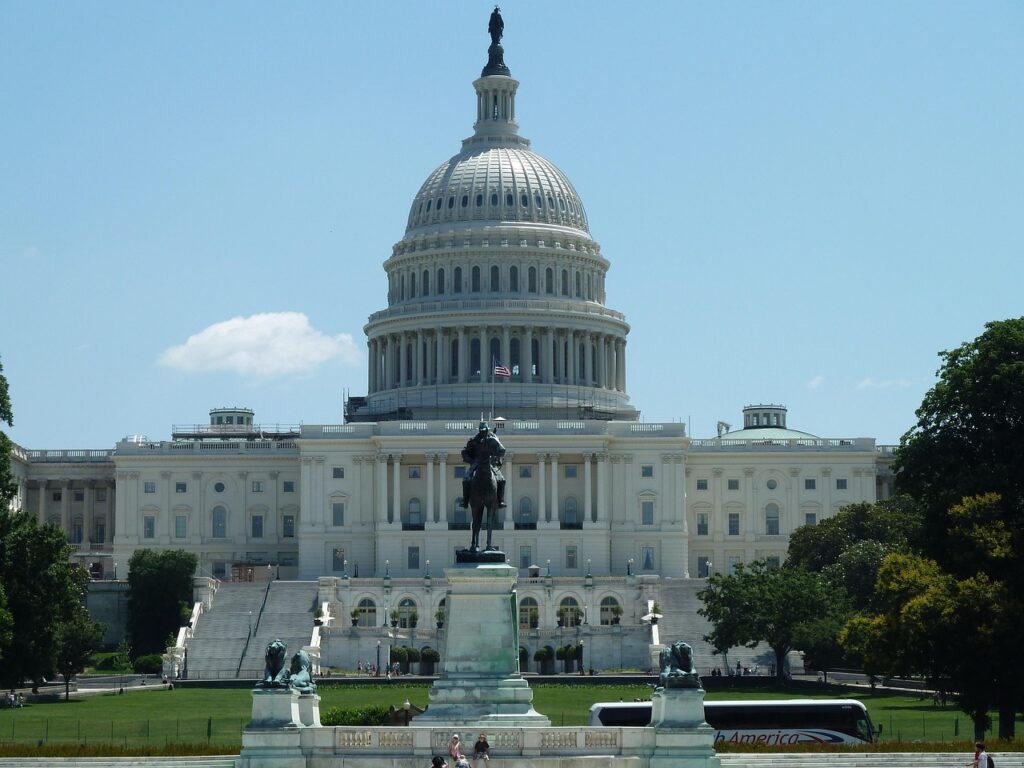

WASHINGTON — The United States Senate failed to advance a legislative effort to restrict President Donald Trump’s authority to initiate military action against Iran on Thursday, leaving executive war powers intact despite escalating conflict in the Middle East.
The procedural vote in the upper chamber fell short of the threshold required to bypass a filibuster, contrasting sharply with the House of Representatives, which passed a concurrent resolution seeking to curtail presidential authorization in foreign hostilies.
Context of Executive Military Authority
The legislative showdown follows a series of military exchanges between U.S. forces and Iranian-backed entities, raising fears of a broader regional conflict.
Congress enacted the War Powers Resolution of 1973 to limit the commander-in-chief’s ability to commit U.S. troops abroad without explicit congressional approval or a formal declaration of war.
However, successive presidential administrations have interpreted Article II of the Constitution to allow unilateral executive action for defensive purposes, frequently sparking disputes with lawmakers over constitutional boundaries.
Senate Vote Exposes Deep Partisan Divisions
The failure to advance the measure underscores the persistent gridlock in Capitol Hill regarding national security priorities.
Majority leadership argued that limiting the president’s operational authority sends a signal of weakness to foreign adversaries and undermines immediate deterrence capabilities.
Opponents of the war powers limitation maintained that the chief executive must retain the agility to respond instantly to emerging threats against U.S. personnel and allies in the Persian Gulf.
Conversely, supporters of the resolution emphasized that Article I of the Constitution unequivocally grants Congress the sole power to declare war.
Sponsors of the bill expressed concern that unchecked military actions risk dragging the nation into an unauthorized and prolonged conflict without public consensus or legislative debate.
Constitutional Debates and Expert Analysis
Legal analysts note that the balance of war-making authority has steadily shifted toward the executive branch over recent decades.
National security scholars at the Center for Strategic and International Studies indicate that without clear legislative boundaries, executive agencies will continue to rely on existing Authorizations for Use of Military Force (AUMF) passed decades ago.
Data from public policy surveys shows that nearly 62 percent of Americans favor requiring explicit congressional approval before initiating major military strikes overseas.
Despite public sentiment, congressional attempts to reclaim war powers have repeatedly stalled due to procedural hurdles and presidential veto threats.
Implications for Defense and Foreign Policy
The Senate’s inaction effectively grants the administration continued tactical latitude to execute defense strategies in the region without preemptive legislative approval.
This outcome is expected to shape upcoming deliberations on the annual National Defense Authorization Act, where lawmakers may attempt to attach revised oversight provisions.
Observers and foreign policy analysts will be watching closely to see whether the House pushes for further statutory constraints or if diplomatic negotiations reduce the risk of further military escalation.