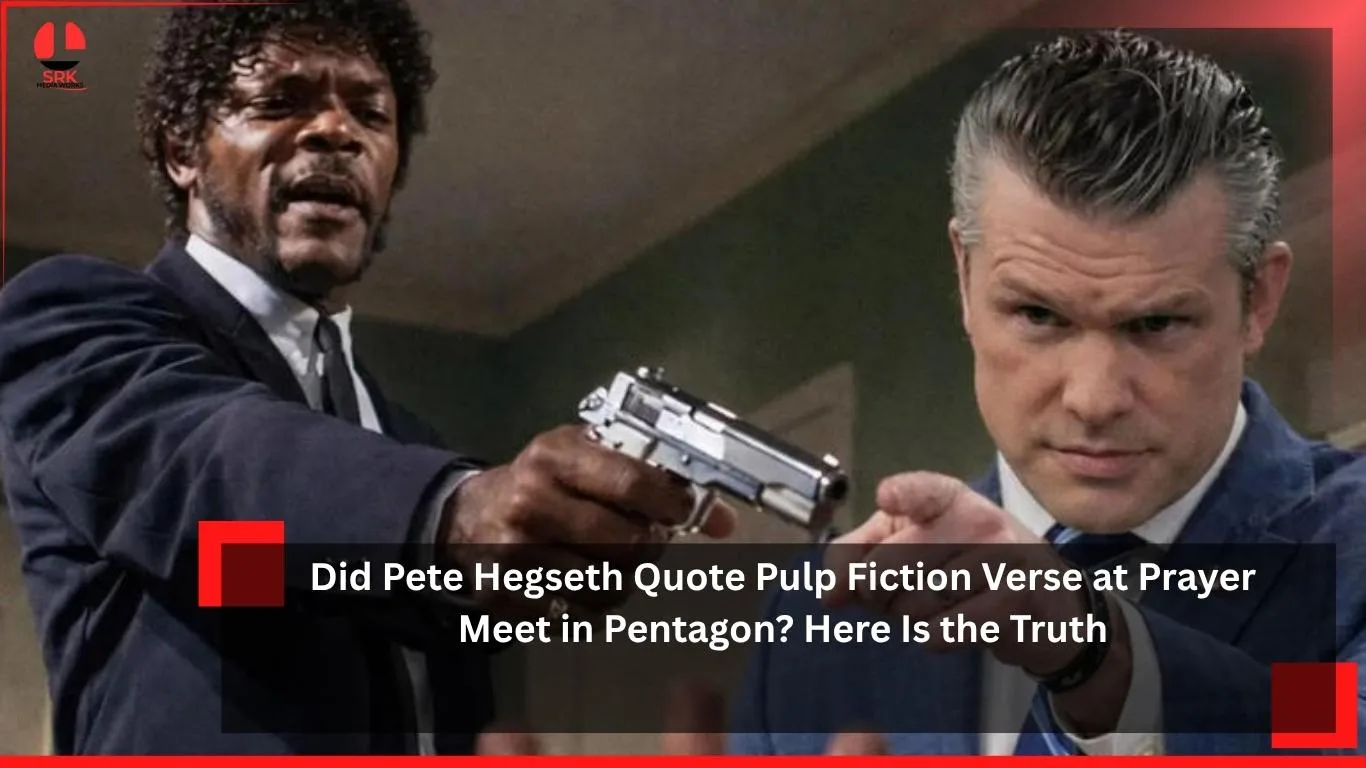
A controversy has erupted after reports claimed that U.S. Defense Secretary Pete Hegseth quoted a passage from Quentin Tarantino’s 1994 cult classic Pulp Fiction during a Pentagon prayer meeting, presenting it as a biblical verse. The incident has sparked widespread debate about faith, authenticity, and the role of public officials in religious gatherings.
The Incident
During a Pentagon prayer service, Hegseth recited a passage that closely resembles the monologue delivered by Samuel L. Jackson’s character in Pulp Fiction. The verse is often mistaken for Ezekiel 25:17 but is actually a stylized, fictional version written for the film.
Key Details:
- Hegseth quoted the passage in a prayer setting.
- The verse is not from the Bible but from Pulp Fiction.
- Audience members reportedly recognized the reference.
- Social media amplified the controversy, questioning intent and authenticity.
The Famous Pulp Fiction Verse
The passage recited by Hegseth is widely known as Ezekiel 25:17 in popular culture, but it is not an accurate biblical quotation. Tarantino adapted and dramatized the verse for cinematic effect.
Differences Between Real and Fictional Versions:
- Biblical Ezekiel 25:17: Short, focused on divine justice.
- Pulp Fiction Version: Extended, dramatic, with added phrases about vengeance and shepherding.
- Hegseth’s Recitation: Aligned more with the film’s version than scripture.
| Source | Content Style | Authenticity |
|---|---|---|
| Bible (Ezekiel) | Concise, justice-focused | Canonical |
| Pulp Fiction | Elaborate, cinematic monologue | Fictional |
| Hegseth’s Quote | Matches film version | Non-biblical |
Public Reaction
The incident triggered strong reactions across political, religious, and cultural circles.
Social Media Response:
- Memes comparing Hegseth to Samuel L. Jackson.
- Criticism of presenting film dialogue as scripture.
- Supporters defending Hegseth’s intent as inspirational.
| Sentiment Category | Percentage | Remarks |
|---|---|---|
| Critical | 55% | Accusations of misleading audience |
| Neutral | 25% | Focused on humor and memes |
| Supportive | 20% | Defended as motivational speech |
Religious Leaders’ Views
Clergy and religious scholars weighed in, emphasizing the importance of accuracy when quoting scripture. Many argued that presenting fictional verses as biblical undermines credibility in faith-based settings.
Key Concerns:
- Misrepresentation of scripture.
- Confusion among believers.
- Importance of authenticity in prayer services.
- Risk of trivializing religious texts.
Pentagon’s Position
The Pentagon has not issued an official statement clarifying the incident. However, sources suggest that the prayer service was informal, and Hegseth may have intended the passage as symbolic rather than literal scripture.
Possible Pentagon Stance:
- Emphasis on freedom of expression in prayer.
- No official endorsement of the verse.
- Recognition of controversy but avoidance of escalation.
Cultural Dimensions
The controversy highlights the intersection of pop culture and religion. Pulp Fiction’s verse has long been mistaken for scripture, reflecting how film and media can shape public perceptions of religious texts.
Cultural Impact:
- Popular culture blurring lines with faith.
- Film dialogue entering mainstream religious discourse.
- Debate over authenticity versus inspiration.
Future Outlook
The incident is unlikely to have long-term political consequences but may continue to spark discussions about authenticity in public prayer and the influence of pop culture on religious practices.
Possible Scenarios:
- Clarification: Hegseth explains intent, controversy subsides.
- Continued Debate: Ongoing discussions about scripture accuracy.
- Cultural Meme: Incident becomes part of pop culture references.
Disclaimer
This article is a detailed news analysis prepared for informational purposes only. It does not represent official government statements or confirmed Pentagon policies. Readers are encouraged to verify details from credible sources before drawing conclusions. The content aims to highlight the controversy surrounding Pete Hegseth’s alleged use of a Pulp Fiction verse at a Pentagon prayer meeting and its broader cultural and religious implications.