









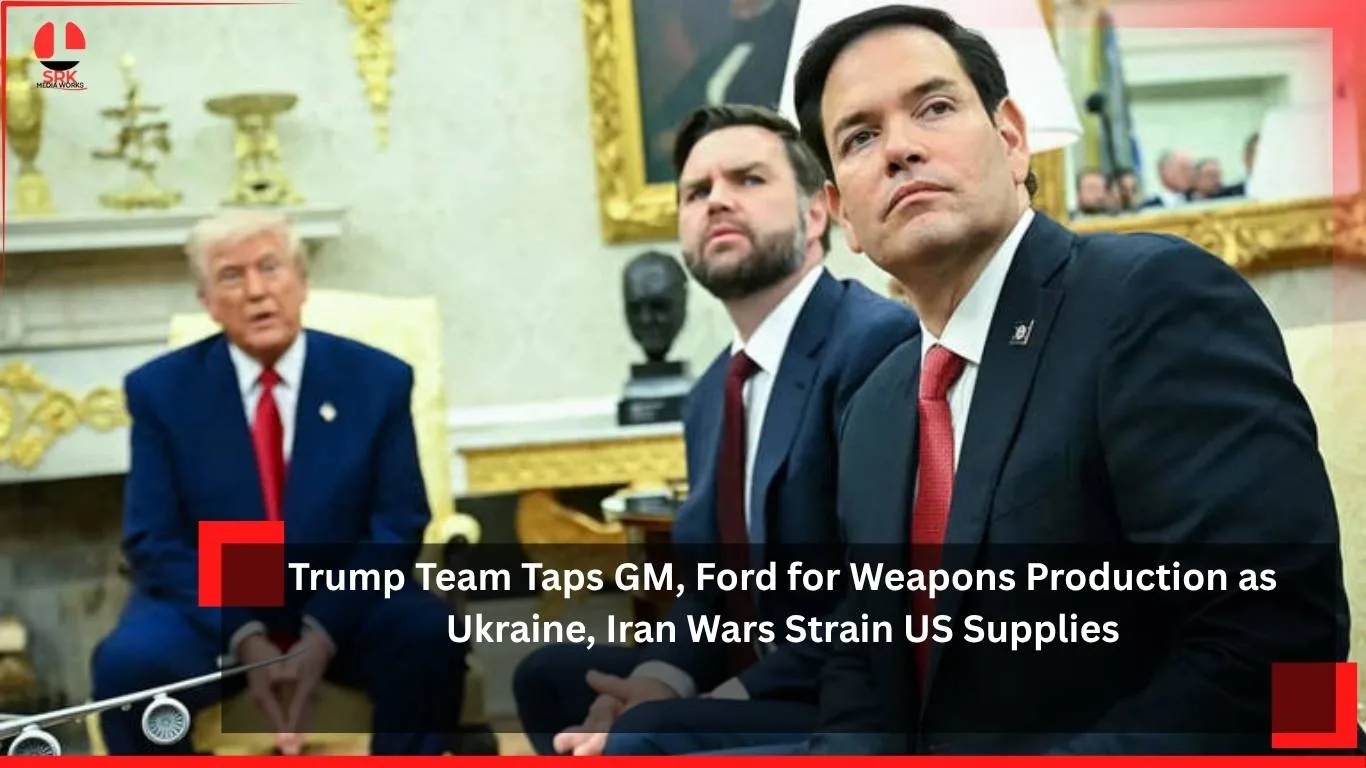
The Trump administration has taken a dramatic step to address mounting pressure on America’s defense supply chain by enlisting automobile giants General Motors (GM) and Ford to produce weapons and military equipment. With simultaneous conflicts in Ukraine and Iran stretching US stockpiles thin, the move signals a return to wartime industrial mobilization reminiscent of World War II, when civilian industries were repurposed to support military needs.
Why GM and Ford Are Being Tapped
The decision to involve GM and Ford stems from their massive manufacturing capacity, advanced engineering, and ability to rapidly scale production.
- GM’s Role: Expected to focus on armored vehicles, transport carriers, and specialized components.
- Ford’s Role: Likely to produce logistics vehicles, drones, and parts for artillery systems.
- Strategic Goal: Bridge the gap between military demand and strained defense contractors already overburdened by dual conflicts.
Strain on US Defense Supplies
The wars in Ukraine and Iran have created unprecedented demand for weapons, ammunition, and logistical support.
- Ukraine Conflict: Continuous supply of artillery shells, tanks, and air defense systems.
- Iran Conflict: Naval and aerial assets stretched across the Middle East, requiring rapid replenishment.
- Stockpile Depletion: Pentagon reports indicate shortages in precision-guided munitions and armored vehicles.
Comparative Overview of Industrial Mobilization
| Era | Civilian Industry Role | Military Demand | Outcome |
|---|---|---|---|
| World War II | Auto companies produced tanks, planes | Global war effort | US became arsenal of democracy |
| Cold War | Limited civilian involvement | Nuclear arms race | Specialized contractors dominated |
| Ukraine & Iran Wars | GM, Ford tapped for weapons | Dual-front conflicts | Civilian-military collaboration revived |
This comparison shows how the current mobilization mirrors historical precedents but adapts to modern warfare needs.
Pivot Analysis: Civilian Industry vs. Defense Contractors
| Scenario | Economic Impact | Military Impact | Political Impact |
|---|---|---|---|
| Reliance on Defense Contractors | Higher costs, slower output | Supply shortages | Criticism of inefficiency |
| Inclusion of GM & Ford | Lower costs, faster scaling | Increased supply | Political credit for innovation |
The pivot analysis highlights how involving GM and Ford could stabilize supply chains while boosting political narratives of efficiency.
Reactions
- Pentagon Officials: Welcomed the move, citing urgent need for expanded production capacity.
- GM & Ford Executives: Expressed readiness to contribute, emphasizing patriotism and industrial strength.
- Defense Contractors: Mixed reactions, with concerns about competition but acknowledgment of supply chain strain.
- Public Opinion: Divided, with some praising industrial mobilization and others worried about economic disruption.
Global Implications
- Russia & Iran: Likely to view the mobilization as escalation, prompting countermeasures.
- European Allies: Supportive, as increased US production ensures continued aid to Ukraine.
- China: Observing closely, as industrial mobilization could set precedent for future conflicts.
Economic Impact
The mobilization of GM and Ford for weapons production will reshape the US economy.
- Job Creation: Thousands of new positions in manufacturing and logistics.
- Supply Chain Shifts: Civilian auto production may slow, affecting consumer markets.
- Defense Budget: Increased spending but offset by efficiency gains from mass production.
Conclusion
The Trump administration’s decision to tap GM and Ford for weapons production marks a turning point in US defense strategy. With wars in Ukraine and Iran straining supplies, industrial mobilization offers a solution rooted in America’s historical strength as the “arsenal of democracy.” The success of this initiative will depend on how effectively civilian industries adapt to military demands and whether the US can sustain dual-front conflicts without exhausting its resources.
Disclaimer
This article is a journalistic analysis created for informational purposes. It does not represent official government statements or endorsements. Readers are encouraged to consult multiple perspectives for updates. The content is intended for educational and news reporting use only, without promoting any political agenda.