


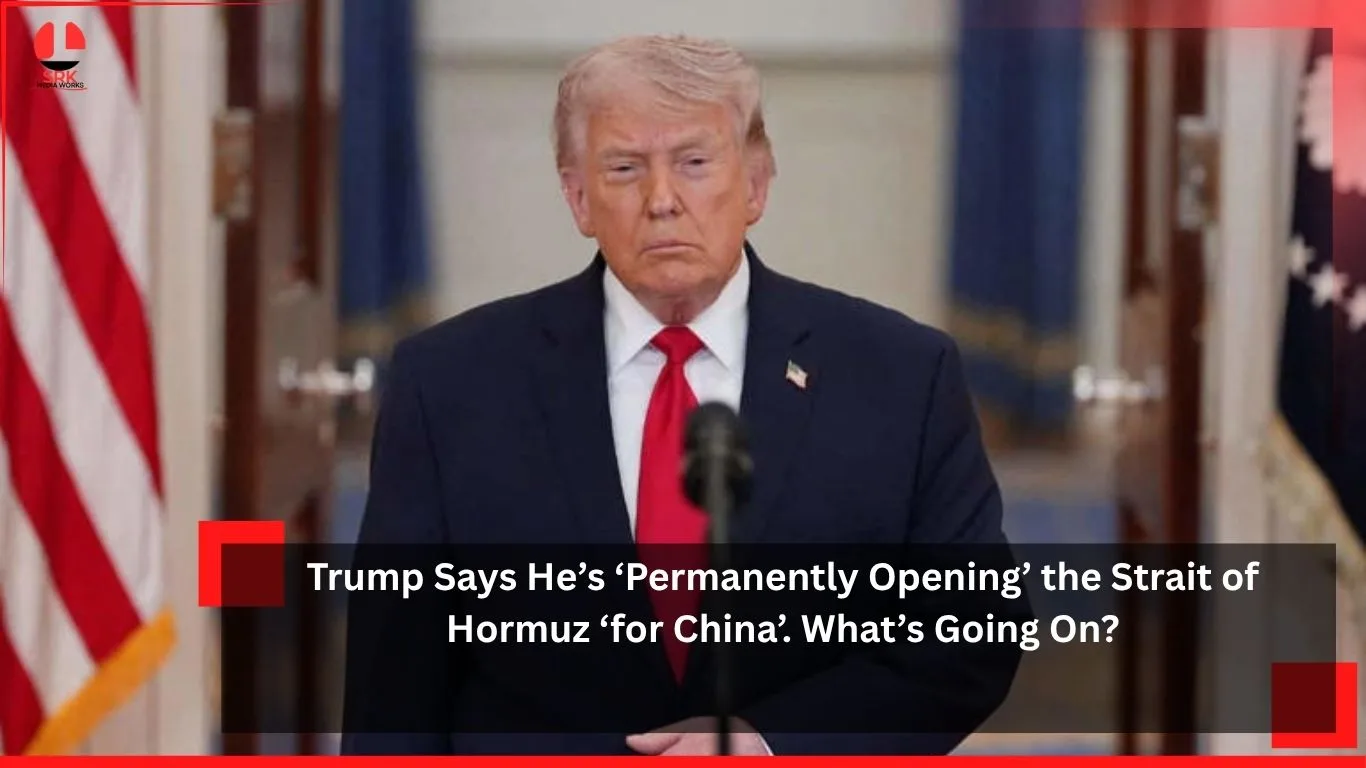
U.S. President Donald Trump’s latest remarks about “permanently opening” the Strait of Hormuz “for China” have sparked global debate, raising questions about Washington’s intentions in one of the world’s most strategically vital waterways. The statement, delivered in the context of ongoing tensions in the Gulf, has been interpreted as both a geopolitical signal and an economic maneuver, with implications for global trade, energy security, and regional stability.
Understanding the Strait of Hormuz
The Strait of Hormuz is a narrow passage connecting the Persian Gulf to the Arabian Sea and the wider Indian Ocean. It is one of the most critical maritime chokepoints globally, with nearly 20% of the world’s oil supply passing through it. Any disruption in this region has immediate consequences for global energy prices and trade flows.
Strategic Importance:
- Vital for global oil and LNG shipments.
- Connects Gulf producers with Asian and European markets.
- Historically vulnerable to geopolitical tensions.
- Central to U.S. and allied naval operations in the region.
Trump’s Statement
Trump’s declaration of “permanently opening” the Strait “for China” has been interpreted as a mix of diplomatic signaling and economic strategy. While the U.S. has traditionally sought to secure freedom of navigation in Hormuz, linking the move explicitly to China suggests a recalibration of priorities.
Possible Interpretations:
- Assurance to China of uninterrupted energy supplies.
- Strategic move to reduce tensions over shipping disruptions.
- Signal to Gulf allies about U.S. commitment to maritime security.
- Attempt to leverage Hormuz stability in broader U.S.-China relations.
Global Reactions
The statement has triggered varied responses across the globe.
| Stakeholder | Reaction Summary | Key Concerns |
|---|---|---|
| China | Welcomes assurance, focuses on energy security | Stable oil supplies, reduced shipping risks |
| Gulf States | Mixed reactions, cautious optimism | Regional stability, sovereignty concerns |
| Iran | Skeptical, questions U.S. motives | Sovereignty, external interference |
| EU Nations | Diplomatic support, cautious watch | Energy security, avoiding escalation |
| India | Observes closely, concerned about trade | Oil imports, shipping costs |
Economic Implications
Trump’s statement carries significant economic weight. By ensuring the Strait remains open, the U.S. indirectly stabilizes global energy markets, benefiting major importers like China, India, and Europe.
Economic Impact:
- Stabilization of oil prices.
- Reduced shipping insurance costs.
- Assurance for Asian economies dependent on Gulf energy.
- Potential boost to global trade confidence.
Security Dimensions
The Strait of Hormuz has long been a flashpoint for military tensions, particularly involving Iran. Trump’s remarks suggest a stronger U.S. commitment to maintaining naval presence and deterring threats.
Security Challenges:
- Ensuring compliance with freedom of navigation.
- Preventing militant or state-sponsored disruptions.
- Balancing U.S. military presence with regional sensitivities.
- Managing Iran’s opposition to external control.
Comparative Maritime Policies
Trump’s statement can be compared with past U.S. positions on maritime chokepoints.
| Chokepoint | U.S. Policy Focus | Outcome |
|---|---|---|
| Strait of Hormuz | Freedom of navigation, deterrence | Ongoing tensions, naval patrols |
| Malacca Strait | Cooperation with ASEAN nations | Stable trade flows, reduced piracy |
| Suez Canal | Diplomatic support, monitoring | Ensured global shipping continuity |
This comparison highlights the consistency of U.S. policy in securing global trade routes, though Trump’s explicit mention of China adds a new dimension.
Political Implications
Trump’s remarks also carry political significance. By linking Hormuz stability to China, he may be signaling a willingness to cooperate on specific economic issues despite broader tensions in U.S.-China relations.
Political Outcomes:
- Potential easing of U.S.-China trade frictions.
- Reinforcement of U.S. role as global maritime guarantor.
- Increased scrutiny from domestic critics questioning motives.
- Diplomatic balancing act with Gulf allies and Iran.
Future Outlook
The future of Trump’s “permanent opening” promise will depend on regional dynamics and U.S. naval strategy. While the assurance may stabilize markets in the short term, long-term success will require cooperation among regional stakeholders and careful management of tensions with Iran.
Possible Scenarios:
- Stable Passage: U.S. presence ensures uninterrupted shipping.
- Conditional Stability: Reduced tensions but occasional disruptions.
- Renewed Conflict: Escalation undermines freedom of navigation.
Disclaimer
This article is a detailed news analysis prepared for informational purposes only. It does not represent official government policy or confirmed diplomatic agreements. Readers are encouraged to verify details from credible sources before drawing conclusions. The content aims to highlight the implications of Trump’s statement about “permanently opening” the Strait of Hormuz for China.