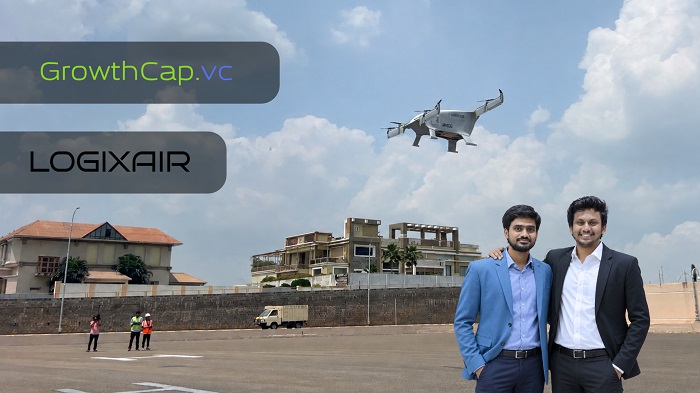

GrowthCap Ventures, an early-stage Deeptech venture capital firm focused on technology-led businesses, has invested in LogiXair, a Hyderabad-based deep-tech aerospace and logistics company developing autonomous hybrid-electric Vertical Take-Off and Landing (VTOL) aircraft for cargo logistics across India and international markets along with angel investors with professional backgrounds at Honeywell Aerospace have joined the round, adding aerospace industry experience and strategic insight.
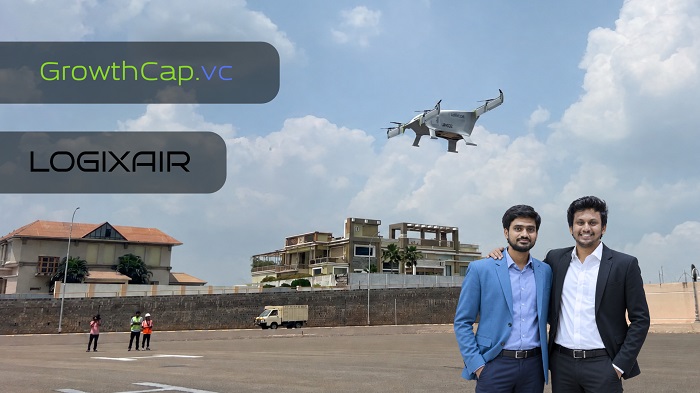 |
LogiXair Founders Pulla Kapil and Bhanu Teja Chidura (right), alongside the Winghead 002 flight demo in an operational environment, validating TRL 6
Founded by Bhanu Teja Chidura and Pulla Kapil, LogiXair is closing a critical gap in India’s logistics: fast, reliable short-haul cargo movement of up to 600 km between metros, industrial hubs and Tier II and III cities, without conventional runways, with a roadmap built for international markets as well. Its engineering-led team, spanning aerospace engineering, autonomous systems, robotics and software, with experience across both research and commercial technology systems, has validated a hybrid-electric powertrain, flight-tested sub-scale prototypes and built six IP assets at TRL 6. Working with DRDO and other aerospace and defence OEMs, the team tests its technology against real operational requirements, and the resulting revenue supports a capital-efficient path to commercialisation.
The L560, an autonomous hybrid-electric VTOL carrying up to 300 kg over 600 km, together with modular cargo containers, autonomous ground handling and fleet operations software, forms a new logistics layer alongside road, rail and conventional aviation, giving it a scalable platform for India’s fast-growing logistics market and for export to international markets. The investment will fund continued engineering development, technology validation and commercialisation, with partnerships across logistics, industrial and strategic sectors to be explored.
LogiXair’s progress comes amid growing momentum in India’s deep-tech and aerospace ecosystem, supported by initiatives such as the government’s Rs. 1 lakh crore Research, Development and Innovation (RDI) Scheme aimed at accelerating indigenous technology development and commercialisation. With increasing interest in autonomous aviation, advanced mobility and strategic technologies, the company sees significant opportunities to build globally competitive aerospace solutions from India.
“Our vision is to build a new layer of logistics infrastructure that makes regional cargo transportation faster, more flexible and less dependent on traditional transportation networks. We are developing an integrated platform that combines autonomous aviation, hybrid-electric propulsion, and intelligent cargo handling. GrowthCap Ventures’ backing, together with support from experienced aerospace professionals, strengthens our journey towards building scalable aerial logistics infrastructure for India and global markets,” said Bhanu Teja Chidura, Co-founder, LogiXair.
“Logistics is one of India’s largest and most underserved infrastructure opportunities, and LogiXair is attacking it with rare engineering depth. Bhanu brings more than eight years in aerial robotics and holds an EASA pilot’s licence; with Kapil and a team backed by advisors from Honeywell and IIT Hyderabad, he has taken the company from concept to a flying hybrid-electric VTOL, built six IP assets and a revenue-generating defence engineering business. That platform can serve defence and offshore logistics first, then India’s middle-mile cargo, with Europe and Asia-Pacific as natural international markets. That execution is what gave us conviction, and it shows that India has the engineering talent to build globally relevant deep-tech companies,” said Pratekk Agarwaal, Founder and General Partner, GrowthCap Ventures.
About Growth Cap Ventures: The Operator VC Backing India’s Early-Stage Deeptech, Fintech and AI Founders
Growth Cap Ventures is a SEBI-registered Cat2, operator-led fund that invests from seed alongside founders in deeptech, fintech and AI. Deeptech accounts for about 40% of its portfolio. The fund is led by Founder & General Partner Pratekk Agarwaal, an IIM-Kozhikode alumnus whose career spans Bajaj Finserv, Fullerton India, IndoStar Capital and BharatPe. It combines Pratekk’s operating experience with capital, advice and an institutional network for founders.