






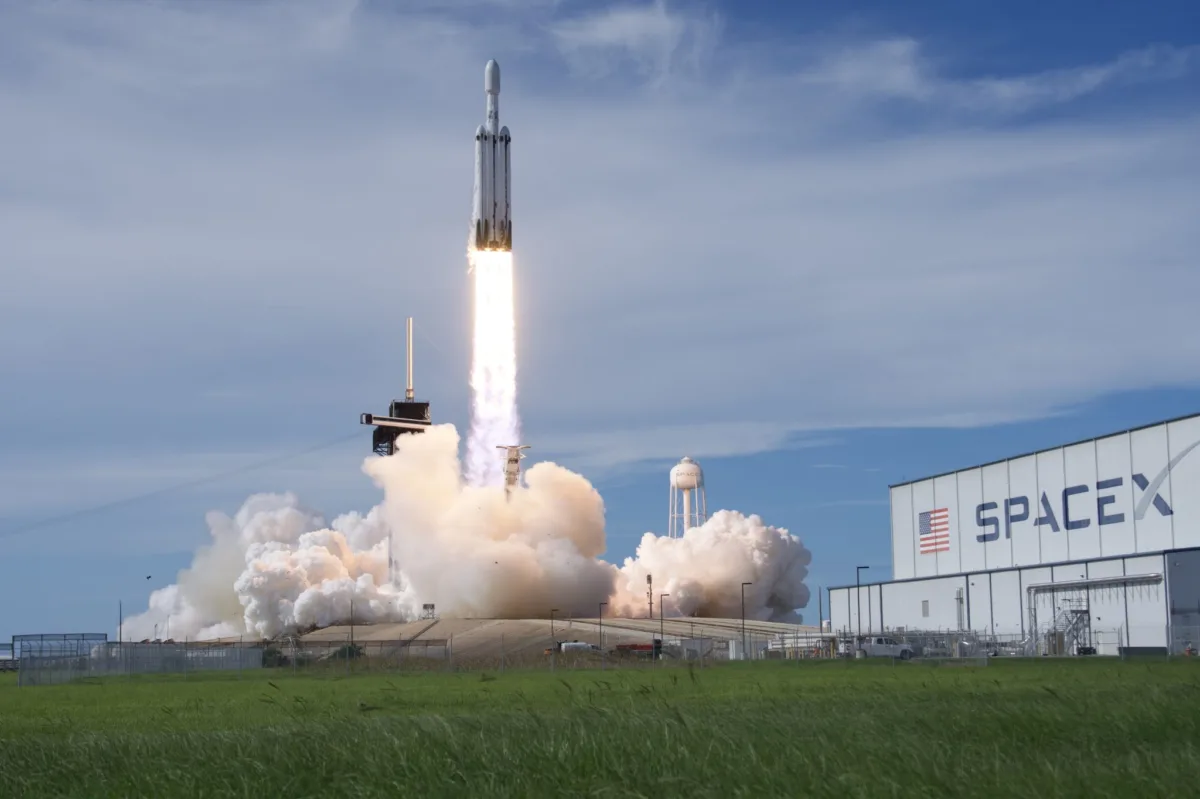
Oh, look. The sky has been set on fire again. It is truly heartwarming to watch humanity’s collective resources get distilled into a giant, kerosene-guzzling phallus, thrusting itself toward the heavens with the kind of reckless abandon usually reserved for a toddler with a flamethrower. The Falcon Heavy is back, roaring like a wounded dragon, and for what? To deliver yet another mega-satellite into orbit so we can ensure that, even when you are hiking in the remotest corners of the Andes, you can still experience the existential dread of reading a stranger’s political rant on social media in high definition.
The Audacity of Orbital Clutter
There is something inherently poetic about the sheer wastefulness of it all. We have spent decades turning our immediate planetary neighborhood into a celestial landfill, a chaotic orbit of dead bolts, paint chips, and obsolete hardware that threatens to turn our exit strategy into a game of lethal dodgeball. But why stop there? Let’s add more. Let’s pack the sky with broadband satellites so that the next generation of digital nomads can complain about their latency while sitting on a beach in Bali. Because clearly, the most pressing problem facing our species is not the climate crisis, nor the crumbling infrastructure of our cities, but rather the inability to stream 4K cat videos from the middle of the Pacific Ocean.
The Engineering Marvel of Excessive Bandwidth
Technologically, one has to tip their hat to the spectacle. Watching three boosters land in synchronized, balletic defiance of gravity is undeniably impressive—if you ignore the fact that the primary function of this engineering masterpiece is to facilitate the infinite scroll. It is the ultimate flex of the tech-bro industrial complex: spending billions to solve a problem that only exists because we are too bored to look at the trees. We have built a machine capable of hauling massive payloads into the void, and we have decided that the most valuable payload is the ability to maintain a constant, unblinking connection to the digital abyss.
When the Sky Becomes a Billboard
Let us not forget the aesthetic contribution to our night sky. Astronomers are absolutely thrilled, I am sure, to have their view of the cosmos obstructed by a shimmering, metallic necklace of broadband satellites. Who needs to study the deep history of the universe when you can have a satellite flare ruin your long-exposure photograph of a nebula? It is the ultimate democratization of the sky: turning the infinite expanse into a private ISP network. After all, the universe was looking a bit empty anyway. It needed to be cluttered with the infrastructure of modern distraction to truly feel like home.
We live in an era where we have mastered the physics of rocket propulsion only to use it as a glorified delivery service for the internet. It is a stunning indictment of our priorities that we can land rockets on floating barges with pinpoint accuracy, yet we struggle to manage the basic requirements of living on a planet that does not want us to treat it like a disposable commodity. We are so enamored with the roar of the engines and the shiny, polished exterior of the rocket that we forget the payload is just another layer of the same digital noise we are desperately trying to escape. Perhaps one day we will launch something into orbit that actually makes our lives better, rather than just faster, but until then, we can at least enjoy the view of the fire as it climbs toward the stars, carrying our collective attention span into the vacuum of space, where it will likely remain, orbiting in silence, waiting for a signal that never quite satisfies the hunger for something real.


